This copy is for your personal, non-commercial use only. Distribution and use of this material are governed by our Subscriber Agreement and by copyright law. For non-personal use or to order multiple copies, please contact The Epoch Times Reprints.
On Feb. 12, 1884, while serving in the state legislature in Albany, Theodore Roosevelt (1858–1919) received a telegram from New York City that his wife, Alice, who was living in his mother’s house, had delivered their first baby. He had already arranged to return home later that day when a second telegram brought news of the precarious state of Alice’s health. Rushing back to Manhattan, he found Alice semiconscious and dying from Bright’s disease and his mother, Mittie, stricken with typhoid fever. Both women died within hours of each other on Valentine’s Day.
Though devastated by this double catastrophe, Roosevelt hid his innermost feelings from others, sitting stone-faced during the funeral service while so many around him were weeping. His diary, however, reveals the true state of his heart and mind. Though normally effusive, on this occasion he could only write: “The light has gone out of my life.”
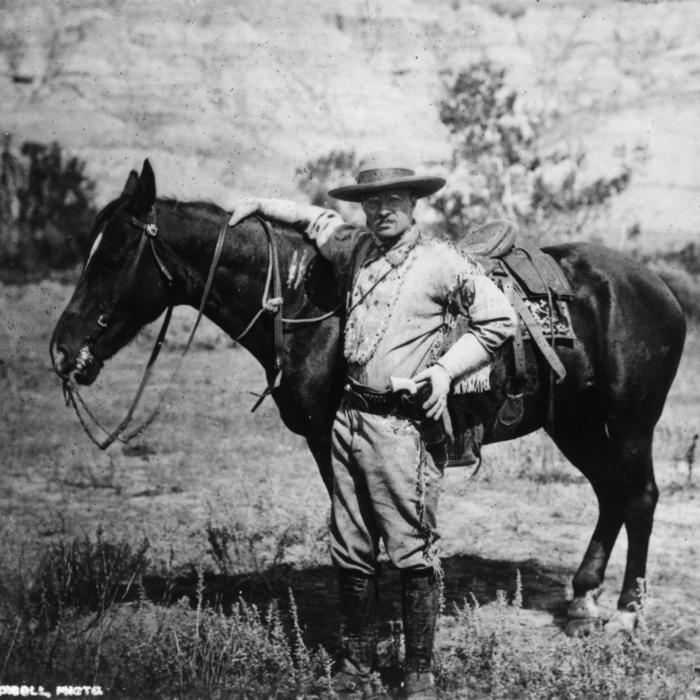
He struggled through a session of the legislature and the Republican Convention. Then, like so many other Americans who had fled disaster and sadness in search of a new beginning, Roosevelt packed up his sorrows and headed west. He chose the Badlands of North Dakota as the sanatorium for healing his fractured soul.
‘Mako Sica’
Theodore Roosevelt during a visit to the Badlands of Dakota in 1885, after the death of his first wife. Photo by T.W. Ingersoll. MPI/Getty Images
Long before the coming of white explorers, the Lakota people had called this territory “mako sica,” which means “bad lands.” The French traders and trappers who ventured into this same area followed suit with their description, “les mauvaises terres a traverser,” or “bad lands to cross.” Traveling this rugged terrain with its hills, canyons, and, in some places, strange geological formations shaped by the wind was made all the worse by the region’s stone-cold winters and furnace-like summers.
As Americans pushed westward, the Dakotas became one of the battlefields with Native Americans, particularly the Sioux. In the late 1870s, with those conflicts coming to an end and with the arrival of the railroads, cattle and ranching became a focal point of the territory. In tandem with these developments, newspaper reports and the pulp fiction of the day were romanticizing cowboys and the Western life, attracting wealthy Easterners who purchased cattle and bought up vast tracts of land throughout the West, giving themselves an air of the exotic among their peers.
During these same years, living up to its name in a different way, the territory of the Badlands was a haven for outlaws and rough men, where disputes were often settled by gunplay rather than by a court of law.
It was to this unruly land that Roosevelt traveled in 1883 to hunt buffalo.
The Badlands Helped Make America’s Parklands
Roosevelt’s trip west changed both the man and the history of the United States.
Rather than being put off by the craggy landscape and harsh climate, Roosevelt fell in love with the Badlands. He had made this journey in part to acquire a taste of the cowboy life, and the Dakotas gave him exactly what he was looking for. Impulsively, he made a large investment in the Maltese Cross Ranch, and a year later, following the deaths of his wife and mother, he moved to the Badlands and purchased more land and more cattle, establishing what he called the Elkhorn Ranch.
Despite his relative youth and inexperience, Roosevelt played a key role in the establishment of the Little Missouri Stockmen’s Association, an organization named after the region’s principal river and founded to regularize and enforce the rules and customs of ranching. Shortly afterward, he was elected president of the association.
On the Fourth of July, 1886, Roosevelt also revealed the views of America that he would later carry into the White House. He delivered his first major public address, now known as his “Big Things” speech, to an audience in Dickinson, North Dakota: “Like all Americans, I like big things; big parades, big forests and mountains, big wheat fields, railroads—and herds of cattle too; big factories, steamboats and everything else. But we must keep steadily in mind that no people were ever yet benefited by riches if their property corrupted their virtue.”
A lone buffalo in Theodore Roosevelt National Park in Western North Dakota. Roosevelt originally came to North Dakota in1883 to hunt buffalo. Laima Swanson /Shutterstock
Roosevelt’s Dakota years and his subsequent trips there eventually had vast ramifications for the rest of the country. As president, the hunter was also a conservationist. He helped rescue the buffalo, which were on the edge of extinction, and sought to preserve the American wilderness and forests by establishing some 230 million acres of parkland around the country. This “conservationist president,” as Roosevelt is sometimes called, is the only one of our country’s chief executives to have such a park named after him: North Dakota’s Theodore Roosevelt National Park.
President Theodore Roosevelt (L) poses with naturalist and botanist John Muir on Glacier Point in Yosemite, California. MPI/Getty Images
Yet the knowledge he gained, especially those lessons absorbed during his early infatuation with the Badlands, would influence the history of the country in another way—or so Roosevelt believed. In a 1918 letter of appreciation to professor Albert T. Volwiler, who had described those North Dakota years in an article, Roosevelt wrote: “I have always said I never would have been President if it had not been for my experiences in North Dakota.”
When East Met West
Life in the Badlands shaped Roosevelt in a multitude of ways.
Still in his 20s during these years, he was young enough to be molded by the challenges of this place and its people. Concerned about his physical health since boyhood, he had fought off life-threatening asthma attacks, and with the encouragement of his father, he had focused on physical well-being and exercise. His years in the American West pushed him even further in the direction of strength and fortitude. The cowboys and other ranch hands whom he supervised later testified to his abilities to endure the weather, to ride long hours in the saddle, to exert himself when they themselves were flagging from fatigue and hunger. For the first time in his life, he was doing truly hard work alongside hard men.
Moreover, those men were radically different from Roosevelt’s friends and companions back East. Privately schooled, a graduate of Harvard, a member of New York’s elite, and a budding politician, he found that his company now consisted of a rougher crew. Their companionship enlarged his sympathies for the working class.
Other tests of manhood also came Roosevelt’s way. In one incident, for example, a drunken and armed cowboy in a bar began to ridicule Roosevelt for his glasses. When the man’s mockery became a threat, Roosevelt dispatched him with a couple of punches, knocking him senseless to the floor. He had learned to box as a youth and at Harvard, and unlike his opponent, he was sober.
The Stolen Boat
(L–R) Wilmot Dow, Theodore Roosevelt, and Bill Sewall at Elkhorn Ranch, circa 1886. Public Domain
The incident most revealing of Roosevelt’s character and which gained the widest attention among locals occurred in March 1886. Three thieves stole a boat belonging to Roosevelt. Most men would not have thought it worth their while to pursue these men, much less in the cold and wet weather of March. Yet Roosevelt set off after them in a boat quickly constructed by Wilmot Dow and William Sewall, who accompanied him on this manhunt.
Three days later, they caught up with the surprised crooks, who were surprised again when their captors did not execute them on the spot. Roosevelt was an outspoken advocate for law in this territory, and so he insisted they take the men to a sheriff for justice. For several more days, they battled the ice-cold weather, wet clothes, and lack of provisions before finally delivering the men to the sheriff in Dickinson, who was also surprised that the thieves were brought to justice rather than being shot out of hand.
These sorts of conflicts along with the daily trials of frontier living helped create the man who would become a police commissioner of New York City, the leader of the Rough Riders in Cuba during the Spanish-American War, and a strong and vigorous American president.
From the Badlands to the Arena
Roosevelt’s plans to become a Western rancher were short-lived. The winter of 1886–1887 brought blizzard after blizzard, and temperatures far below zero wiped out thousands of cattle, including over half of Roosevelt’s stock. By then, he had also felt a pull back to the East, both from a renewed interest in politics and because of his marriage to childhood friend Edith Carow. Eventually, he sold his interests in the two ranches he owned.
Yet those few years in the Badlands remained a large and vivid part of his life.
Perhaps Roosevelt was thinking of his time as a cowboy when, two years after leaving the White House, he spoke at the Sorbonne—an address originally titled “Citizenship in a Republic,” which we know today as his “The Man in the Arena” speech. Here, he spoke of “the man who is actually in the arena, whose face is marred by dust and sweat and blood … who at the best knows in the end the triumph of high achievement, and who at the worst, if he fails, at least fails while daring greatly.”
A warrior both in Cuba and in the rough-and-tumble politics of his time, Roosevelt had become a man of the arena whose training ground was the North Dakota Badlands.
Col. Theodore Roosevelt, 1898, by B.J. Falk. Library of Congress. Public Domain
What arts and culture topics would you like us to cover? Please email ideas or feedback to [email protected]
Jeff Minick has four children and a passel of grandkids. He has written two novels, “Amanda Bell” and “Dust on Their Wings,” as well as “Learning as I Go” and “Movies Make the Man.” You’ll find more of his writing at JeffMinick.substack.com.