Birdsong. Clean air. Wildlife. Exercise. Homegrown food and clean well water. Eagles overhead in expressionist skies.
When I go down to the barn at sunrise to turn out the horses, I stop to admire a spray of wild roses hanging over the paddock fence lit by dawn light.
In winter, warmth is two dogs, a fireplace, and fine wool.
In summer, light lingers in the northern sky long past bedtime.
Owls prowl our lane in the evening, aerial ghosts.
Air conditioning is free—afternoon breezes blow up from the hay meadow.
All I need to do is open the door each morning and I have a fabled lifestyle that has been drawing people from city to country for centuries. I dreamed of it often as a boy in the city, and finally made it 10 years ago.
When Nicole and I moved to our island farm, my blood pressure plummeted by 20 points. I quit spending $80 per month at a “health” club and turned my “workouts” into “home” work. I learned things I never had a clue I'd want to know about hay and horses, wells and wellness and weeds, dirt and gravel, fencing, firewood, and foxes. I’m an expert on aimless palaver with guys who own excavators and Bobcats.
Last time I had a physical, my blood pressure was the lowest it has ever been in my adult life. Ever. I went home and had homegrown salad and cherrywood-grilled steak for dinner, then put the horses up for the night with four flakes of hay. What’s a “flake” of hay, you ask? Got a few minutes? Not the same as a flake of dandruff, which I imagine city folk still fret about.
My urban friends have Fitbit step counters. I have chores.
There are no stoplights in our county. That’s right—zero. Four cars at the four-way stop are an obnoxious traffic jam.
That’s life in the country. Awesome, but there are dues to pay. Different rules apply than in the city, which is where about 80 percent of Americans live now. Nonetheless, the dream of a peaceful pastoral existence out in the countryside abides in millions of people. Having lived on 27 acres on a small island for 10 years now at Owl Feather Farm, I can attest that all the wished-for treasures of country life are real, and I would not go back to the city if you paid me millions of dollars.
But there are a few things to know before you pack up the pickup, Mr. Green Jeans.
You Will Be Pestered
“That one nest could have 2 million wasps in it,” the pest control guy said as he shook his head soberly at the yellow jacket hive in the ground 20 feet away. “Let’s see what I can do.”
His comment was so alarming that I did some online research. Two million was an exaggeration. More like 200,000, turns out.
Ponder that a minute. Disturb this nest and you'll be running from thousands of angry wasps. Ours is a chemical-free farm, but exceptions will be made in the case of massive yellow jacket and hornet nests. If it’s attached to a house or barn or shed, bye-bye. This one was in the orchard too close to the dog-and-pony runs, and even our 17-hand Polish Warmblood could get in trouble with 200,000 yellow jackets. The pest tech had to blast it twice (the complex was more than two feet deep), but in the end, chemical warfare won.
“Nature, red in tooth and claw,” Alfred Tennyson wrote, observing a fact of life modern urban residents are largely able to overlook.
Aside from yellow jackets, out in the country you'll find mosquitos, ticks, hornets, bees, field mice, sugar ants, forest ants, rats, scorpions, spiders, and more. At Owl Feather Farm, we have termites that fly each year at about Labor Day and look alarming; luckily, these are not the termites that eat your house for breakfast. But still. Every fall the kitchen and dining room fill up with fruit flies because, well, our orchard produces large amounts of fruit. Did you know that a female fruit fly can lay up to 500 eggs in her lifetime?
The solution is no fruit in the house. But then, what’s the point of having an orchard?
Bigger pests are sporadic but not nonexistent. One year we had a raccoon we dubbed Barry; he was a big boy and we contributed to his girth with our fresh, delicious midsummer berry crop. One night, at supper out at the picnic table, we watched him teetering on a branch in a nearby wild cherry tree. The branch broke and down went Barry the berry thief, never to be seen again.
In most of the United States, snakes are omnipresent. We have lovely, completely harmless garter snakes—often mistakenly called “garden snakes” because that’s their habitat. Elsewhere, you'd best keep the grass mowed around the house so you can see rattlers and other such creepy crawlies.
Many of our residents are lovely creatures—the little ladybugs that come in the house in small swarms in midwinter; the tiny frogs that sit six feet up in a corn stalk; the swallows that nest in the same eaves as the hornets—but we welcome them because their profession is eating 100 mosquitos per hour. As for snakes, our garter snakes’ favorite food is slug and snail eggs. Heroes!
If you find any of these beings grievously alarming, you may wish to stay in the city. Just saying.
You Don’t Need 2 of Everything
Actually, you need three.
Consider lockjaw pliers. Better have one set in the garden for taking care of balky hose couplings. Another one belongs in the barn for ... balky couplings, period. And a third needs to be in the house for general purposes, including balky hose couplings, such as—have you ever looked behind the washer and dryer?—yeah, there.
Hammers? More than three, because a country place wants small ones and big ones. Eight might do the trick.
Screwdrivers? Well, long ago some troublemaker invented Phillips screws, thereby instantly doubling the screwdriver universe, so we’re talking, um, at least a dozen. Barn, house, garden.
Two socket sets, English and metric.
You Need 3 Hands, Too
Speaking of the rule of three, while giving hominids the awesome opposable thumb arrangement, nature overlooked the obvious need for more than two such instruments.
For example: You approach the paddock gate to take your Shetland for a walk. You’ve got his lead in one hand, but it takes two hands to open the gate. No, I can’t ask Cocoa to hold his own lead for a minute. Yes, that equals three hands.
I heartily recommend the creation and installation of as many one-hand-operable devices as possible—gate latches and door handles above all. Remote control items are OK, but remember that the remote requires a hand to operate and probably two to find and retrieve it, so ... that leaves us with one-hand gates and doors.
You Can Never Have Too Much Fence
Strong. Tall. Impregnable. A six-foot chain link mounted on galvanized steel poles set in concrete is ideal (unless you’re raising bison, which is not for amateurs and requires an even stronger, taller, Olympic-caliber fence).
Don’t forget those sturdy gates with latches that can only be worked by the five-fingered, opposable thumb beings of the universe.
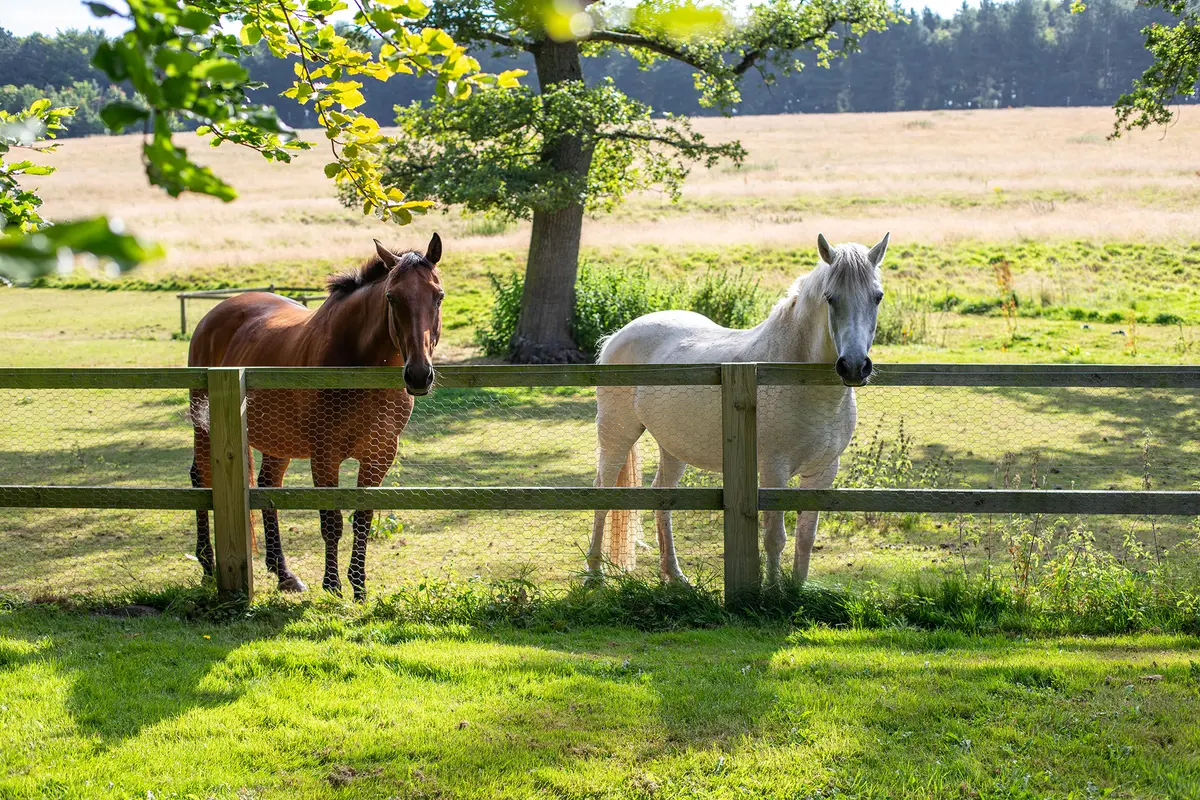
Why? Your neighbors think that your horses are cute—but not as guests.
Domestic Animals Have Only 1 Hobby
The general category is “mischief,” but let’s be more specific: escape.
They don’t actually want to go anywhere—well, maybe down the road to tromp around in your neighbor’s corn. It’s just, well, you know, freedom.
That’s why all that fencing and all those gates requiring opposable thumbs are so crucial. Gold medal fences are good for the beings they keep in and the ones they keep out. You’re helping your animals be good citizens. Don’t we all want that?
There Will Be Mud
Gravel is the answer. No, not cement. There’s plenty of that in the city, which is why many urban homes lack a marvelous facility known as a “mud room,” where you dump shoes, boots, buckets, jeans, gloves, and, who knows? Maybe you somehow got mud on your cap. It can be done, believe me.
If your country home doesn’t have at least one mud room, call a home contractor right away.
Back to mud. You can resolve mud cornucopia with savvy, measured application of gravel. Our horses were sinking in the mud at the top of their paddock in January until we laid a path of gravel for them to walk on. Then we bettered the situation even more by having one of our excavator guys install a cutoff drain, aka drainage tile. That dried out the upper half of the paddock completely. Then I did the same for my orchard.
All Gates Are Closed at All Times. Period.
No wandering horses, dogs, or deer in places they ought not be.
Always close gates, in all circumstances.
Any questions?
No Wimpy, Pretty City Cars
If you live somewhere along typical country roads, you had best get a country car—a sturdy, reliable cargo vehicle that stands up to rugged circumstances. Modern unibody cars (even many so-called SUVs) will shake into shards with regular travel along rough roads. They are made of pieces of sheet metal. You want a welded ladder-steel frame, made of high-strength steel, underneath your vehicle. I have one such that has gone 320,000 miles, including about 25,000 miles on roads many city people have refused to ride on.
Once upon a time, all vehicles were built this way, for the simple reason that they last. Dicey, over-complicated modern cars will strand you when you least expect it, for incomprehensible reasons that make your brain melt.
All his life, my dad wanted a Mercedes, and after he finally got one, he and my mom were marooned half a day until a very smart mechanic called the emergency helpline and found out that the car won’t start if the gas cap is not completely screwed in. No, I’m not kidding.
Spend your money on top-notch tires and batteries, not glistening luxury. Ninety percent of the time, or more, poor tires or batteries are the cause of strandings, and if you can even get AAA to come rescue you, it may be a day later.
Yes, you do want four-wheel-drive vehicles. The county snowplows won’t be here until tomorrow, or the day after, or next week. And not only will they not plow your lane, but they will also leave a two-foot snowbank where it joins the county road.
Can you have a fancy city car? Sure, if it’s your second vehicle. Take it on vacation to Palm Springs, California.
City Folk Won’t Believe That ...
You can’t put raw dog bones out in the yard. They draw buzzards.
You cannot order pizza for dinner, no matter how tired you are. There’s no food delivery.
The grocery store closes at 5 p.m. in the winter. Forgot something? Tough.
No, we can’t get high-speed broadband. Well, we can, but it costs $90,000 to bring the line to our house.
No, we don’t have 5G high-speed cell service; there’s no high-octane tower in line of sight. Actually, we don’t want it. Country people will be the last humans with unfried brains.
Need a new dress for your sister’s wedding? That means a trip to the city. Possibly an overnight trip.
Ford
Long ago, in a universe far away, there were two kinds of people in America: Ford fans and Chevy fans. The latter took delight in a jibe that averred that the former’s company name was an acronym for “Fix or Repair Daily.”
I won’t reveal which camp I was in, but I use this today as a meme for country life. To quote Gilda Radner, “It’s always something.”
For example, I’m out mowing a small cove in the woods with three-foot-tall grass—tall enough to hide an old tree stump on which I hang the mower like an MGB on a curbstone. I manage to push the mower off (an effort that’s equivalent to an hour spent in a gym’s weight room), but now the blade is as dull as a shoelace and cattywampus on its drive. Since it requires a lift to get underneath, and I don’t have that, it has to go to the shop.
I approach the one-hand paddock gate with Cocoa, our Shetland, only to discover that gravity was exceptionally strong last night (full moon?) and it has sagged an inch. It won’t open. It needs emergency hinge repair—and these are not just average kitchen cabinet hinges, no siree, Bob. They’re two massive galvanized steel plates, attached by random screws to old barn wood.
Remember all those screwdrivers and lockjaw pliers? Go fetch.
The next day: A tree came down on the paddock fence in last night’s storm.
Learn to Cook
My urban acquaintances are aghast, but we lack many features of modern life that most 21st-century humans consider ubiquitous. Food provision is the prime example: The nearest DoorDash driver is in another county (for me, another country—Canada).
If we don’t cook, we don’t eat.
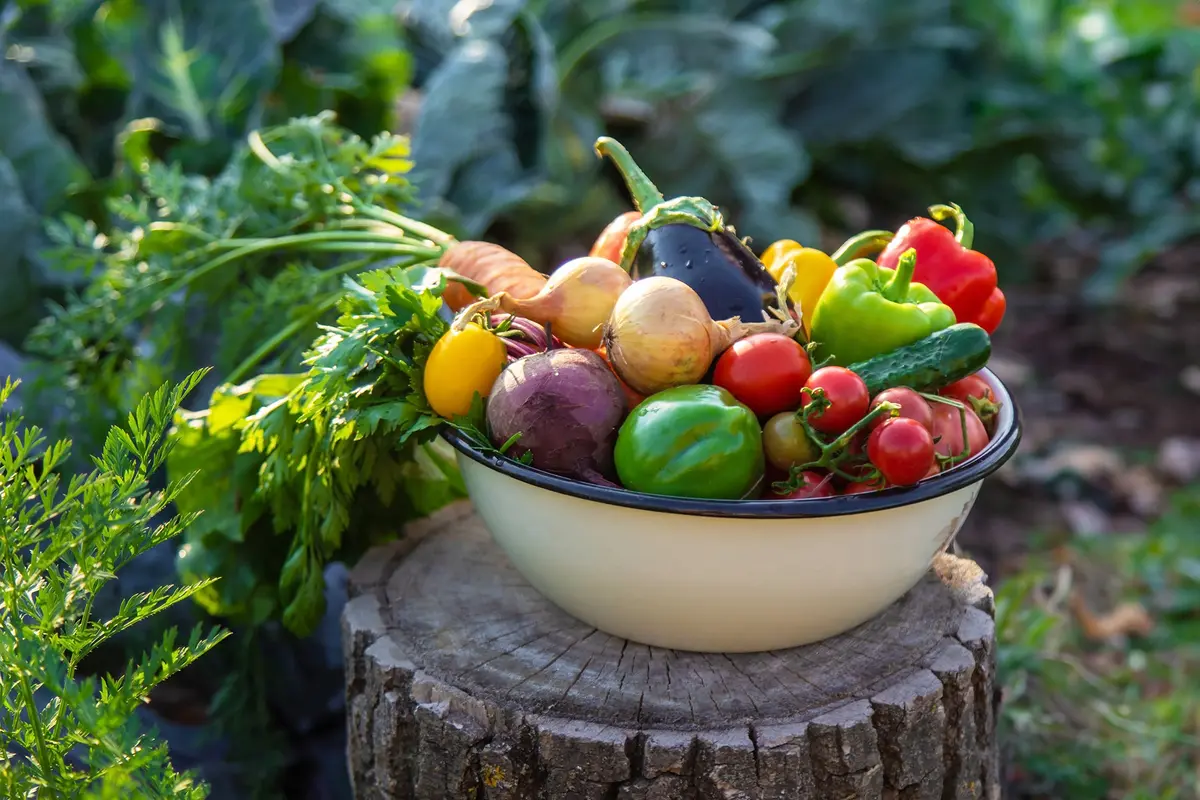
As incomprehensible as that seems to city folk, it’s a blessing in disguise. We have something from the garden or orchard on the table almost every night, and it’s organic, sustainable, healthful, non-GMO, and, best of all, extremely tasty. Lacking Uber Eats is not the reason for our half-acre garden and orchard, but it is the answer. Add in the free-range eggs and pasture-raised meat we get from local farms (sometimes the big spread right next door), and we don’t miss all-access groceries a bit.
The signature dinner at Owl Feather Farm is roast lamb shoulder with chiles, potatoes, carrots, parsnips, sea salt, sage, and thyme—all harvested from within three miles of our kitchen.
We haven’t learned to make pizza. We may be the last American family that never eats the No. 1 meal in the United States. But hey, there are no fights over pineapple slices.
It’s Stewardship, Not Ownership
Among our 27 acres of land are about three acres of mature fir and pine forest. Some of the bigger trees have reached the point at which they represent old-growth forest, a pretty rare thing these days. More than 100 feet tall, they are, for all human purposes eternal and everlasting. One might even be the biggest of its kind.
Every spring, in the woods down at the bottom of the horse pasture, a fox family has a den in which they raise kits who play and tumble in the meadow. Those same foxes ensure that we have no rabbits clear-cutting our garden.
Our picnic table is set below a century-old pioneer homestead pear tree, a magnificent specimen that’s covered with blooms every May and bears amazing fruit each October. Sitting beneath it is like being in an old country church.
The songbirds in the pine grove by the master bedroom, the hummingbirds that buzz around the house and garden, the merlins that sail the hay meadow, and the swallows that nest in the barn—all are precious. Each morning, a young buck we have named Claude drifts out of the woods to join our two equines for a morning of grazing and browsing. The afternoon breeze in the cottonwood leaves is a sibilant song, and the good, deep black soil in the lower orchard is the reason our Gravenstein apple tree grew 20 feet in five years.
We are not the “owners” of all these wonders. It might be more accurate to say they own us, but let’s instead say we are all guardians for each other, every living being here at our farm along with the ground, water, sky, and air that sustain us all. Our spirits are linked inextricably, like gemstones on an infinite golden chain. That’s the famous circle of life, and we’re completely in it.