This copy is for your personal, non-commercial use only. Distribution and use of this material are governed by our Subscriber Agreement and by copyright law. For non-personal use or to order multiple copies, please contact The Epoch Times Reprints.
‘The American Miracle’: How Divine Providence Begat America
Atheists might think attributing divine intervention to random but serendipitous weather patterns is for simpletons, but for the faithful—if you know, you know
The young George Washington (Ryan Williams) escapes capture, in “The American Miracle: Our Nation Is No Accident.” Heroic Pictures/Fathom Entertainment
The premise of the docudrama “The American Miracle: Our Nation Is No Accident” is that divine providence figured heavily in the birth of the United States of America. It’s yet another documentary having to do with divine things that sits at 97 percent with audiences on Rotten Tomatoes, and which no Rotten Tomatoes film critic has yet touched.
The movie’s foundation is the bestselling book “The American Miracle: Divine Providence in the Rise of the Republic” by political commentator, radio show host, and New York Post film critic Michael Medved. Medved hosts the film, which features historical reenactments as well as many talking-head interviews with various political science experts, historians, and professors.
Two Die on the Fourth of July
While the timeline jumps around a bit due to the movie’s being organized more by topic than historical dates, essentially “The American Miracle: Our Nation Is No Accident” tells the story of the founding of America from the beginning of the Revolutionary War to the Constitutional Convention in 1787. It depicts the young George Washington beginning with his career as a surveyor, his leadership during the War for Independence, followed by the events that lead to his becoming commander in chief of the Continental Army.
The young George Washington (Ryan Williams, L) and his older half-brother Lawrence (Dayton Modderman), in “The American Miracle: Our Nation Is No Accident.” Heroic Pictures/Fathom Entertainment
The movie begins with the 50th anniversary of America’s independence, on the Fourth of July 1826. Both Thomas Jefferson and John Adams are near death, and both die later that day. What are the odds of two Founding Fathers passing on the same Fourth of July? It’s a coincidence that many see as an example of divine providence in the history of the young republic, but naturally, some consider chalking such occurrences up to the divine as being completely ridiculous.
Mysterious Weather and Marksmen Who Missed
The second providential event depicted is George Washington coming down with smallpox in 1751, while visiting Barbados with his older half-brother Lawrence. The disease caused his body to build up immunity so that during the American Revolution he was able to walk freely among his smallpox-ridden men, without concern for himself.
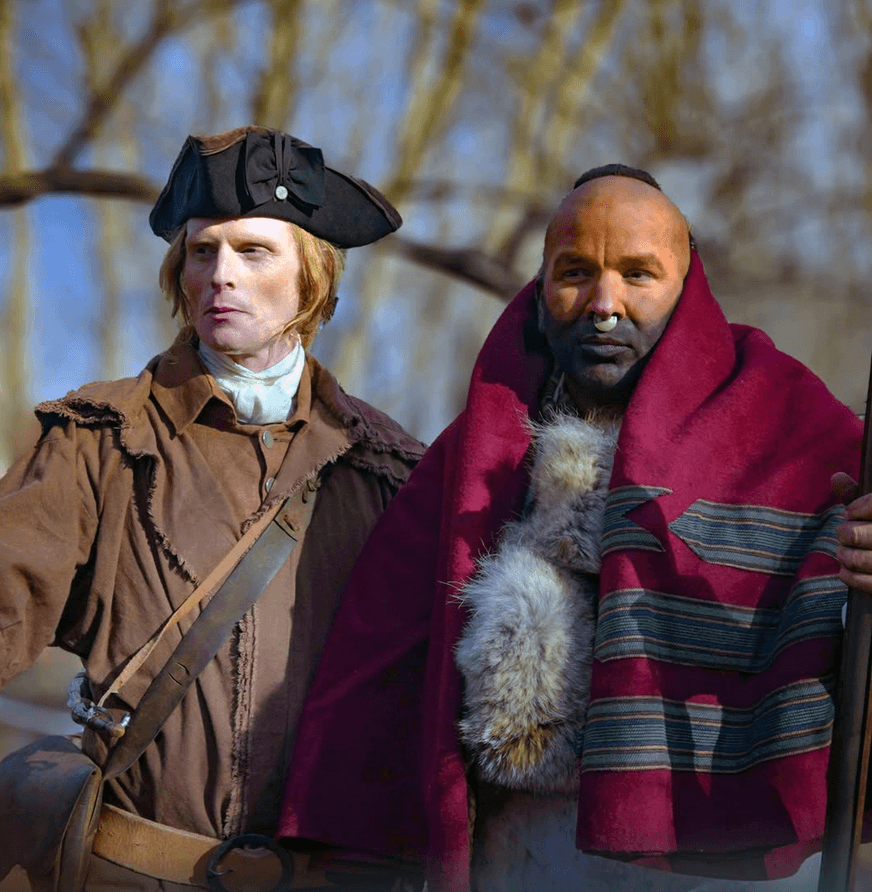
Next up was the time when Tanaghrisson (Henry Jäderlund), a Seneca leader in the Iroquois Confederacy, guided George Washington back to Virginia from a mission to a French fort on the frontier. He led Washington and his friend Dr. James Craik off the path, and attempted to assassinate him.
Tanaghrisson’s shot missed, but Washington nevertheless let him go. Knowing that he would return and attempt to track Washington down with tribal warriors, he and Dr. Craik fled through the snowy wilderness.
The young George Washington (Ryan Williams, a professional George Washington reenactor, L) and Native American guide Tanaghrisson (Henry Jäderlund), in “The American Miracle: Our Nation Is No Accident.” Heroic Pictures/Fathom Entertainment
While fording an icy river to an island on a makeshift raft, Washington slipped and fell in. With freezing, soaked clothing, he camped overnight in the woods with no fire. A fire would have revealed their whereabouts. One usually hears about this type of epic, freezing-cold forbearance being undertaken by world-class mountaineers in extreme survival situations in the Himalayas. Our first commander in chief was a true “hard-man,” as climbers call such survivors.
There’s a recounting of the highly skilled British marksman Maj. Patrick Ferguson (Carter Burch), who had George Washington dead to rights in the Battle of Brandywine, during the American Revolutionary War. According to accounts, Ferguson chose not to shoot, deeming it dishonorable to shoot an unarmed officer. Honor was of an altogether different caliber during the infancy of our nation.
“The Nation Makers,” by Howard Pyle (1853–1911), circa 1903. Oil on canvas. The painting shows patriots at the Battle of Brandywine. Brandywine River Museum of Art.
Repeatedly, Washington and his troops escaped destruction via a series of providential miracles, many having to do with inexplicable and favorable shifts in weather. Numerous fog banks appeared out of nowhere and obfuscated Washington’s troop movements to the enemy.
Also, during the French and Indian War in 1770, Seneca leader Guyasuta met with and recounted to George Washington that he himself had attempted to shoot Washington twice during the Battle of Monongahela, but his bullets were mysteriously deflected.
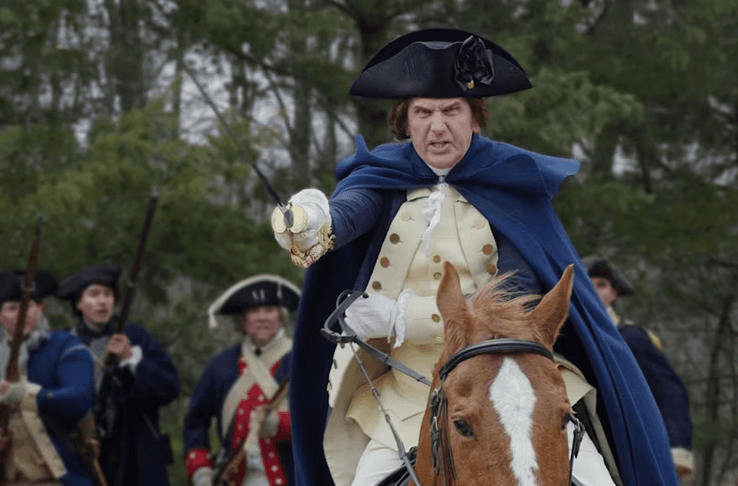
According to history, after that battle it was discovered that six separate bullets had passed through Washington’s garments, plus another one through his hat. Guyasuta told his warriors that Washington “cannot die in battle,“ and continued: ”The Great Spirit protects that man and guides his destinies. He will become chief of nations, and a people yet unborn will hail him the founder of a mighty nation.”
George Washington (Daniel H.T. Shippey) leading his men into battle, in “The American Miracle: Our Nation Is No Accident.” Heroic Pictures/Fathom Entertainment
Constitutional Convention
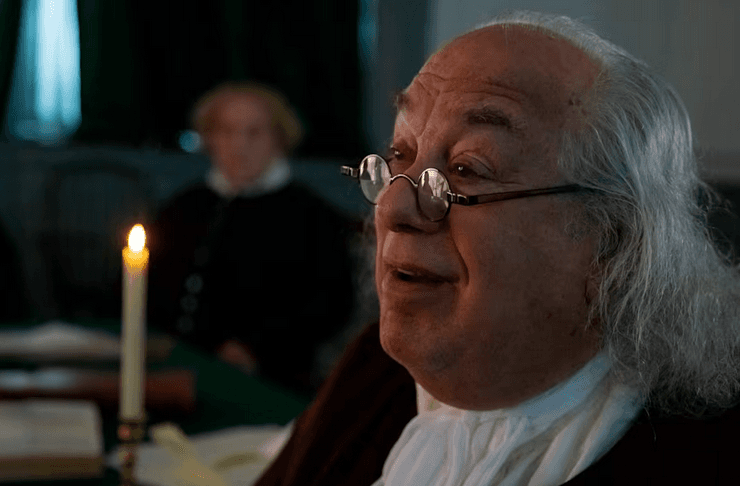
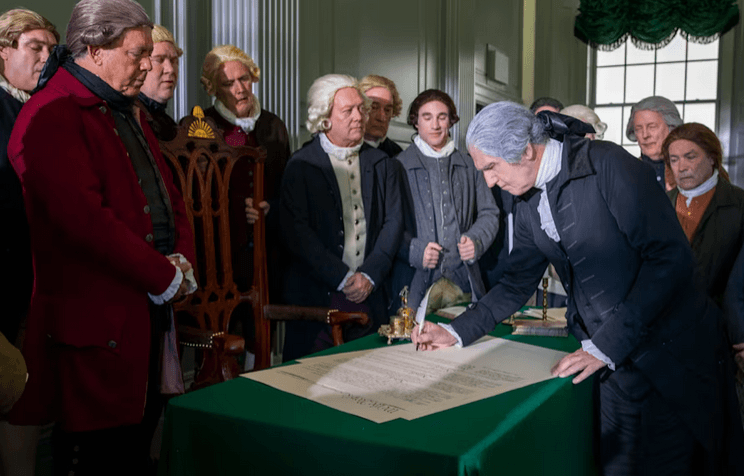
The movie ends with a reenactment of the debates at the Constitutional Convention in 1787, including a discussion of the issues of slavery and equality under the law. Most moving is the call for prayer by Benjamin Franklin. After days of squabbling, he queried as to how everyone could possibly think that they could bring the constitution of a future, great nation into existence without the help of God. The figurative raised eyebrows, head-scratching, and imagined mutterings of “Oh ... right …” is almost Monty Python-esque.
Benjamin Franklin (Barry Stevens) reminding delegates that they must request divine guidance in morning prayer sessions, in “The American Miracle: Our Nation Is No Accident.” Heroic Pictures/Fathom Entertainment
Cynics have theorized that Benjamin Franklin, a self-declared deist (who once quipped that lighthouses were more useful than churches), didn’t call for prayer because of the fact that he was religious. It’s more plausible to them that it was because the whole convention was falling apart, and Franklin wanted all the delegates to stop bickering.
George Washington (Daniel H.T. Shippey) signs the American Constitution, in “The American Miracle: Our Nation Is No Accident.” Heroic Pictures/Fathom Entertainment
If You Know, You Know
“The American Miracle” has strong biblical and patriotic worldviews that support the concepts of divine providence, miracles, and prayer. Throughout, the acceptance of the miraculous is a given.
The production value feels ever so slightly amateurish, with some sections that have less bearing on the topic at hand feeling unnecessarily long. Generally speaking, though, “The American Miracle” is pleasing to the eye and carries powerful American nostalgia. Lush forests, Native Americans in war paint, livestock, muskets, flags, cannons, bonnets, barrister wigs, and early American speech mannerisms abound, realistically sprinkled with the occasional full-blown old-country Irish and Scottish accent.
It’s understandable that cynics, atheists, and agnostics will scoff and see the divine providence theory as an early American version of a skit from “Monty Python and the Holy Grail.” Terry Jones’s character poses the following question to the madding crowd, who’ve presented a witch for burning: “And hoooow do you know she is a witch??” (Much introspection and head-scratching follows.) Suddenly Michael Palin’s face-in-the-crowd character has a light bulb go off over his head: “Because she looks like one!!!!”
Nonbelievers will think that ascribing divine intervention to some completely random but serendipitous and advantageous fog banks moving around is for simpletons. For we faithful ... if you know, you know.
The sheer number of coincidences piling up would appear to deny conventional thinking. How many things have to go right for people to stop discounting them? Where there’s smoke, there’s usually fire. And where there’s a fog bank it means—if there hadn’t been a fog bank obscuring, say, Washington crossing the Delaware—there would simply be no United States of America.
Promotional poster for “The American Miracle: Our Nation Is No Accident.” Heroic Pictures/Fathom Entertainment
“The American Miracle” released in theaters nationwide on June 9, 10, and 11, 2025, and is now available on DVD and Blu-ray. Pre-order and Private Screening Events through Faith Content Network. Visit AmericanMiracleMovie.com.
‘The American Miracle’
Docudrama
Director: Timothy P. Mahoney
MPAA Rating: Unrated
Running Time: 2 hours, 30 minutes
Release Date: June 9, 2025
Rating: 3 1/2 stars out of 5
Would you like to see other kinds of arts and culture articles? Please email us your story ideas or feedback at [email protected]
Mark Jackson is the senior film critic for The Epoch Times and a Rotten Tomatoes-approved critic. Mark earned a bachelor's degree in philosophy from Williams College, followed by classical theater conservatory training, and has 20 years' experience as a New York professional actor. He narrated The Epoch Times audiobook "How the Specter of Communism Is Ruling Our World," available on iTunes, Audible, and YouTube. Mark is featured in the book "How to Be a Film Critic in Five Easy Lessons" by Christopher K. Brooks. In addition to films, he enjoys Harley-Davidsons, rock-climbing, qigong, martial arts, and human rights activism.