‘St. Francis in the Desert’: A Beloved Bellini Painting

Giovanni Bellini’s painting poetically communicates St. Francis’s devotion and contemplation.
‘St. Francis in the Desert’: A Beloved Bellini Painting
A detail of "Saint Francis in the Desert," circa 1475–1480, by Giovanni Bellini. The Frick Collection, New York City. Public Domain
|Updated:
0:00
Giovanni Bellini’s enigmatic masterpiece “St. Francis in the Desert” at New York City’s Frick Collection is considered the greatest Italian Renaissance painting in the United States. It depicts the critical moment in the life of St. Francis when he experienced the stigmata, the imprint of the five Crucifixion wounds of Christ.

There is a rich art historical tradition of depicting this event, but Bellini’s interpretation has no precedent. “St. Francis in the Desert,” circa 1475–1478, reflects the artist’s genius in the burgeoning medium of oil paint to depict color, light, religious iconography, and the natural world—all with great beauty and detail.

Bellini (circa 1424/1435–1516) was a familial member of an influential Venetian art dynasty as well as teacher to the likes of Giorgione and Titian, the next generation of great painters. He is believed to have been the son of Jacopo Bellini and younger brother of Gentile Bellini. Both Giovanni and Gentile learned their profession in the successful workshop of their father. Gentile went on to run it and is admired for his oeuvre today, but Giovanni is now considered the most talented and innovative Bellini. Their brother-in-law, Andrea Mantegna, was another giant of the Renaissance whose influence can be seen in Giovanni’s early work.

Scholars believe that Sicilian artist Antonello da Messina’s visit to Venice around 1475 may have played a pivotal part in Bellini’s switch from tempera to oil. Antonello was an early Italian practitioner in the medium. This new technique allowed for more precise detailing and richer colors that, in Bellini’s hands, were luminously saturated.

Bellini is best known for his altarpieces and private devotional works. As his career progressed, his interest increased to include topographical landscapes with natural light in religious paintings. A constant throughout his oeuvre is his ability to poetically communicate devotion and contemplation.

St. Francis of Assisi

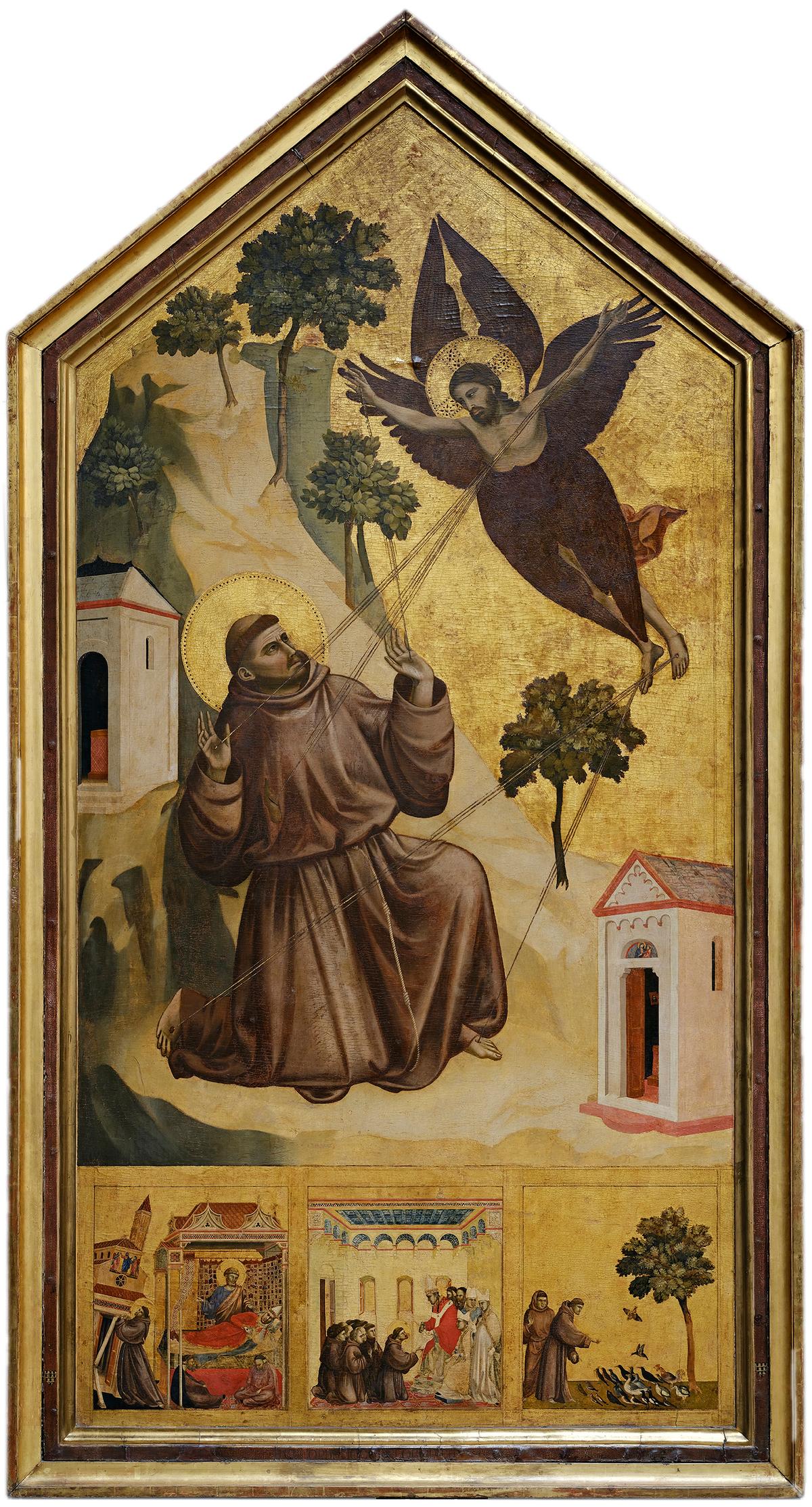
“St. Francis of Assisi Receiving the Stigmata," circa early 14th century, by Giotto di Bondone. Tempera and gold on poplar panel;  123 1/5 inches by 64 1/5 inches. Louvre Museum, Paris. (Public Domain)
“St. Francis of Assisi Receiving the Stigmata," circa early 14th century, by Giotto di Bondone. Tempera and gold on poplar panel;  123 1/5 inches by 64 1/5 inches. Louvre Museum, Paris. Public Domain

There is an immediacy to Renaissance portrayals of St. Francis, as he lived shortly before the Early Renaissance began. Francis (circa 1181–1226) was born to a wealthy merchant family in the town of Assisi in Italy’s Umbria region. As a young adult, he rejected his worldly possessions to live a Christian life of poverty in dedicated service to the poor and all creatures. He founded the Franciscan Order, which continues to play an influential role in the Catholic Church.
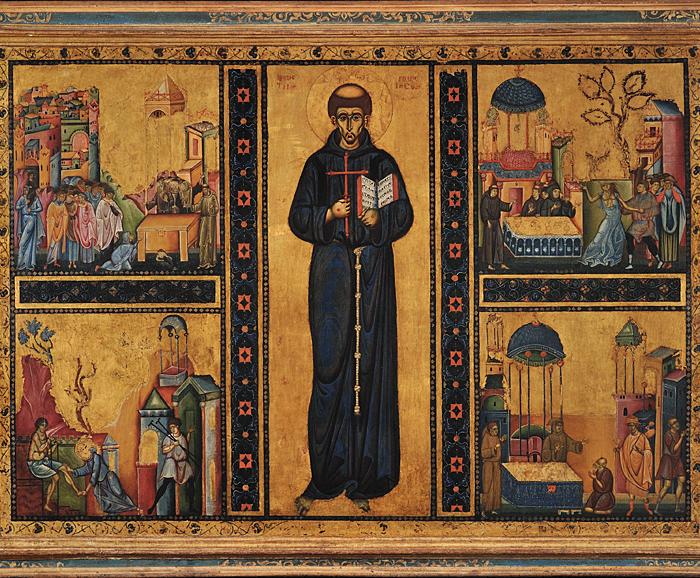
In the summer of 1224, Francis retreated to Monte della Vernia, known as La Verna, in the Tuscan Apennine Mountains. During this 40-day fast and meditation retreat, he had a vision of a six-winged seraph carrying the image of the crucified Christ. Physically, he received the stigmata. This became a popular subject for art in the late 15th century, and the seraph was usually included.

Bellini’s unconventional version features Francis in a rocky, austere wilderness, but does not show a seraph. Recent scientific examination of the painting has confirmed that while a portion of the canvas’s top edge was cut off at some point, it is highly unlikely that it contained a seraph.
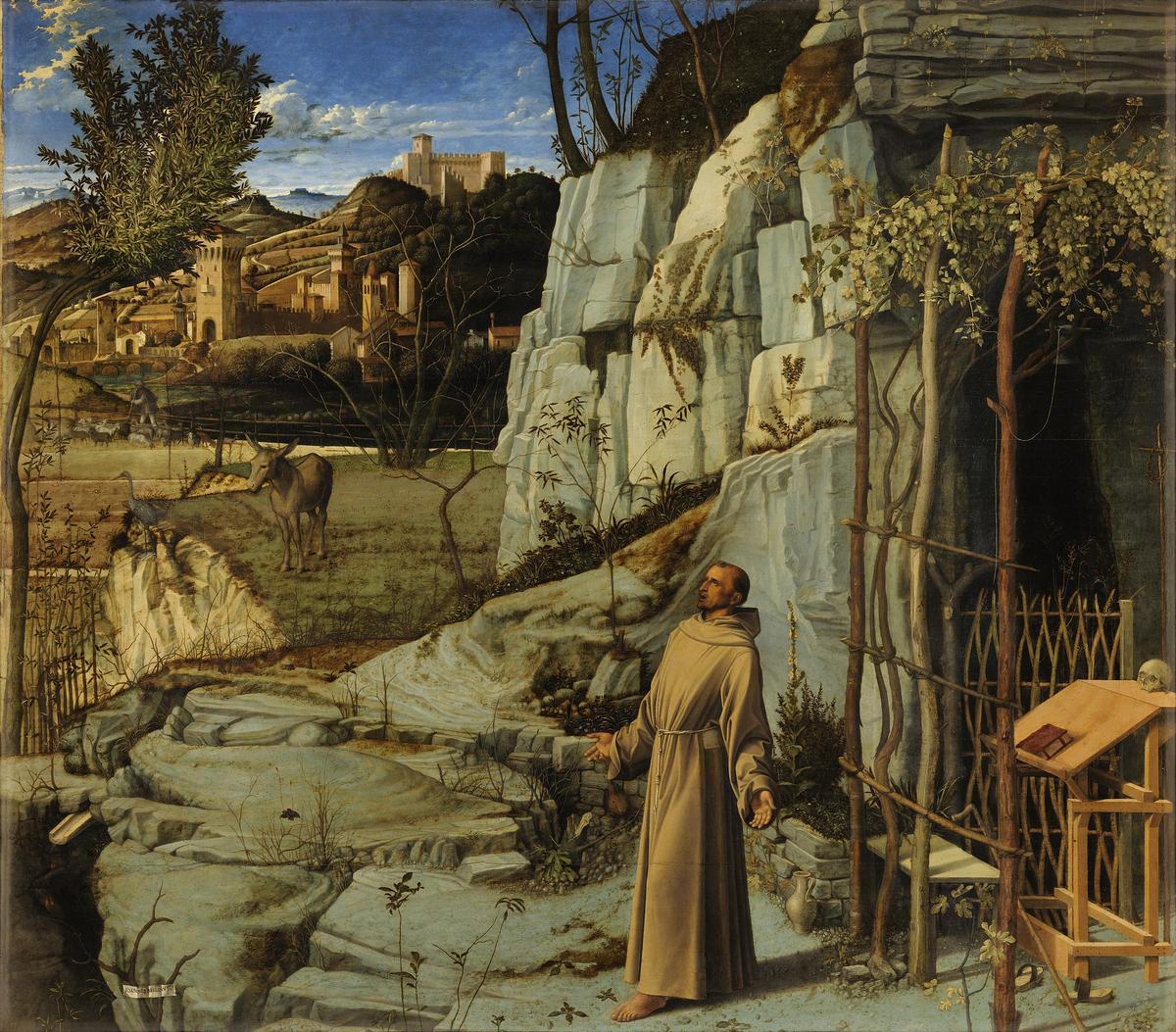
"Saint Francis in the Desert," circa 1475–1480, by Giovanni Bellini. Oil on panel; 49 1/16 inches by 55 7/8 inches. The Frick Collection, New York City. (Public Domain)
"Saint Francis in the Desert," circa 1475–1480, by Giovanni Bellini. Oil on panel; 49 1/16 inches by 55 7/8 inches. The Frick Collection, New York City. Public Domain
Instead, the divinity of the story is conveyed by golden light coming from the clouds at the upper-left corner. Reaching Francis, it gives him the appearance of a radiant transfiguration. The glowing and bending laurel tree reflects the power of this enlightenment, too. The whole landscape is bathed in light, and Francis is open-mouthed in wonder. 

Francis is usually illustrated in a kneeling position receiving five stigmata, but Bellini depicts him standing with open arms. Today, only two stigmata are visible, on the palms of his hands. However, the technical investigation revealed a wound on the left foot. Due to abrasion over the centuries, it is no longer visible without high magnification.

The special, harmonious relationship between the saint and the natural world is highlighted in this panel by the inclusion of meticulous landscape details. There are animals, such as a donkey and rabbit, birds, including a heron and kingfisher, and plants, like a fig tree and flowers. Behind the countryside is a medieval walled town. Nearby is one of the few signs of human life, aside from Francis: a shepherd bringing his flock along a river.

The painting was commissioned by Venetian nobleman Giovanni Michiel, and it stayed in the city in various prominent family collections for over 330 years. After extended time in private French and British collections, it was bought in 1915 for $170,000 ($5.45 million) by Henry Clay Frick and installed in his mansion’s living room. It remains there today as part of his eponymous museum and is a favorite artwork of many visitors.
What arts and culture topics would you like us to cover? Please email ideas or feedback to [email protected]
Google LogoMark Us Preferred on Google
Michelle Plastrik
Michelle Plastrik
Author
Michelle Plastrik is an art adviser living in New York City. She writes on a range of topics, including art history, the art market, museums, art fairs, and special exhibitions.