One mark of the 21st century is the explosion of photographs and images taken on smartphones and published on social media. In 2016, the number of cellphone subscriptions surpassed the global population, a gap that continues to widen. Many phone owners take dozens, if not hundreds of photos and videos every year. That amounts to billions of family shots, selfies, pet pictures, and more.
These staggering numbers far outpace the number of photographs produced in the 20th century, and absolutely dwarf the number of images created when only the wealthy could afford to hire an artist and sit for a portrait. For most of human history, even these creations on canvas were rare. No drawings or paintings of William the Conqueror exist, whereas many modern toddlers have enough snapshots taken of them to fill a scrapbook.
Fortunately, some writers from long ago left thumbnail sketches of people—real and fictional, patricians and commoners—that allow us, if we employ our imagination, to picture figures from the past. One of these word artists was Geoffrey Chaucer (circa 1343–1400), who in his Prologue to “The Canterbury Tales” describes in detail the dress and physical appearance of a company of pilgrims.
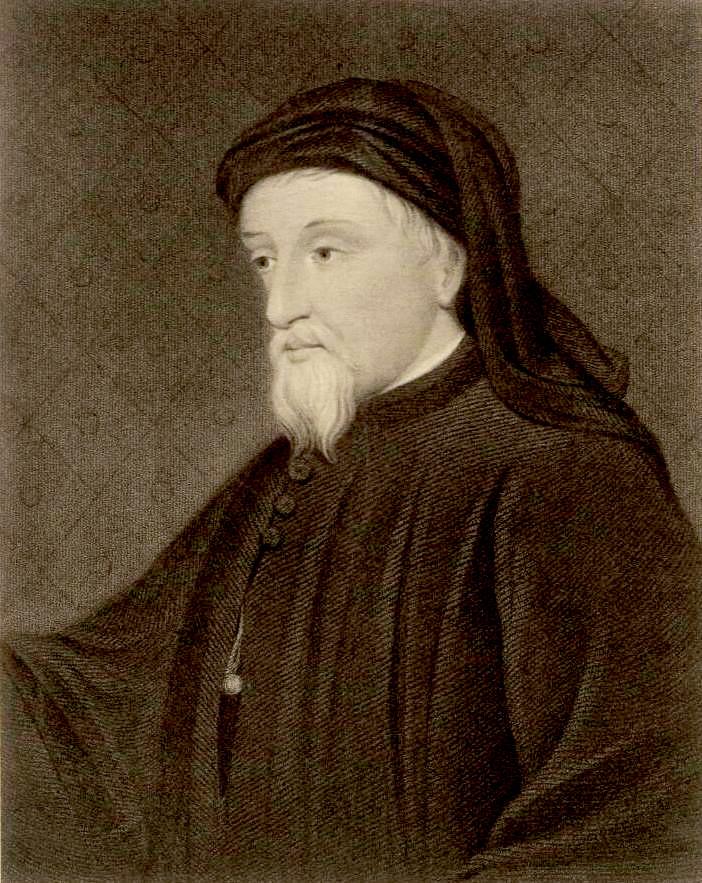
A portrait of the English poet and author Geoffrey Chaucer, from the Welsh Portrait Collection at the National Library of Wales. Public Domain
The Knyght and His Yeman
“Whan that Aprill with his shoures soote” begins Chaucer’s most famous work, which is rendered into modern English as “When April with its sweet-smelling showers.” It’s in this season that a band of pilgrims set out on a trip to Canterbury, shrine of the martyred saint Thomas Becket. Chaucer, who includes himself as one of the pilgrims, could have simply listed each traveler by profession or reputation and left it there, but instead he rendered both literature and history a great service by providing intimate portraits of each.By his descriptions, not only does Chaucer make us aware of how these pilgrims earned a livelihood and the nature of their virtues, vices, and personalities, but he also gives us his word pictures of their clothing and appearance, or as he promised, “in what array that they were inne.”
The noble knight, we’re told, is not “gaily dressed” but “wore a tunic of coarse cloth all stained (with rust) by his coat of mail, for he was recently come (back) from his expedition.” That brief mention of stains, the mark of battles and marches around the Mediterranean, gives us a valuable detail about the effects of armor on clothing. It also reminds the reader of the hardship and humility suffered by this workaday warrior who was “prudent, and of his deportment as meek as is a maid.”
Oddly, the knight’s yeoman, the single servant accompanying him on this pilgrimage, fairly glitters in comparison to his master. He’s clad in a green hood and cloak, carries in his belt “a sheaf of peacock arrows, bright and keen,” and is decked out with even more weapons: a bow, a shield, a sword, and “an elegant dagger well-ornamented and sharp as the point of a spear.” His equipment also includes a horn—“the shoulder strap was green”—and “a Christopher-medal of bright silver on his breast.”

Mural by Ezra Winter illustrating the characters in "The Canterbury Tales" by Geoffrey Chaucer. Library of Congress John Adams Building, Washington, D.C. This mural on the west wall shows (L–R) the Miller, in the lead, piping the band out of Southwark; the Host of Tabard Inn; the Knight, followed by his son, the young Squire, on a white palfrey; a Yeoman. Public Domain
The Prioress and the Wife of Bath
Three women—a prioress, a nun who acts as her secretary and companion, and the Wife of Bath—have joined this pilgrimage. The second nun receives only a nod from Chaucer. However, the prioress and the Wife of Bath are as different from each other as night and day; here they are together, riding off toward Canterbury and joining the others in telling tales to pass the time.Here, too, Chaucer gives us valuable descriptions of their physical appearance. The prioress, a nun who had charge of a convent, speaks French and practices exquisite table etiquette—“Her greatest pleasure was in good manners,” and “She let no morsel fall from her lips.” Of her face, Chaucer writes of her well-formed nose, “her eyes gray as glass,” her small mouth, “soft and red,” and her fair, broad forehead. He offers this inventory of her clothing and jewelry:
Her cloak was very well made, as I was aware, About her arm she bore of small coral A set of beads, adorned with large green beads, And thereon hung a brooch of very bright gold, On which there was first written an A with a crown And after Amor vincit omnia (‘Love conquers all.’)”
In stark contrast to the dainty prioress is the earthy Wife of Bath, a woman enriched by her five dead husbands, all of whom she dominated. She’s a well-traveled pilgrim who has journeyed to Rome, Jerusalem, and other places far from England. “Bold was her face, and fair, and red of hue,” wrote Chaucer. He described her as broad-hipped and gap-toothed, which she later claims is a sign of sexual allure. She wears a large wimple (a cloth covering the head, neck, and sides of the face) “and a hat as broad as a buckler or a shield,” likely to protect her from the sun.The Prologue also tells us that “her stockings were of fine scarlet red,” and that her shoes were “very supple, and new.” Later in the “Tales,” the Wife of Bath speaks of her red dresses, again a symbol of her sexual approach to love and marriage, but also another hint as to her taste in expensive fashions.
Millere, Reve, Somnour, and Pardoner
Chaucer also supplies vivid physical descriptions of the miller, reeve, summoner, and pardoner who rode with this company. Like a photograph, his pictures include blemishes and warts—in one case, literally—as well as compliments.The miller “was stoutly built, broad, a large-framed fellow; there was no door that he would not heave off its hinges.” His spade-shaped beard was “red as any sow or fox.” On his nose was “a wart, and thereon stood a tuft of hairs, red as the bristles of a sow’s ears”; his mouth “was as large as a large furnace”; and “his nostrils were black and wide.”
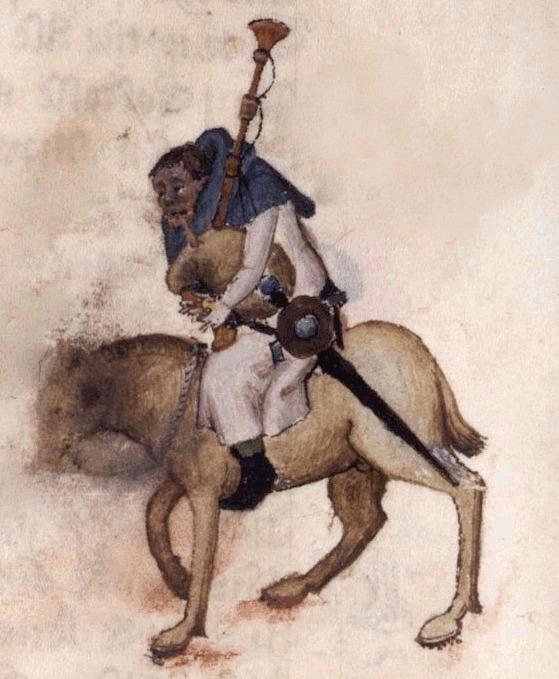
The miller from Chaucer's "Canterbury Tales." Public Domain
The reeve, a word meaning the manager of a lord’s lands and estate, differs completely from the miller in appearance. He “was a slender choleric man.” His “hair was closely cropped by his ears; the top of his head in front was cut short like a priest’s.” And “his legs were very long and very lean, like a stick; there was no calf to be seen.” He wears a long, blue cloak, “hitched up and belted, like a friar.” He is an efficient though dishonest estate manager whose underlings are “afraid of him as of the plague.”
The summoner, who brought people before a court for crimes committed against the Church and who was infamous for taking bribes from those wishing to evade this fate, is awful in his appearance. “Children were afraid of his face,” Chaucer wrote, which, given the man’s description, is entirely understandable.
He has a “fire-red cherubim’s face, for it was pimpled and discolored, with swollen eyelids,” a visage adorned by “black, scabby brows” and a “beard with hair fallen out.” No drugs will cure his ugliness:
There was no mercury, lead monoxide, nor sulphur, Borax, white lead, nor any oil of tarter, Nor ointment that would cleanse and burn, That could cure him of his white pustules, Nor of the knobs sitting on his cheeks.
The pardoner, who sold indulgences for the forgiveness of sins, evokes a prettier but equally striking portrait from the poet. Chaucer focuses the reader’s attention on this man’s hair, describing it “as yellow as wax, but smooth it hung as does a clump of flax.” He spreads the small strands of hair “over his shoulders,” and “it seemed to him that he rode in the very latest style; with hair unbound, save for his cap, he rode all bareheaded.” He has large, “glaring eyes such as has a hare” and “had no beard, nor never would have; it (his face) was as smooth as if it were recently shaven.”This absence of facial hair, plus “a voice as small as a goat has,” is probably why Chaucer wrote of the pardoner, “I trowe he were a geldyng or a mare,” meaning that the pardoner was either a eunuch or homosexual.
The Poet as Camera
Now have I told you truly, briefly, The rank, the dress, the number, and also the cause Why this company was assembled.
So Chaucer writes near the end of the Prologue. Here we’ve looked at only eight of the 30 pilgrims bound for Canterbury. For those interested in fashion, these others deserve attention as well, as they also afford information on the dress and physical appearances of people 700 years ago.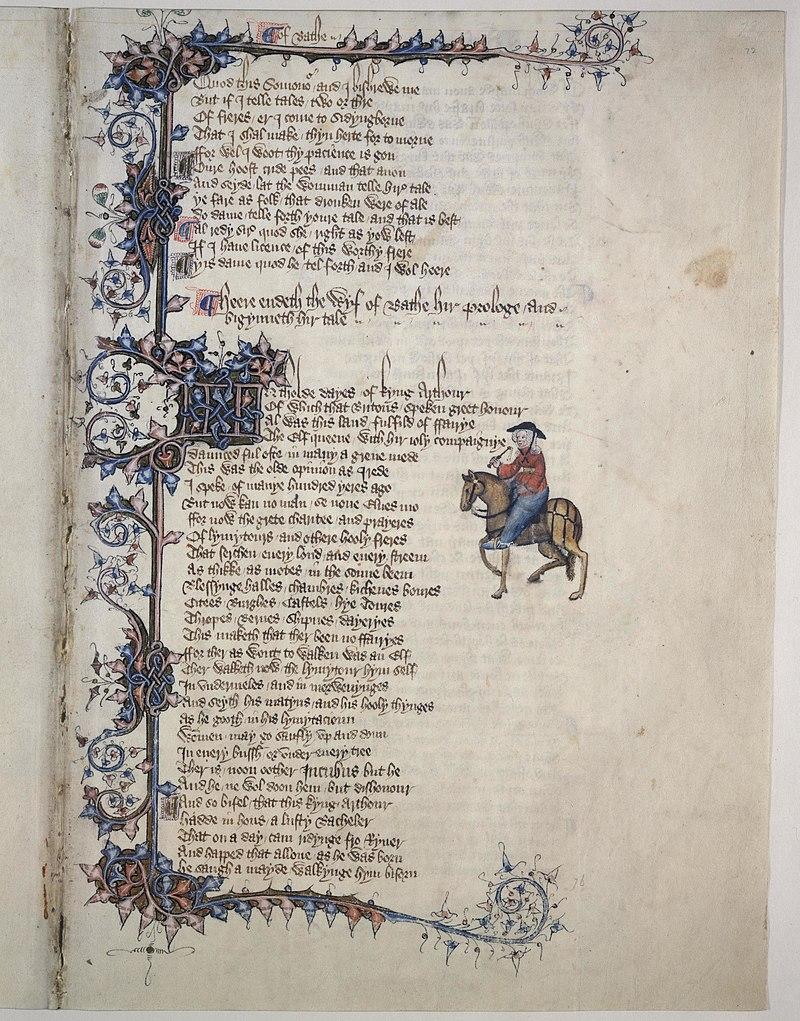
The Wife of Bath's Tale in the Ellesmere manuscript of "The Canterbury Tales," circa 1405–1410. Public Domain
A picture is worth a thousand words, goes the old adage, yet from a time when pictures were unavailable, we must be thankful for Chaucer’s words and eye for detail. He was the camera that provided these snapshots.
What arts and culture topics would you like us to cover? Please email ideas or feedback to [email protected]