The rise of Pisistratus had not been an easy one. The tyrant of ancient Athens had fought political enemies, endured exile, and won and lost power during the final decades of his life. In his last dozen years, he reigned without rival. Upon his death in 527 B.C., his throne became hereditary, falling to his two sons, Hippias and Hipparchus. Their reign began smoothly, but ended dramatically with Hipparchus’s assassination (the result of a love triangle) and later Hippias’s deposition in 510 B.C., ultimately leading to Athenian democracy. This era of tyrants, war, and revolution made up the childhood of the great tragedian Aeschylus.
Considering the dramatic events that surrounded his early life and his later involvement in the battles of Marathon (490) and Salamis (480) against the Persians, it stands to reason that one Greek warrior, Aeschylus, became known as the father of Greek tragedy. Despite his moniker, he was not the first of the Greek tragedians. He was a product of them.
Every year in Athens a competition was held: three playwrights, four plays each. Of Aeschylus’s early rivals were the elder Choerilus, Phrynicus, and Pratinas — though hardly any of what they wrote survives. But it is the work of Aeschylus that is the oldest to survive in full text, yet even that is sparse (of his 90-plus plays, only six survive that can be definitively attributed to him).
In the annual Athenian playwright competition, Aeschylus’s early rivals were the elder Choerilus, Phrynicus, and Pratinas. Hardly any of what they wrote survives. Only Aeschylus’s works survive in full text. Yet of his 90-plus plays, only six survive that can be definitively attributed to him.
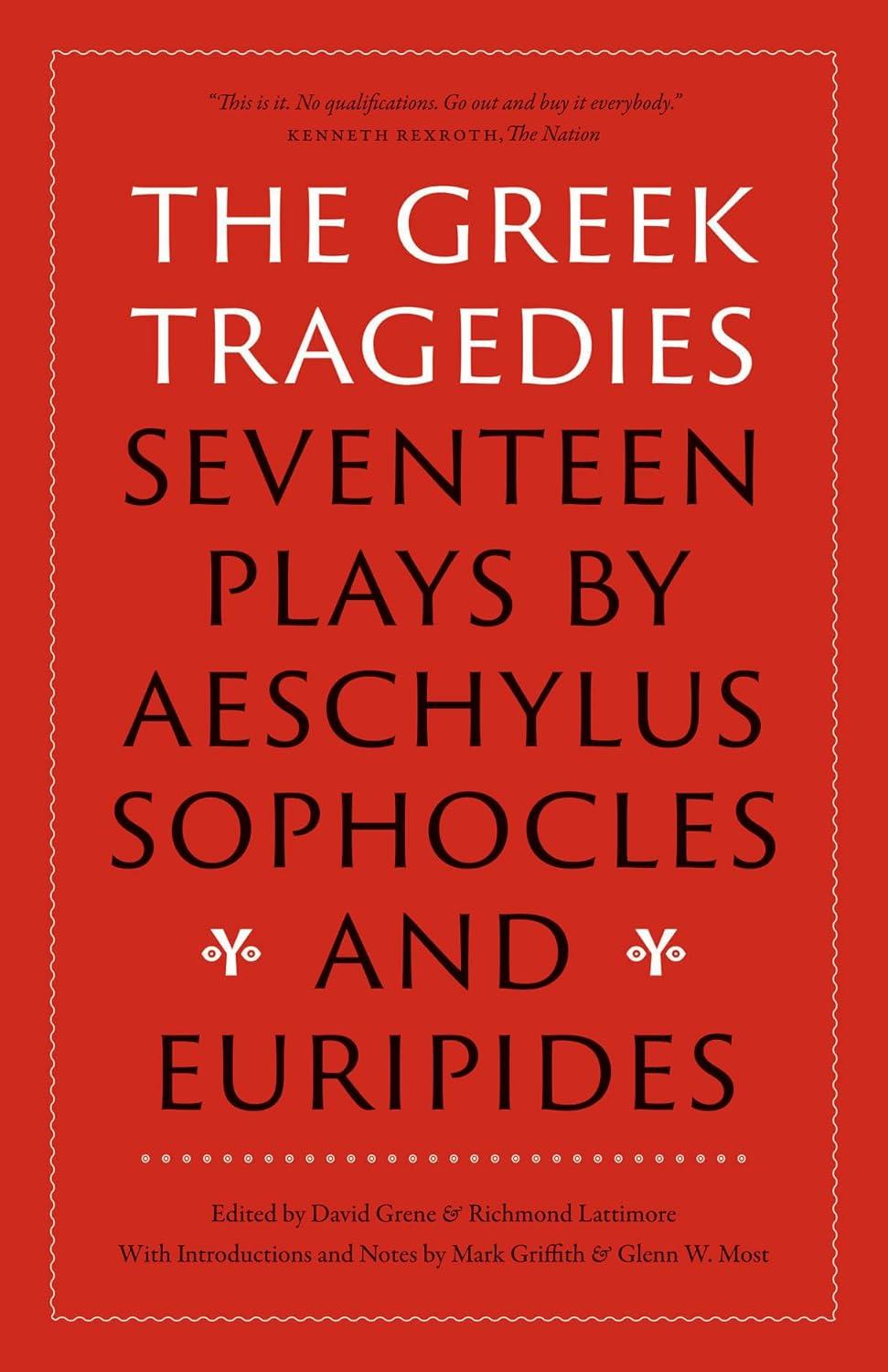
Of those six surviving works, five have been compiled by the University of Chicago Press in a recently published collection of ancient Greek tragedies, famously edited originally by the late David Grene and Richmond Lattimore. In this collection, Aeschylus is joined by two other literary gods of the Ancient Greek world: Sophocles and Euripides. These two were approximately 30 and 40 years Aeschylus’s junior. Together, they make up the trinity of the most influential of the Greek tragedians.

Meeting the Tragedians
In the University Press’s “The Greek Tragedies: Seventeen Plays by Aeschylus, Sophocles and Euripides,” readers are given insight into the ancient Greek competitions that took place during the religious festival of Dionysus, the god of wine and festivity. There are also brief, yet informative biographies of the tragedians—all of which are written by Greek literary scholars Mark Griffith and Glenn W. Most.
In those biographical introductions, we learn the difficulty of truly ranking the three against each other. Griffith and Most note that of the three, Sophocles was the most successful during the annual competitions. He won 18 first prizes, compared to Aeschylus’s 13, and Euripides’s five. But the number of first prizes isn’t indicative of their rank. Griffith and Most claim that “since the 19th century [Aeschylsus’s] plays have been regarded as the foundation stones of Western drama,” but that “since the late 18th century … it has been Sophocles’ plays—along with Shakespeare’s—that have been taken to represent the culmination of the genre of tragedy and its capacity to represent human experience and heroic suffering.”
True to Ancient Greece
“The Greek Tragedies” is a mammoth collection, spanning more than 1,100 pages. The work’s foundation stems from the efforts of Grene (1913–2002) and Lattimore (1906–1984), who translated nine of the 17 plays. The other eight translations hail from the talents of Robert Fitzgerald (1910–1985), William Arrowsmith (1924–1992), Emily Townsend Vermeule (1928–2001), Seth Bernadete (1930–2001), Oliver Taplin (born 1943), Anne Carson (born 1950), and Elizabeth Wyckoff (born 1959).Grene and Lattimore had first translated their Greek selections in the 1940s and 1950s, and were first published as a collection by the University of Chicago Press in 1960. This third edition, updated by Griffith and Most, provides translation corrections, informative textual notes, and the aforementioned introductions to the tragedians and the history of the Greek tragedy. In his review of the 17-play collection, Seth L. Schein, a leading Greek literature scholar, noted that the translations:
“are sometimes a bit less fluent than the earlier versions, but preserve more of what is linguistically, stylistically, and semantically distinctive in the original texts, and thus will remind readers that the works they are reading come from another language, culture, time, and place.”
When the first University Press collection of this work was published nearly 70 years ago, it proved to be groundbreaking. It allowed readers—from scholars to teachers to students—to better understand not only the works themselves, but the culture in which they were written. This ongoing effort over the decades, with its current capstone of the Griffith and Most edition, continues to bring readers closer to the worlds of Ancient Greece’s three greatest tragedians.
This collection is comprised of the following:
By Aeschylus—The Persians (translated by Seth Bernardete), Prometheus Bound (David Grene); The Oresteia trilogy: Agamemnon, The Libation Bearers, and The Eumenides (Richmond Lattimore)
By Sophocles—The Theban Plays: Antigone (Elizabeth Wyckoff), Oedipus the King (Grene), Oedipus at Colonus (Robert Fitzgerald); Electra (Grene)
By Euripides—Alcestis (Lattimore), Medea (Oliver Taplin), Hippolytus (Grene), Hecuba (William Arrowsmith), Electra (Emily Townsend Vermeule), The Trojan Women (Lattimore), Iphigenia among the Taurians (Anne Carson), and The Bacchae (Arrowsmith)