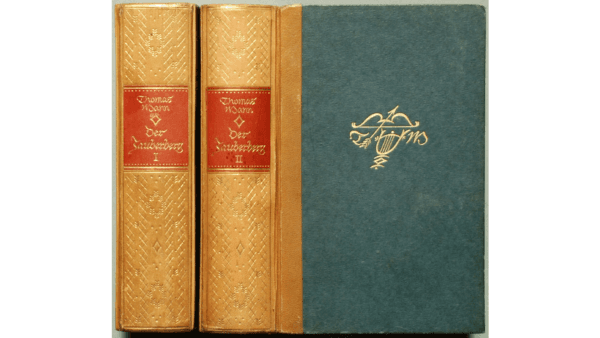
Tradition has the Gods living on Mount Olympus, Lao Tzu retreating to Mount Laojun, Mohammed meditating on Mount Hira, and Moses receiving the Ten Commandments on Mount Sinai. Sinai rises to 1,096 feet in height, but a person less illustrious than Moses, Hans Castorp, the hero of Thomas Mann’s “The Magic Mountain,” found himself in Alpine Davos, 5,118 feet above sea level thousands of years later, and had his own revelations.
Young Hans was of the German upper classes, disinclined to ponder life’s larger questions, a “simple soul” except for his keen sensitivity to music. “Hans Castorp loved music with all his heart,” the author tells us at the outset. He sings aloud, standing alone in the vast mountainous expanses, and sings quietly to himself while changing for dinner at the lavish sanatorium where he had come to visit his slightly ill cousin.
A Mountain Perspective on Life and Death
The view of his settled ways 5,000 feet below, with its bourgeois pieties, seemingly so real, so logical, is turned upside down, inside out, compressed, and crystallized by this new mountain perspective. His attitudes toward life, love, time, fate, and death, expand, conjoin, take on different forms and slowly assume a solid granite shape.The eighth-century church antiphon “Media vita in morte sumus,” (“in the midst of life we are in death”), became a greater reality to Hans Castorp as he lay down to sleep each night at the Behrens International Sanatorium, on a bed where many a patient breathed his last consumptive breath. On that same bed, dreams of love for the beautiful Russian, Clavdia Chauchat, were dreamed although they remained unfulfilled.
His stay of three weeks expanded to seven years as he found himself infected with the same disease as his cousin, and in the vast succession of days and seasons that followed, he encountered a number of aggressive personalities. Jesuits, humanists, atheists, capitalists, storm the frontiers of his mind, with a multitude of theories, sometimes scientific, sometimes mystical, about such things as the perception of time, the psychic cause of disease, the origin of matter the meaning of meaning, provoke questions he had never thought of asking, and answers that were hard to grasp, or that led to still more bewildering questions.
The Great Box of Revelations
An astounding new apparatus had been introduced to the Behrens International Sanatorium: a gramophone of the highest quality. As it was produced around 1911, that high quality might seem negligible to the modern reader of this article, but if one has heard such a machine, sitting directly before it, he cannot deny a certain truthfulness of sound, an immediacy that does not project very far from the instrument itself. This new piece of technology and its profound influence on our civilization make their first appearance in the canon of our literary tradition by way of this novel.
So music began to speak to Hans Castorp and reveal to him things it reveals only to its elect. The other guests in the sanatorium were intrigued for a moment or two, and then went their own ways with their own concerns. Not so with our Hans. He sat alone before the instrument for hours, the sounds penetrating the farthest reaches of his mind. Thoughts, until now casually addressed, lying deeply buried in his unconscious mind were abruptly pulled up like so many fish from the depths of the sea and lay open-mouthed, wide-eyed, in the light of day.
All descriptions of music are futile—as futile as descriptions of sight to those who are born blind. Thomas Mann himself admits this, but still, he tries and inevitably misses the mark just as all our greatest poets and novelists have done. A soul’s reaction to what he hears is more easily put into words.

Opera, Ideals, and Eternity
Time itself, the canvas upon which music is apprehended, becomes a great mystery to our hero. An unidentified orchestral piece (one guesses it to be the third act prelude of Carmen), courses through his mind. Its “… richness and volume were reached and sustained in a single fugitive moment that yet held all eternity.” The “single fugitive moment,” however, was gone before it could be thought—but not before it could be felt. One is reminded of Goethe saying, “It is only the moment that can make us aware of eternity.”Hans Castorp’s thoughts were reborn as feelings as he heard the song of the young corporal of dragoons, Don José, as he struggled between his passion for Carmen and the demands of military duty, that is to say, the demands of his society. Our listener came to feel the bankruptcy of the existing social order that ordains with iron authority who will be rich and who will be poor, and often dresses injustice in crowns and robes so that it passes for justice, and requires armies of men to murder perfect strangers in the name of honor. Listening to Carmen mock the young soldier and seeing that man’s passion for her obliterate the sense of duty filled Hans Castorp with dismay rather than compassion for these rather primitive individuals.
Compassion however, ran strong in him when he heard the story of love, deep and true, between Radames and Aida. In the final scene of the opera, Aida had stolen into the sealed tomb where Radames begins his slow, painful death. She will die with him. Hans feels and understands “… the triumphant idealism of the music, of art, of the human spirit, the power they had of shrouding with a veil of beauty the brutal horror of the fact.”
The work, however, that affected our listener the most was not an opera, but a German lied, Schubert’s “Der Lindenbaum,” half folk song, half art song, both root and blossom of a civilization at its zenith. The text, a simple remembrance of a happier time, meant much to our protagonist. “To make it clear what that meaning was,” the author tells us, “is a truly ticklish endeavor, requiring great delicacy of emphasis.”
Mann’s “making clear” is quite beautiful, but perhaps unnecessarily prolix. It seems to be no more than the old Socratic view that an object represents a larger idea lying behind it. He loves, longs for, the beauty and peace that the old linden tree represents, that is, beauty and peace itself. It “… soared higher than his understanding.” Fanciful poetry, perhaps, but ultimately our last, and our only hope.
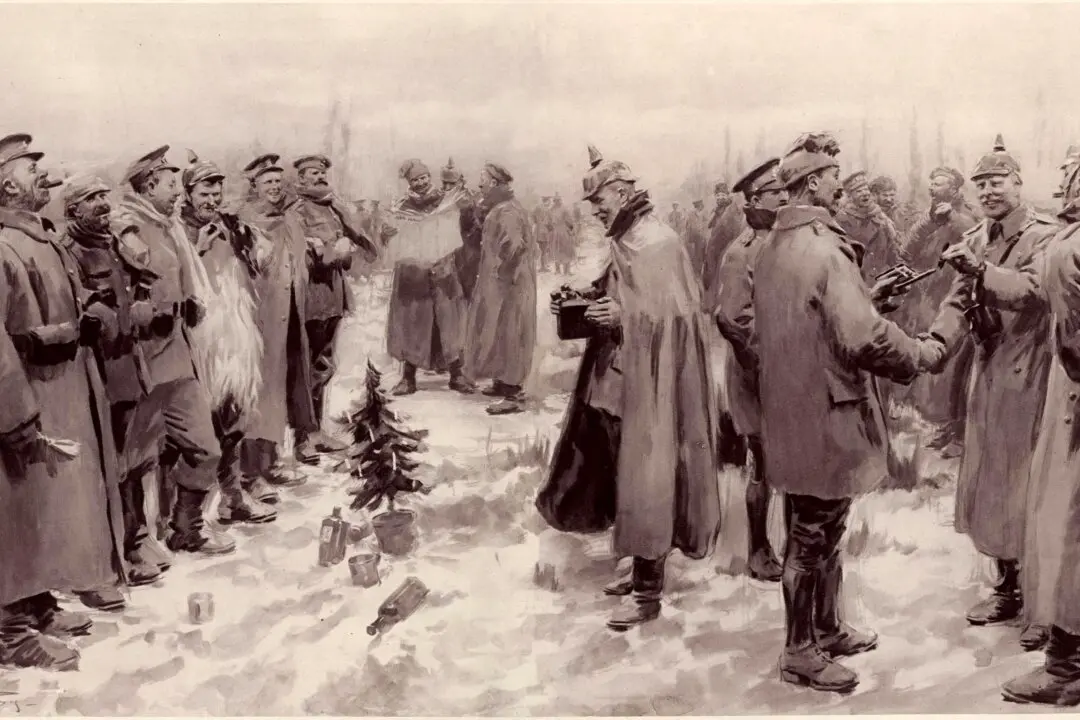
Of course, even the Apostles had to come down from the Mount of Transfiguration, and Hans Castorp eventually had to return to “the land below,” a world plunged into dark times. He was no longer a “simple soul.” Filled as he was with new life and new thoughts, he found himself a victim of the society that had both nurtured and misled him. It put a rifle in his hand, forced him to war, so that the old society could continue to flourish in its old, cruel ways.
Still, while lying in a muddy battlefield, his life hanging by a thread, the music of Schubert made its way, unbidden, to the surface of his mind, “come to me, you wanderer, you will find rest here,” it sang to him. After all, “Hans Castorp loved music with all his heart.”