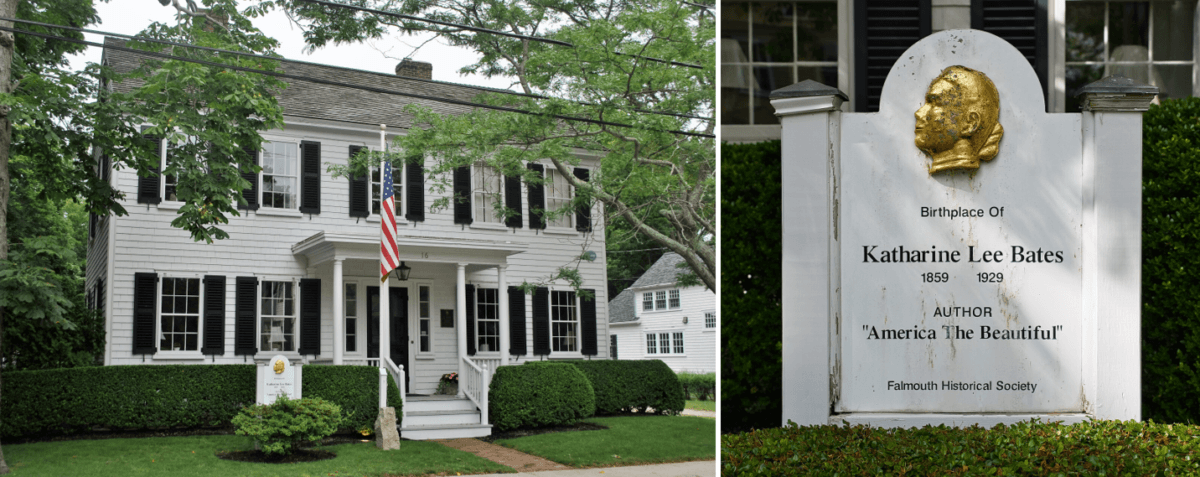
Katharine Lee Bates was an educated woman who spent most of her life primarily in the company of other women. Her father, a Congregationalist minister in Boston, died a month after her birth, so Katharine and her three older siblings were raised by their hardworking mother and an aunt.
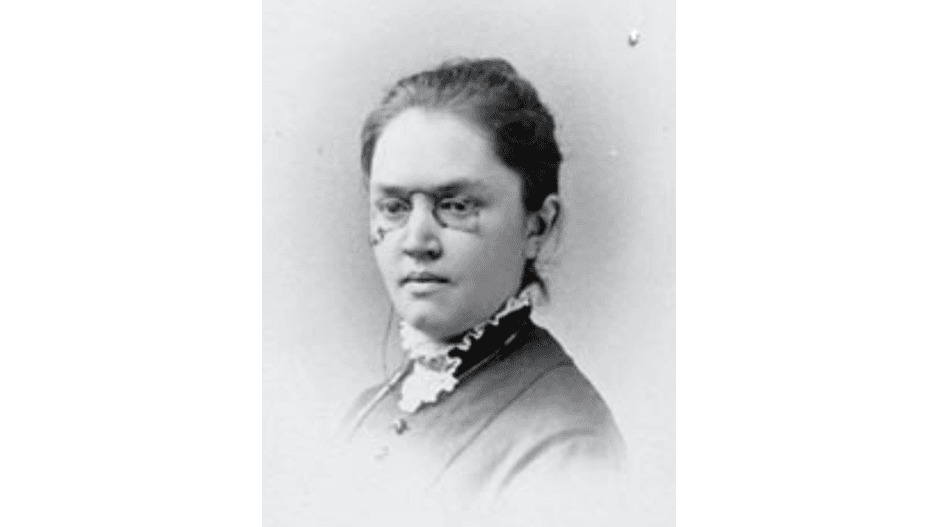
From an early age, she was interested in writing, and she started to journal at age 6. She called herself “a shy, near-sighted child, always hiding away with a book.” Although her characteristic pince-nez were never absent in photographs, her nearsightedness didn’t keep Bates from exploring the world.
Wellesley College
Bates followed in the footsteps of her relatives in pursuing higher education. She attended Wellesley High School and Newton High School before entering the learning institute that would shape the rest of her life—Wellesley College. She entered this newly formed female college in 1876 as part of its second full class, which consisted of just 43 students.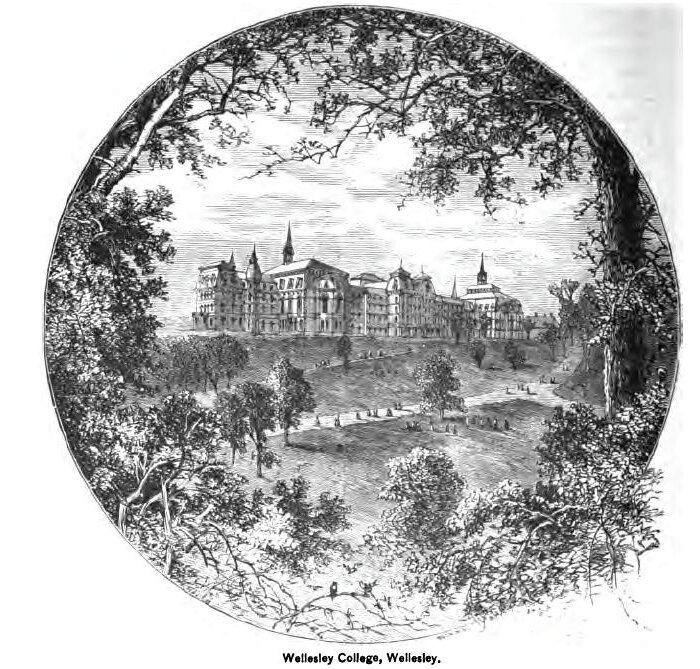
She graduated in 1880 with a Bachelor of Arts degree and taught at various schools for the next decade. However, Bates continued her education at Oxford University in England from 1890 to 1891, with prize money awarded to her for a young adult novel.
After returning from her studies abroad, Bates became an associate professor at her alma mater. She eventually became an English literature professor after gaining her master’s degree at Wellesley.
In this book, she divided her native country’s history into six lengthy chapters covering three periods and discussed the social and literary circumstances of each. Through biographies of and quotes from the finest writers on American soil, Bates demonstrated the creativity and artistry that this land of liberty breeds. She summed up her thoughts on that matter in the book’s introduction:
More Than ‘America the Beautiful’
Although it was undeniably her most famous work, “America the Beautiful” wasn’t Bates’s only literary output. Before and during her long tenure at Wellesley College, she penned novels, short stories, editorials, articles, and poetry.During the Spanish-American War, she was a war correspondent for the New York Times. She fought bigotry against Spaniards in her reporting. She also wrote a 1900 travelogue for the publication, “Spanish Highways and Byways.” In 1930, she published “An Autobiography, in Brief, of Katharine Lee Bates.”
Although she never married, Katharine Bates is credited with popularizing one of the most beloved wives in children’s tales—Mrs. Claus. Her Yuletide poem “Goody Santa Claus on a Sleigh Ride” appeared in her 1889 collection “Sunshine and other Verses for Children.”
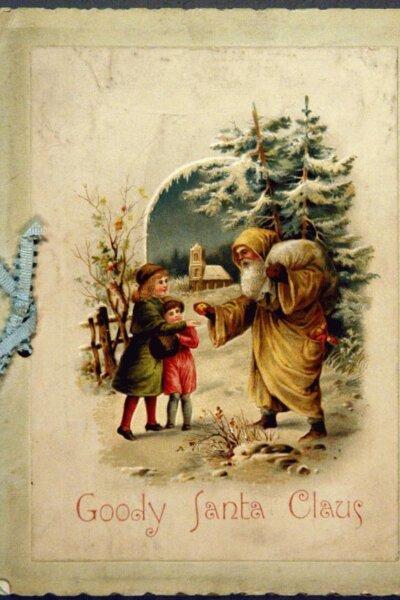
It’s an appeal to Old Saint Nick in the first person from his own wife, whose first name seems to be Goody. Mrs. Claus does the work all year long of tending their magical groves, which grow not only Christmas trees but toys. Now, she wants to join her husband on his Christmas Eve sleigh ride. It’s a delightfully whimsical poem with very cleverly turned phrases that thinly veil a plea for women’s equality.
Many the lands that the true-hearted honor; Many the banners that blow on the sea; Ah, but one country, —God’s blessing upon her!— Ah, but one only is precious to me; Dear for her mountains, rock-based, cloudy-crested, Hooded with snow ‘mid the ardors of June, -Haunts where the bald-headed eagle has nested, Staring full hard on his neighbor, the moon;
This poem is incredibly poignant today because its author didn’t whitewash America’s darker chapters. Ever the champion of social reform, later in the poem Bates bemoans “the blots that bestain her Beautiful vestments, that sully the white.” She would give her own blood if, by doing so, she “could purge her forever From shame of the Indian, shame of the slave.”Nevertheless, this acknowledgement of the great nation’s flaws comes from humility and love, not bitterness and acrimony. She ends this poem with the beautiful line: “So shall thy children yield loyal devotion,/All for the love of mine own countrie.”
Bates found her true love and vocation in devotion to her country, to which she pledged herself through writing and teaching. She knew no better way than the cultivation of American literature to serve the country, which she called “my mother and my queen.”