While it wasn’t until the Civil War that slaves were freed throughout the nation, many slaveowners freed their slaves decades earlier in Northern states. These freed men and women occupied an interesting role in late 18th- and early 19th-century communities.
Some blacks of this time period, both enslaved and free, managed to flourish with creativity, leaving a rich imprint on the budding American culture even as their contributions were underacknowledged.
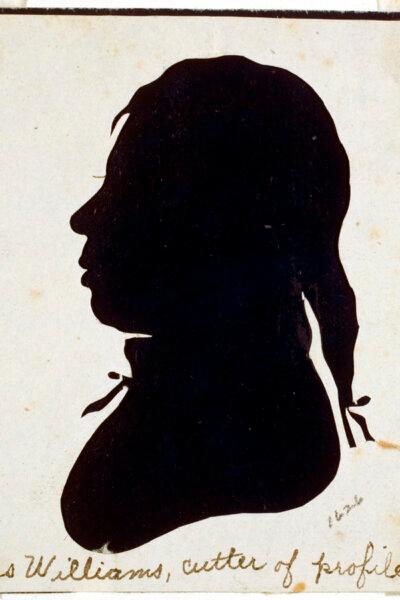
One black artist in New England was born into slavery in the household of a very artistic family. Despite his enslaved status, this boy was raised alongside the master’s children. By mastering a profitable artistic skill, Moses Williams (circa 1777–1830) was able to purchase his freedom.
Humble Beginnings
Moses was born around the year 1777 in Philadelphia though some sources suggest he was born as early as 1775. His parents, Scarborough and Lucy, were both slaves who belonged to Charles Willson Peale, the most successful portrait painter in colonial America.Peale acquired them sometime between 1769 and 1775 as payment for a portrait of their previous owner in Annapolis, Maryland. Some sources state that the infant Moses was part of this acquisition, but he was most likely born in the Peale household.
Although the mixed-race couple originally had the surname Peale, Scarborough changed not only his last name but his first name upon receiving his freedom, becoming John Williams. His son would also adopt the surname Williams when he was freed years later.
In 1780, Pennsylvania passed the Act for the Gradual Abolition of Slavery, a law aimed at gradually eliminating slavery in the newly independent nation. Rather than immediately freeing all slaves, this law required that slaves be freed at age 28.
Lucy and Scarborough were freed in 1786, leaving their son in the Peale household. It’s unclear how involved they remained in their son’s life as he was compelled to work for Peale until his own 28th birthday.
The 18th Peale Child
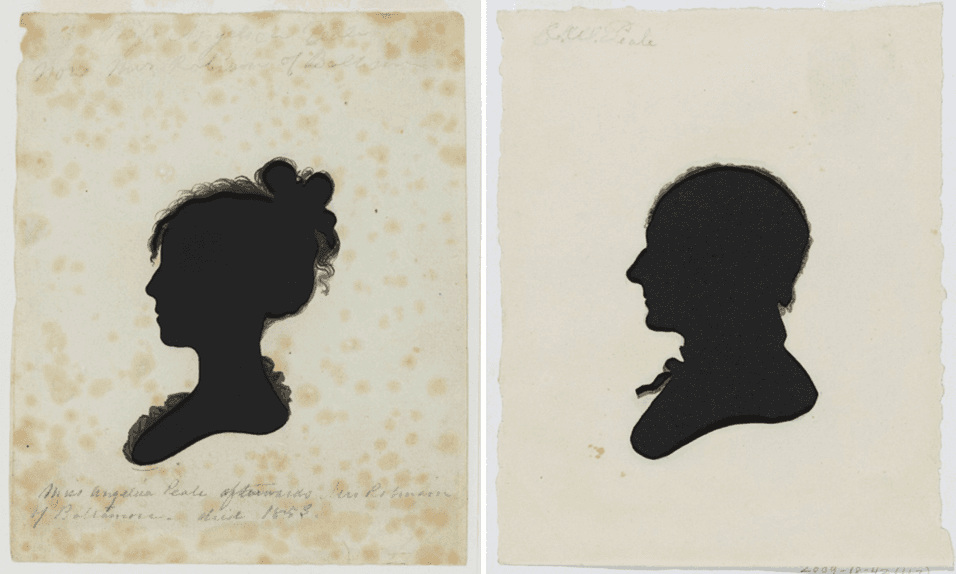
By all indications, Moses was the only slave owned by Peale after his parents were freed. Although there’s some evidence that Peale accepted other slaves as payment for his paintings, they doubtless were freed shortly after 1780.Moses, who was around the age of Peale’s oldest children, could be considered the 18th child in the Peale family. (Peale had 17 biological children from his first two of three wives, although only 11 lived to adulthood.)
Peale didn’t have a plantation; he had a museum. The family lived in the Philosophical Hall, a building which was also home to Peale’s Philadelphia Museum, the first museum in the United States.
Rather than picking cotton or tending livestock, Moses worked in the museum, helping Peale preserve specimens, display artwork, label collections, and create profitable attractions. He did this work alongside Peale’s children.
Interestingly, Moses was of mixed race, as Willson Peale frequently referred to him as “my Molatto Man Moses.” Yet Willson Peale was not claimed to be Moses’s biological father. Peale’s correspondence indicates that he often gave Moses as much regard as his own children, sparking suppressed resentment from his son Rembrandt. The lack of clarity surrounding the dates of Moses’s birth and his parents’ acquisition by Willson Peale makes it difficult to determine whether that’s even a possibility.
The Physiognotrace
Willson Peale named his children after famous artists and great thinkers, and he gave them the artistic training to try to live up to those names. Moses, too, received training in an art form, although he wasn’t allowed to learn the more refined and profitable discipline of painting.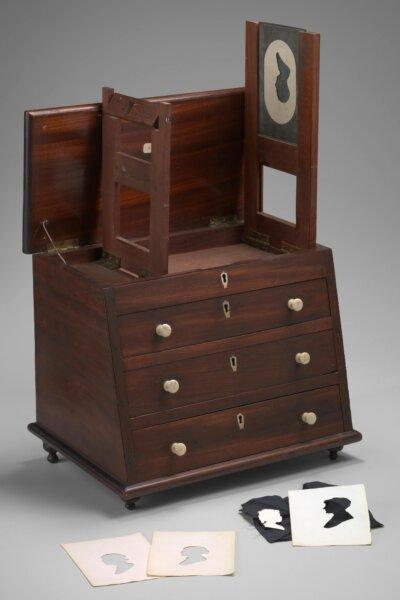
Instead, Willson Peale taught him how to use the physiognotrace to produce silhouettes. This machine was a mechanical drawing device used to trace the outline of the sitter’s features. The machine created a silhouette which was more accurately to life than the artistic interpretation of a painting.
This technology was the forerunner to photography, which would be developed a few decades later.
In the early 19th century, Willson Peale had a physiognotrace installed at his museum. Rather than just a piece of equipment to produce artwork, this machine became a display in itself. Like it was an antique photobooth, visitors would pay the machine’s operator 8 cents to produce their silhouette.
While Rembrandt Peale became an excellent portraitist, Raphaelle (the oldest son) an expert at still life, and Rubens (another son) an accomplished naturalist, Moses became the family’s best silhouette maker.
Willson Peale taught him how to use the machine, and Moses quickly became so proficient at it that no one could equal his skills. In an 1803 letter to Raphaelle, Willson Peale recounted an encounter with a bigoted visitor from the South.
Buying His Freedom
Moses became so successful as a silhouette maker that he was freed a year early, at the age of 27. The date of his manumission is consistently listed as 1802, which would support the 1775 birth year. Whether he bought his freedom or was given it by Willson Peale because of his skills is unclear.Rembrandt later recalled:
“[Moses] took a fancy to amuse himself in cutting out the rejected profiles made by the machine, and soon acquired such dexterity and accuracy, that the machine was confided to his custody with the privilege of retaining the fee for drawing and cutting. This soon became so profitable, that my father insisted upon giving him his freedom one-year in advance.”
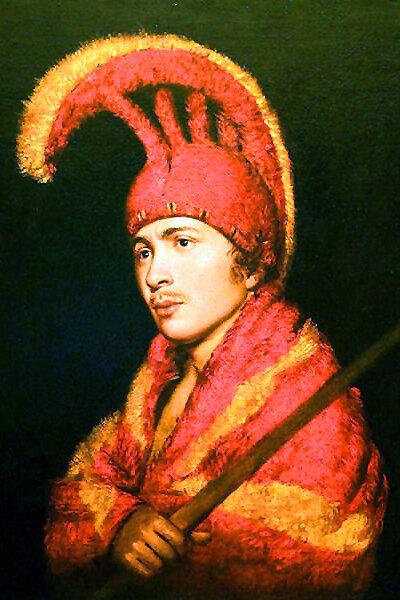
Moses worked at the Museum for years; he received instruction in taxidermy, animal husbandry, and object display. He also dressed as other ethnicities for theatrical purposes, including as a Hawaiian chief for a painting and as an Indian to hand out playbills for an exhibit.
In 1802, Moses set up a shop in the Peale Museum, where it became one of the museum’s greatest attractions. Around 80 percent of visitors had their silhouettes executed by Moses, who produced over 8000 silhouettes over the years.
These silhouettes were rarely signed, so it’s difficult to say for certain who the artist was, but there’s a great likelihood that any silhouette stamped for the Peale Museum was Moses’s work.
After a few years, Moses had earned enough money to buy his own two-story house in Philadelphia. He married the Peale family’s cook, a white woman named Maria, and they had several children.
Sadly, as the popularity of silhouettes waned in the 1820s, so did Moses’s business. By 1823, he had to sell the house. Little is known of his last years, and the date of his death is uncertain.
Moses Williams was unacknowledged as a member of the great Peale art dynasty until the 1990s. Since then, people have acknowledged and explored his contributions to the American art scene and the developing technology, which would pave the way for photography.
He remains a great example of someone who showed impressive talent and skill even in difficult circumstances.