This copy is for your personal, non-commercial use only. Distribution and use of this material are governed by our Subscriber Agreement and by copyright law. For non-personal use or to order multiple copies, please contact The Epoch Times Reprints.
Coming just three years after a 1950 film by director David Bradley, the second screen adaptation of Shakespeare’s immortal play “Julius Caesar,” by director Joseph L. Mankiewicz, is considered the more intense effort.
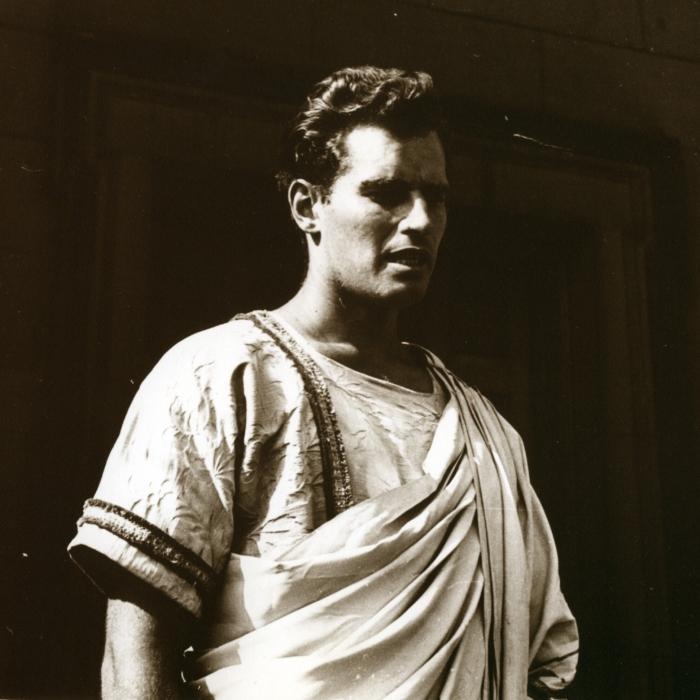
Roman senators weigh the enviable ascent of the man about to be crowned emperor: Julius Caesar (Louis Calhern). One camp, led by orator Brutus (James Mason), believes that Caesar’s ambition is too dangerous. The hero must be snuffed out, if necessary, by his death. Another camp, led by military commander Mark Antony (Marlon Brando), believes that Caesar’s statesman-like nobility and soldierly valor deserve nothing short of the crown.
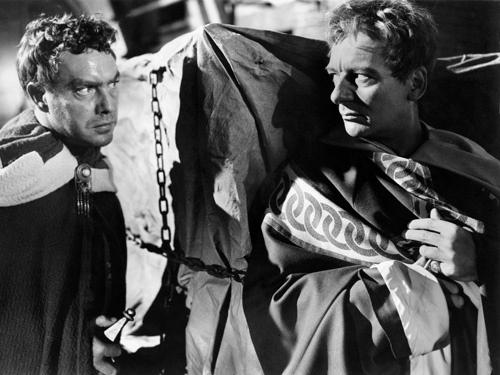
Co-conspirators Cassius (John Gielgud) and Casca (Edmond O’Brien) share Brutus’s intent, although they’re driven by envy, not the common good. Daggers at the ready, they set a date for the assassination.
Conspirators Casca (Edmond O'Brien, L) and Cassius (John Gielgud), in “Julius Caesar.” Metro-Goldwyn-Mayer
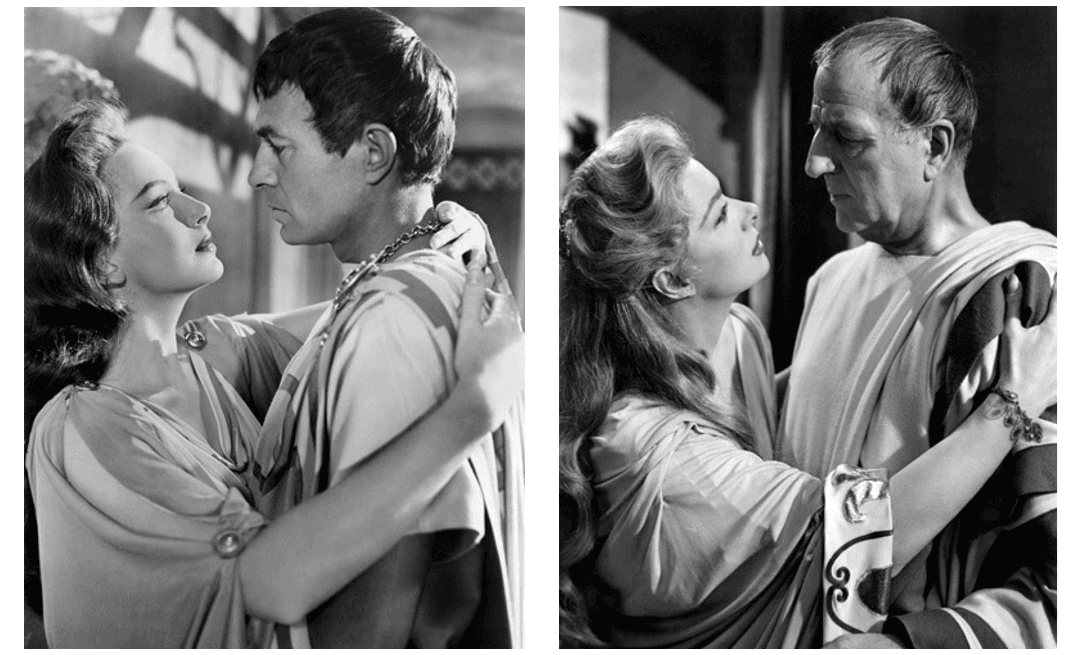
Brutus’s wife, Portia (Deborah Kerr), and Caesar’s wife, Calpurnia (Greer Garson), suspect something’s off. Portia tries extracting from Brutus what he’s hidden from her. Calpurnia’s dream warns that unless Caesar stays hidden from public view, he’ll be killed. Caesar first defers to Calpurnia, but his pride gets the better of him. He swaggers toward the senate, and then falls to the blades of his assassins.
The Ides of March
That hurls Rome to the brink of a public uprising. It’s up to noblemen Brutus and Antony to sway the minds of commoners. Brutus claims to have acted on the people’s behalf, implying that they’re unable to think or act for themselves.
Antony asks them to reclaim their ability to think and act for themselves. Will stirring speeches in the public square inspire acquiescence to the assassins? Or provoke retribution?
(L) Portia (Deborah Kerr) and her husband, Brutus (James Mason), and (R) Calpurnia (Greer Garson) and Julius Caesar (Louis Calhern), in “Julius Caesar.” Metro-Goldwyn-Mayer
Both Gielgud and Mason stood 5 feet, 11 inches tall; and Calhern towered, being nearly 6 feet, 2 inches tall. Although relatively muscled and bull-necked, Brando was a mere 5 feet, 9 inches tall, but he compensated for that with his charisma and his physicality. All he had to do was flash a thick forearm here, clench a fist there, spread his massive chest, or square his broad shoulders. Even silent, he steals scenes from these stage veterans. O’Brien pulls off the haunted look he’d reprise later in “1984,” here as a guilty man, there as an innocent one.
Mankiewicz mixes his medium shots with medium close-ups to break the monotony of soliloquies and monologues. This showcases Shakespeare’s ability to convincingly flesh out both prosecution and defense. The director also spotlights Shakespeare’s penchant for puns (a cobbler smilingly, philosophically calls himself a mender of bad “soles”) and sarcasm (Antony’s reference to the assassins as “honorable” men).
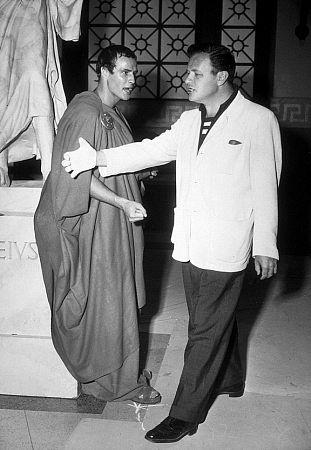
Marlon Brando (L) and director Joseph L. Mankiewitz on the set of "Julius Caesar." Metro-Goldwyn-Mayer
Through his brief but incisive portraits of Portia and Calpurnia, Shakespeare implies that it is womanliness that enables womanly intuition. To shun the feminine sixth sense, as Caesar does, amounts to the numbing of a vital part of what makes women unique, that is, their gift for seeing before seeing, as it were.
Shakespeare implies that sight lies not in seeing alone, but in seeing the truth. Cassius, blind to his own ambition, offers himself as a mirror, a “glass,” a conscience of sorts to Brutus. Unable to truly see, Brutus accepts him as such. The beggarly soothsayer sees without seeing; blind, he truthfully foretells danger.
Perils of Freedom of Expression
It’s tempting to read this film purely as a commentary on political power, legislative or executive. But Shakespeare and Mankiewicz seem concerned with a more primeval power: the power of words and actions. Caesar is more of a supporting character; the protagonists are power brokers wielding the clout to articulate, or distort, the public will.
The words “ambition,” “tyrant,” “senate,“ ”senator,” “crown,” or “power” appear some 50 or so times in the screenplay. In contrast, “word(s),“ “speak,” “orator,” “oration,” and “speech” appear more than twice as often.
(L–R) Julius Caesar (Louis Calhern), Mark Antony (Marlon Brando), Calpurnia (Greer Garson), and Portia (Deborah Kerr), in Shakespeare’s “Julius Caesar.” Metro-Goldwin-Mayer/MovieStillsDB
Watch for entreaties that Antony or Brutus speak or be silenced. The film seems concerned with the powers (and perils) of freedom of expression. Rightly, Mankiewicz centers how this pillar of democracy can be used or abused.
This freedom can instill patriotism, duty, and honor, or incite violence by appealing to loyalty. Human freedoms are, by their finite and imperfect nature, incomplete. They are derived, not absolute freedoms. The degree of freedom to speak and act depends on the degree to which such speech and action is responsible, restrained, respectful.
To the extent it’s abused, to that extent it becomes enslavement to whim, to self-interest, to malice. It is the opposite of freedom, especially when one’s otherwise rightful speech and action endangers other lives or liberties.
Remember, John Wilkes Booth believed that his assassination of Abraham Lincoln was no less honorable than Brutus’s of Caesar. Following his brutal action, like Brutus, the unseeing Booth too uttered the word “freedom.”
You can watch “Julius Caesar” on Amazon Video, Apple TV, and Spectrum.
‘Julius Caesar’
Director: Joseph L. Mankiewicz
Starring: Marlon Brando, James Mason
Not Rated
Running Time: 2 hours
Release Date: June 3, 1953
Rated: 4 stars out of 5
What arts and culture topics would you like us to cover? Please email ideas or feedback to [email protected]