




French painting during and after the reign of King Louis XIV presents a stark contrast. This era, referred to as the rococo, emerged from the opulence of the baroque like a breath of fresh air with its light, airy colors and pastoral settings. The dominant style departed sharply from dramatic historical and mythological scenes and formal portraiture.
Zenith of the Sun King
On March 17, 1677, King Louis XIV stood on the battlefield and watched his forces lay a swift siege to the Flemish city of Valenciennes. Part of Louis’s vision for the “Frontière de fer” or “iron border,” Valenciennes was refortified in the French style of bastion star forts, of which more than 30 now spanned 160 miles between France and the Spanish Netherlands.Ensuring a rapid transition to French administrative systems and forced cultural assimilations, the decisive victory came in the peak years of Louis’s military supremacy before its slow decline from 1685 to 1715. Jean-Antoine Watteau (1684–1721) grew up in the annexed city during this power shift.
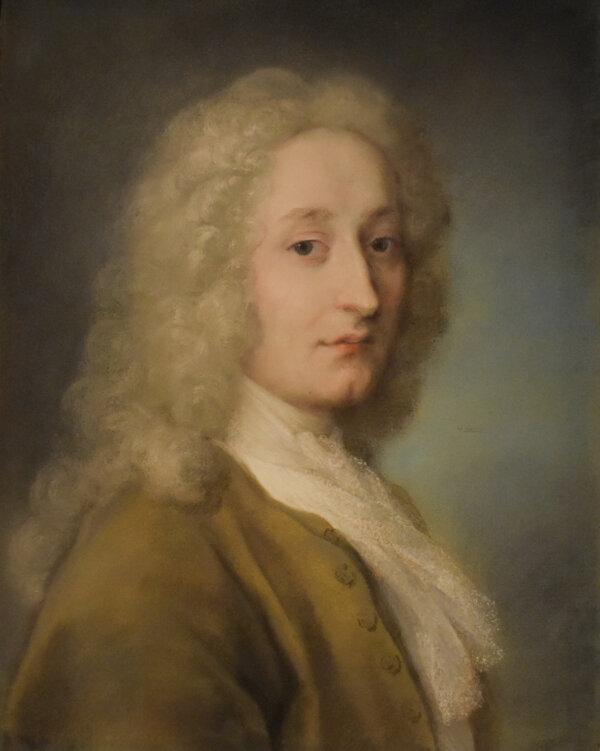
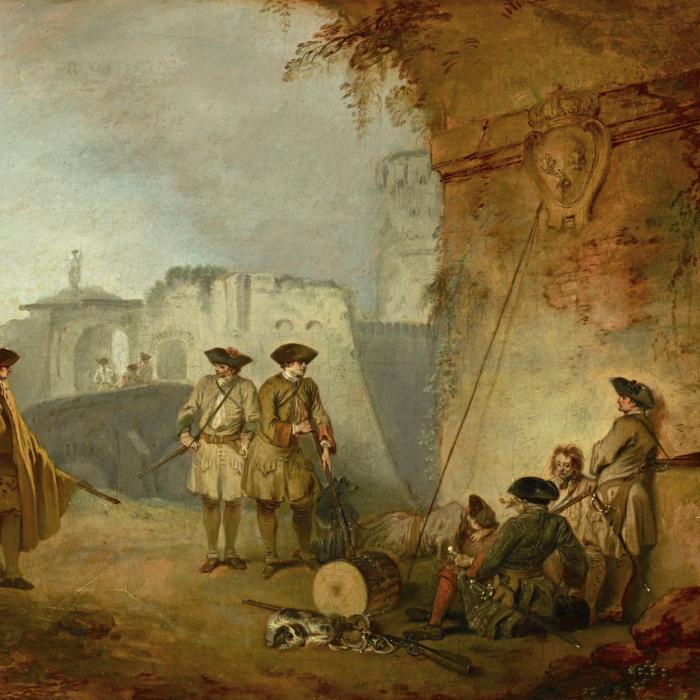
A quiet, keenly observant child, Watteau’s early paintings documented this military occupation and offered a novel depiction of its soldiers. Neither glorified nor vilified, they appear exhausted and melancholy, reflecting the fatigue shared by soldiers and civilians after decades of Louis’s campaigns. Watteau’s eye for detail captured the conflict between his subjects’ outward gestures and inner emotions.
His decision to move to Paris in 1702 led him to the teacher who would most inspire his examinations of human behavior, both superficial and penetrating. Watteau’s apprenticeship with Claude Gillot (1673–1722) introduced him to new painting techniques and the colorful characters of the Italian theater troupes known as Commedia dell’Arte.
Dating as far back as the mid-16th century, the wagons of bawdy, somewhat improvised shows had outgrown their collapsible stages and moved into the Hôtel de Bourgogne, the oldest theater in Paris. While professional actors had previously existed in Greece and Rome, the Commedia dell’Arte troupes marked the beginning of acting as an established profession and industry.
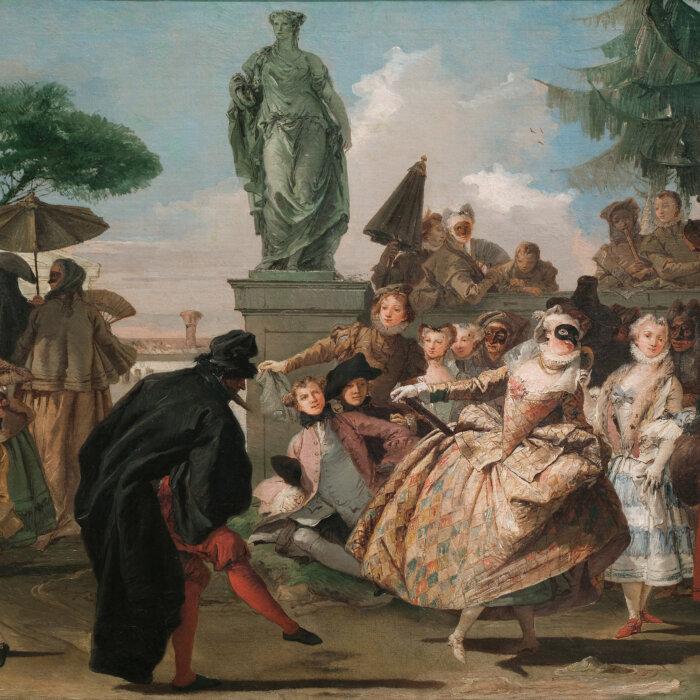
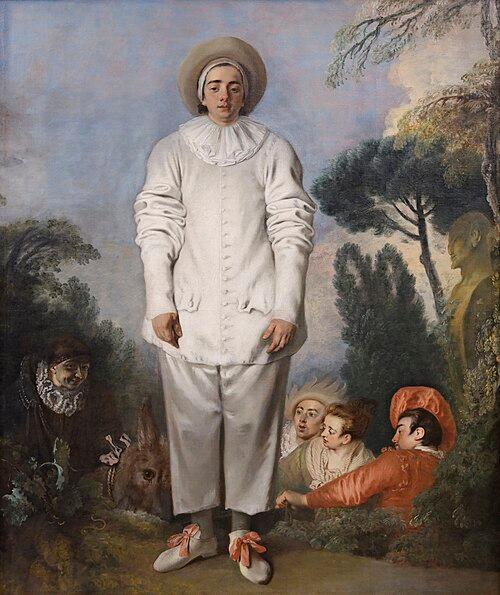
Each show had a cast of recognizable stock characters such as Pantalone, a grumpy, wealthy old man, Colombina, a sly, witty servant girl, Arlechinno, who inspired the iconic jester character of Harlequin, and his counterpart, the sad clown usually dressed in white known as Pedrolino, Pagliacco, or in France, Pierrot.
Twilight of the Sun King and Dawn of the Rococo
On Sept. 1, 1715, four days before his 77th birthday and after a reign of 72 years, Louis XIV finally surrendered his life and legacy of dominance. His deathbed counsel was for the country to go to war as rarely as possible, to spare people much suffering. The Fronde uprisings Louis had survived in his youth had prompted his demand for absolute monarchy and his self-ascribed moniker of “Sun King.”During his final four decades, France’s aristocracy rotated through Versailles, pining for favor and influence. Though the court made inestimable contributions to French culture—the royal academies of architecture, science, letters, dance, painting, sculpture, and music—Louis’s complete control over these institutions ensured their innovations would be limited to his taste.
In the years following his death, Versailles’ centralized power dissolved, restoring political and cultural influence to the aristocracy. Celebrations erupted across France with art, music, and literature all enjoying a newfound sense of freedom. For Watteau, this monumental revival of creative liberty came at a time when the Royal Academy of Painting and Sculpture had already recognized his talent. For three years, they had been awaiting the completion of a work that would secure his membership.
If Botticelli’s “Birth of Venus” can be recognized as one of the Italian Renaissance’s seminal masterpieces, it should be no surprise that Venus would once again inspire Watteau’s seminal masterpiece of the rococo. Though the painting he submitted to the academy in 1717 was neither a traditional history painting nor a genre painting of everyday life, it still possessed an allegorical quality in its depiction of a procession of lavishly-dressed romantic couples.
The couples move from right to left, escorted by angels and cherubs, through a lush Arcadian landscape toward a gilded boat adorned with sirens’ sculptures. In the frame’s lower right corner, beneath a bust of Venus, a child sitting on a quiver of arrows, presumably Cupid, tugs at the skirt of the last woman in the procession. They remain seated, anchoring the narrative.
The sense of movement throughout the composition clearly shows the couples moving from right to left, away from the viewer and into the distance. At the same time, many of the faces look over their shoulders, back to the point of origin beneath the bust of Venus. Scholars have no consensus on whether the couples are departing or returning. Yet, in either context, there is an undeniable sense of growing intimacy as the couples, one by one, become physically closer, from sitting side by side to entwining arms as they approach the gilded boat.
Putting the B in Subtle
The academy’s records listed this painting’s original title as “le Pèlerinage à l'isle de Cithere” or “The Pilgrimage to the Island of Cythera.” As the fabled home of Venus, Cythera became a popular allusion in France to love and courtship. The records later show the title crossed out and replaced with “festes galant.” Translating to “courtship party,” the term had previously described events and performances, but never a painting. Its spelling later evolved to “fête galante,” which became an increasingly common category in the academy’s records for works by many of Watteau’s contemporaries depicting similar scenes.The style became so popular that 19th-century scholars argued the academy had created an entirely new category of painting with Watteau’s pilgrimage. While that claim is now considered an oversimplification, scholars agree that Watteau’s fêtes galantes stand apart for the emotional depth of their figures. Whereas many later rococo pastoral and Arcadian scenes have been described as lush and beautiful but frivolous, Watteau approached his fête galante settings with the same sincerity as his earlier paintings of soldiers. Amid the colorful revelry, shades of nostalgia and melancholy are never far away.
With Pierrots among Harlequins, Watteau portrayed the newly liberated aristocracy with unusual insight. France’s dominant position in Europe faded with the passing of its powerful king, and Louis XV was constantly at odds with the nobility as he tried to replenish the depleted treasury through new taxes. For aristocrats and commoners alike, the moment was celebratory, but the future remained uncertain.
Watteau captured that tension with a blend of vibrant theatricality and soulful sincerity unmatched by his contemporaries. Before dying of tuberculosis at 36, he had already earned recognition as one of France’s most promising artists.

_The_painter_Antoine_Watteau_by_Rosalba_Carriera_-_Museo_civico_di_Santa_Caterina.jpg)