This copy is for your personal, non-commercial use only. Distribution and use of this material are governed by our Subscriber Agreement and by copyright law. For non-personal use or to order multiple copies, please contact The Epoch Times Reprints.
Isabella Stewart Gardner Museum: Lush and Lavish City Oasis
A nondescript, square brick building belies the opulence expressed in the interior of this installment of ‘Larger Than Life: Architecture Through the Ages.’
A brick façade and chimneys, terracotta-tile roof, and tall, rectangular windows are the main architectural features of the original Isabella Stewart Gardner Museum building. Inside, art and furnishings represent primarily Gothic and Renaissance revival styles from circa 20 B.C. to the late 19th century. The exterior materials are chiefly 20th century and American made. From this view, the plain, square, exterior is adorned only by upper-level iron balconies and balconettes and a protruding “Y” design that frames a top-floor, canted-bay window. Beyond My Ken/CC BY-SA 4.0
On the Fenway, surrounded by colleges and universities in busy Boston, is what appears to be a building of simple architectural design. The structure was built by New England architect Willard Thomas Sears (1837–1920), who designed Gothic and Renaissance revival buildings. While the exterior of the Isabella Stewart Gardner Museum conveys some aspects of the Gothic Revival style, it’s the interior—built in the Venetian style of a 15th-century palace—that wows visitors.
Although former grand residences throughout America often become museums, late-19th-century socialite Isabella Stewart Gardner and her husband, John, envisioned a newly erected museum to house not only their vast and varied collection, but also serve as a cultural center for musical and artistic events. John passed away before the structure’s construction began in 1898. But after it was completed in 1901, it thrived under Isabella’s guidance for the next 23 years.
Gardner made it clear in her will that no lasting changes could be made to the museum; therefore, the structure serves as a time capsule of Gothic and Renaissance Revival design. Rooms convey medieval nobility through elements such as red wall coverings, wood-dense rooms, floor-to-ceiling tapestries, ceramic tiles, Moorish-arch windows, and quatrefoil arches.
Most stunning is its centerpiece courtyard, lush with vegetation and Venetian-inspired design elements, including statuary, a glass-and-steel atrium roof, and four stories with Gothic windows and arches.
Originally known as Fenway Court, the Isabella Stewart Gardner Museum is worth visiting for its art collections as much as for its architecture.
The architectural palette for the plethora of plants inside the museum’s courtyard includes eight stone balconies acquired in Venice, as well as a central patio of mosaic tiles purchased in Rome. Assisting with the landscape design in the first-floor courtyard, which is essentially a giant greenhouse, was America’s famed landscape architect Frederick Law Olmsted, responsible for New York City's Central Park, among many other noteworthy sites. Prominent among the flowers, ferns, vines, and orchids are such pieces as a Greek sarcophagus for a child from A.D. 250 and a 20 to 50 B.C. Greek sculpture thought to represent the Greek goddess Persephone. (Amoran002/CC-BY-SA-4.0)
Called the Dutch Room, due to its focus on such portraitists as Peter Paul Rubens, Albrecht Dürer, and Hans Holbein, its light flows through windows framed by Gothic pointed arches and columns. The south wall, visible here, showcases a 19th-century German walnut chest. Over it hangs a 17th-century portrait by Peter Paul Rubens of Thomas Howard, Earl of Arundel. The floor is fashioned of glazed terracotta tiles made in Doylestown, Pa., but handcrafted to be irregular and resemble the floor of a medieval castle. Isabella Stewart Gardner Museum, Boston
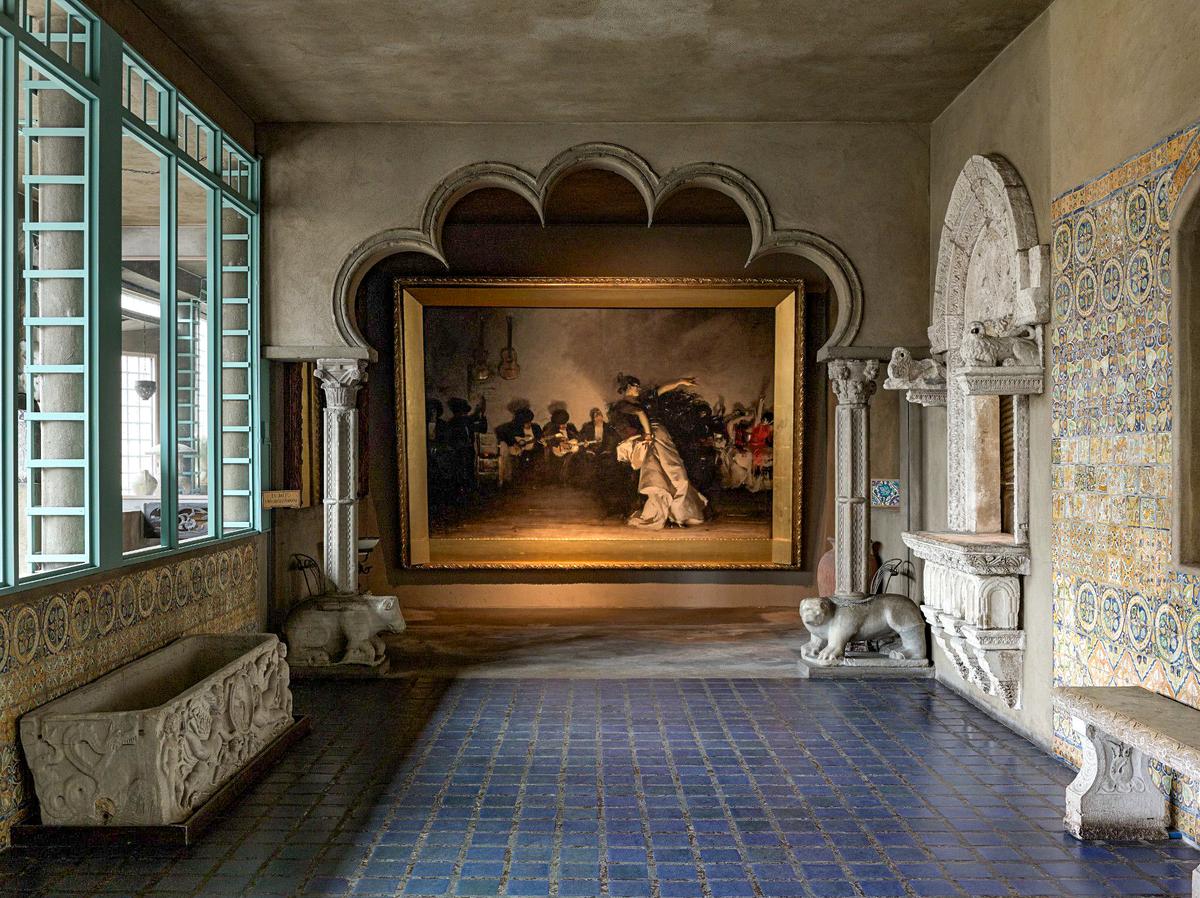
Featured within the museum’s many rooms are more than 7,500 paintings, sculptures, textiles, furnishings, and ceramics from around the world, including this 11-foot, 6-inch wide painting by the famed artist John Singer Sargent. Titled “El Jaleo,” due to its focus on an Andalusian dance, the 1882 painting is featured in the museum’s Spanish cloister’s niche. It's set off by a Moorish, quatrefoil arch and 13th-century marble columns acquired in Italy. On the cloister’s floor are blue tiles manufactured in Massachusetts in 1914, while the decorative, glazed, ceramic wall tiles were made in Mexico in the 17th century. Isabella Stewart Gardner Museum, Boston
Some of the museum’s finest masterpieces, including “The Rape of Europa” by the Venetian artist Titian, are on display against scarlet wallpapered walls in the Titian Room. The famous Titian painting occupies a portion of the left side along the room's east wall. Over a decorative door frame is the 16th-century Vincenzo Catena painting “Christ Delivering the Keys to Saint Peter.” The marble-topped table with an ornately carved wood base and legs is Italian, from the 1700s. Isabella Stewart Gardner Museum, Boston
The Veronese Room is unique due to its walls. They are covered with stamped and painted leather panels from Spain, Italy, and the Netherlands, arranged as if they were tiles. This view of the room features the prominent portrait of Pietro Pisani, procurator of St. Mark’s Basilica, by Italian artist Niccolò Cassana. The floor is a parquet design of hardwoods. Sintakso/CC-BY-SA-4.0
Gardner esteemed the paintings by Renaissance master Raphael so highly that she named one of the museum’s rooms after him. The room is a tribute not only to Raphael’s achievements but also to the works of 15th and 16th-century Italian painters and sculptors. Regal reds are the complementary décor for such works as the “The Story of Lucretia, by Italian painter Sandro Botticelli; it's on the wall to the left of the 15th-century, Italian, hooded limestone fireplace with tapestry-like screens. Situated in front of the fireplace are two 18th-century Venetian chairs covered in velvet. Sintakso/CC-BY-SA-4.0
What arts and culture topics would you like us to cover? Please email ideas or feedback to [email protected]
A 30-plus-year writer-journalist, Deena C. Bouknight works from her Western North Carolina mountain cottage and has contributed articles on food culture, travel, people, and more to local, regional, national, and international publications. She has written three novels, including the only historical fiction about the East Coast’s worst earthquake. Her website is DeenaBouknightWriting.com