Early in his career, 18th-century sculptor Antonio Canova became known for reviving the heritage of ancient Greek sculpture. Some, at the time, even called him the modern Phidias (circa 480 B.C.–430 B.C.). According to legend, only the preeminent Greek sculptor Phidias had seen the exact image of the gods, which he imparted to man, most famously through the Parthenon’s complete sculptural design.
Canova likely enjoyed the comparison; the Italian artist once said: “The works of Phidias are truly flesh and blood, like beautiful nature itself,” according to Jane Martineau and Andrew Robison in their book “The Glory of Venice: Art in the Eighteenth Century.”
In 1779, in his early 20s, Canova carved a marble sculpture of the mythical Greek inventor, architect, and sculptor Daedalus and his son Icarus, named after the pair. The work reflects Canova’s baroque style before he moved to Rome and became known for his neoclassical works.
In the sculpture, Daedalus carefully fashions wings for his son by binding feathers to his back with wax. Daedalus made wings for himself as well, and the pair used them to flee the clutches of King Minos. Famously, Icarus died. His father warned him not to fly too high, but he ignored the advice. His bravado enticed him to fly closer to the sun, which melted the wax holding his makeshift wings together, and he fell into the sea and drowned.
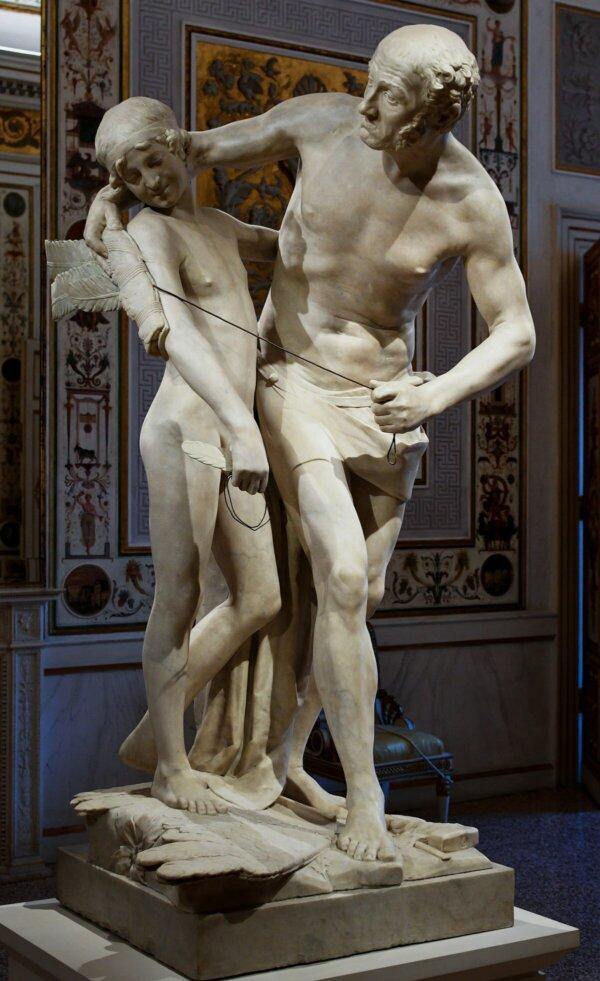
"Daedalus and Icarus," 1777–1779, by Antonio Canova. Marble; 78 1/2 inches by 37 1/4 inches by 38 inches. Correr Museum, in Venice, Italy. (Livioandronico2013/CC BY-SA 4.0)
Daedalus and Icarus fled King Minos after Daedalus helped save the life of the young Athenian prince Theseus. Daedalus gave Theseus’s beloved, Minos’s daughter, Ariadne, the secret to escaping the labyrinth of the dreaded Minotaur. The mythical beast had the body of a man and the head of a bull. Theseus entered the labyrinth after offering himself as a sacrifice to the creature.
Canova depicted Theseus and the Minotaur in 1782. In the neoclassical sculpture, Theseus towers over the Minotaur he has just slain. The work represents the contemplative mind embodied by Theseus, triumphing over the material body, represented by the dead Minotaur, according to art historian David Bindman in his 2015 Sydney J. Freedberg Lecture on Italian Art.
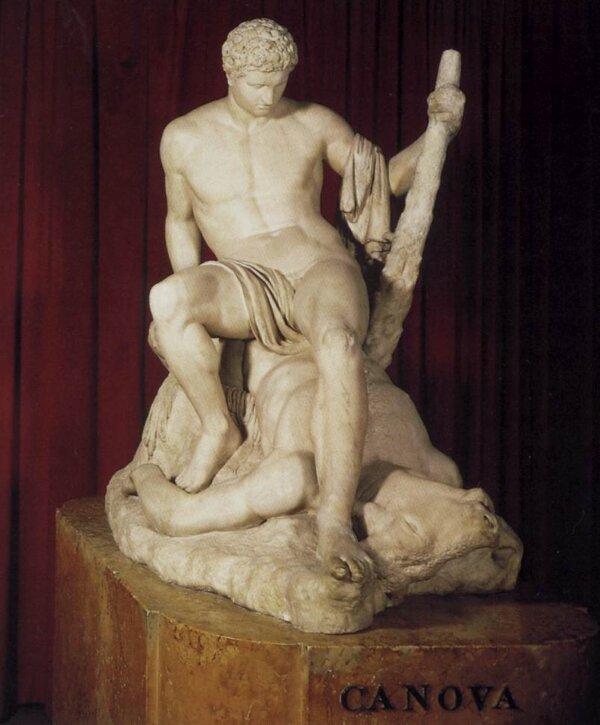
“Theseus and the Minotaur,” 1782, by Antonio Canova. Marble; 57 1/4 inches by 62 1/2 inches by 36 inches. Victoria and Albert Museum, London. Public Domain
Viewers at the time found it difficult to believe that “Theseus and the Minotaur'' was a contemporary work rather than a copy of an ancient Greek sculpture. This work, along with Canova’s first papal commission in Rome—Pope Clement XIV’s tomb (completed 1787) in the Santi Dodici Apostoli basilica—helped cement his fame across Europe.
What arts and culture topics would you like us to cover? Please email ideas or feedback to [email protected]