Few photographers have shaped the public image of a place as profoundly as Henry Hamilton (H.H.) Bennett. At a time when few Americans had seen the sculpted sandstone cliffs, narrow river passages, and striking rock formations created by Ice Age floodwaters and later shaped by the Wisconsin River, Bennett carried his cumbersome camera into the wilderness and returned with images that captivated audiences far beyond Wisconsin. His work introduced the natural beauty of the Wisconsin Dells to countless prospective travelers and helped establish the region as one of the Midwest’s earliest and most enduring tourist destinations.
Bennett was born on Jan. 15, 1843, in Farnham, Quebec. His family later settled in Wisconsin, where he learned carpentry before enlisting in the Union Army during the Civil War. Serving with the 12th Wisconsin Infantry, Bennett suffered a severe hand injury that effectively ended his career as a carpenter. Seeking another profession, he purchased a small photography studio in Kilbourn City—now Wisconsin Dells—in 1865, launching the career for which he became known.
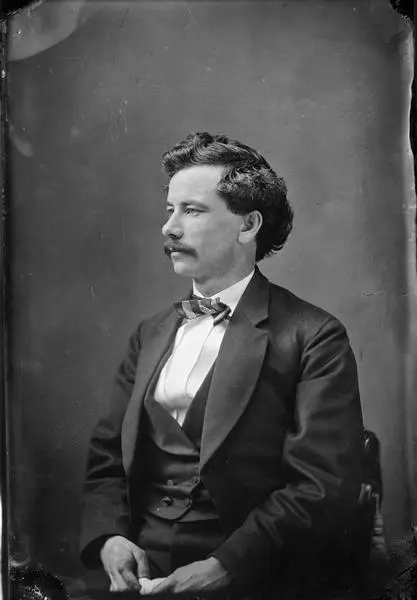
Henry Hamilton (H.H.) Bennett, whose innovative photography introduced Americans to the natural beauty of the Wisconsin Dells. Public Domain
Innovation in the Wilderness
Portrait work offered limited opportunities in a modest lumber town, prompting Bennett to turn his camera toward the spectacular scenery surrounding the Wisconsin River. Beginning in 1868, he hauled heavy cameras, fragile glass plates, chemicals, and a portable darkroom across bluffs, ravines, and wooded trails to record the Dells. Working with the demanding wet-plate collodion process meant each glass negative had to be coated, exposed, and developed while still wet, often requiring Bennett to prepare plates under unforgiving field conditions. He frequently revisited the same locations until weather, season, and light combined to produce precisely the image he envisioned. No amount of labor seemed too great in pursuit of the right view.The images quickly found an audience far beyond Wisconsin. Bennett became especially known for his stereoscopic views, paired pictures that created the illusion of three-dimensional depth when viewed through a stereoscope. During the late 19th century, stereographs ranked among America’s most popular forms of home entertainment, allowing families to experience distant scenery from their parlors. Bennett’s meticulously composed views of Stand Rock, Witches Gulch, and other natural landmarks introduced countless Americans to the Wisconsin Dells long before many considered making the journey themselves. His work is widely regarded as having helped accelerate the transformation of the Dells from a lumber community into one of Wisconsin’s leading tourist destinations.
Bennett was also inventive. Drawing upon his carpentry experience, he designed and built much of his own photographic equipment, including cameras and portable darkrooms suited for fieldwork. He also developed specialized shutters that significantly reduced exposure times, allowing him to capture movement in ways that were highly unusual for 19th-century photography. That mechanical ingenuity distinguished Bennett from many of his contemporaries and expanded what landscape photography could accomplish.
Perhaps Bennett’s most celebrated image depicts his son, Ashley Bennett, leaping across the gap at Stand Rock in 1886. The scene appeared to suspend the young man in midair, demonstrating both Bennett’s technical skill and his instinct for creating unforgettable pictures. Reproduced widely as stereographs and promotional prints, it became inseparable from the growing reputation of the Wisconsin Dells and remains one of the defining images in American landscape photography.
A Lasting Legacy on Broadway
Bennett’s business expanded alongside his reputation. In 1875, he moved into a purpose-built studio on Broadway in Kilbourn City, designed with fellow photographer William H. Metcalf. Large skylights flooded the workspace with natural light, an essential feature before electric lighting became practical for portrait photography.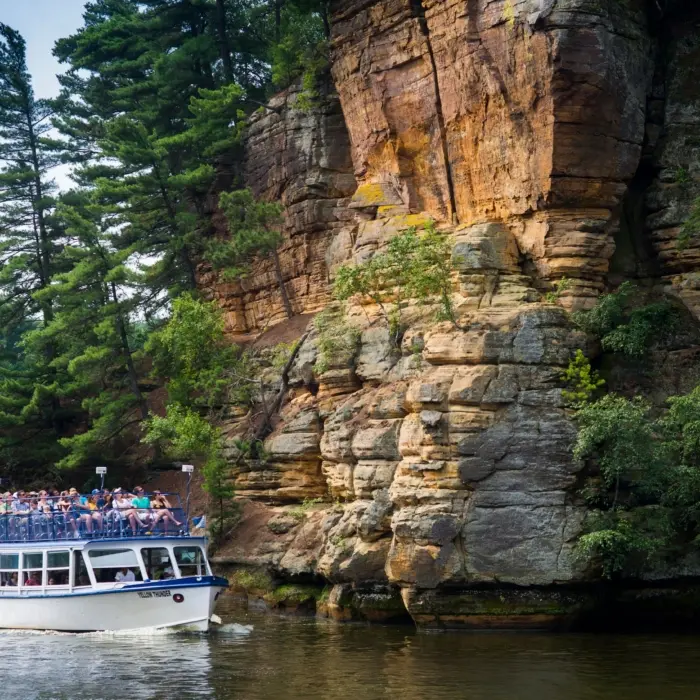
Bennett’s wives—first Frances “Frankie” Douty Bennett and later Evaline Marshall Bennett—played important roles in operating the portrait studio while he spent extended periods documenting the surrounding countryside. Visitors purchased portraits, stereographs, landscape prints, and souvenirs, making the studio an integral part of the community’s growing tourist trade.

The H.H. Bennett Studio in Wisconsin Dells, Wis., was built in 1875. From the studio, photographer H.H. Bennett helped popularize the Wisconsin Dells and pioneered photographic innovations. Today, the restored studio is operated as a museum by the Wisconsin Historical Society and is listed on the National Register of Historic Places. Public Domain
The arrival of inexpensive handheld cameras in the 1890s allowed visitors to take their own vacation photos, but Bennett adapted. He accepted commercial assignments, documented Wisconsin communities and railroads, and continued recording the state’s landscapes with the same artistic care that had long distinguished his work. Indeed, even as photography became more accessible, his images remained distinguished by their craftsmanship, careful composition, and remarkable sense of place.
Bennett died on Jan. 1, 1908, leaving behind an extraordinary legacy and a thriving family business. His descendants continued operating the studio for generations before donating it to the Wisconsin Historical Society in 1998. Today, the H.H. Bennett Studio & Museum preserves thousands of original glass negatives, cameras, and darkroom tools, safeguarding one of America’s best surviving 19th-century photographic workplaces. The studio is recognized as the oldest operating business in Wisconsin Dells. It is widely regarded as the oldest continuously operating photography studio in the United States, although a small number of other historic studios have made similar longevity claims.
Today, Bennett’s work remains an indispensable record of a landscape that has changed considerably since the 19th century. His images are admired not only for their artistry but also for the history they preserve.
He did more than document the Wisconsin Dells. He helped persuade generations of Americans that the region was worth seeing for themselves, and indeed, his visual legacy continues to shape how visitors imagine the Dells today. That enduring influence may be the clearest measure of his achievement.
What arts and culture topics would you like us to cover? Please email ideas or feedback to [email protected]