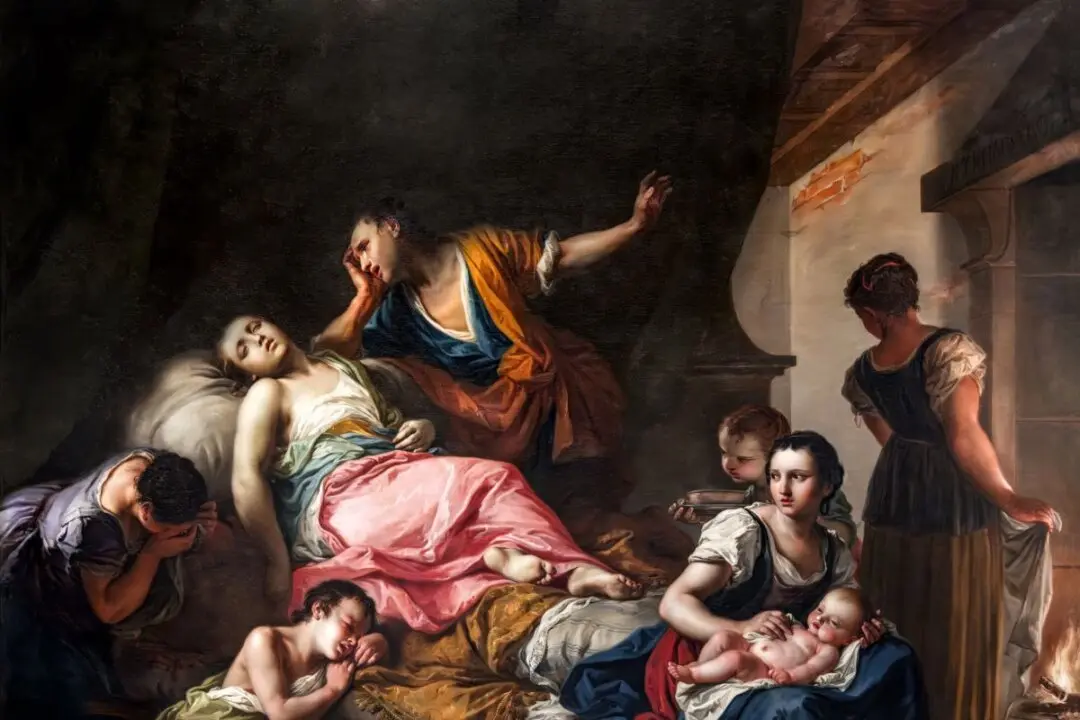
There is one thing that even the most generous heart has difficulty in giving up, and that is the will. Yet throughout history, holy men and women have agreed that surrendering our will to God is the most fundamental step toward spiritual growth.
In the Old Testament, we see that even those who were close to God, like Jacob, still wrestled with him; even some of those he called to serve as prophets, like Jonah, ran away from him. As it happens, by the time English poet George Herbert (1593–1633) was writing thousands of years later, mankind was still struggling with the same problem of surrendering to God’s will.
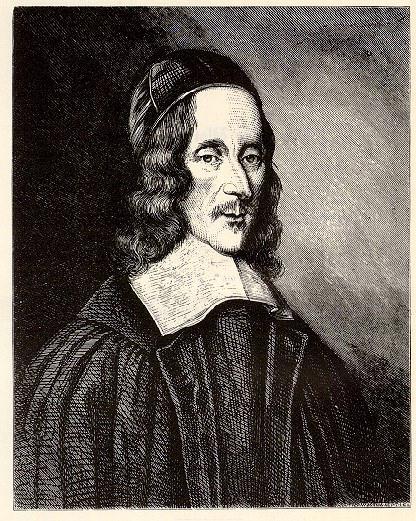
Herbert’s poem “The Collar” is a meditation on the nature of freedom, framed within the speaker’s vocational crisis. Herbert was an Anglican priest, and the title of the poem refers to the priestly collar. The title is in fact a multilayered pun and holds the key to understanding the poem. It is a reference to God as “the Caller,” to a restrictive collar limiting one’s freedom, and to the “choler” or anger with which the speaker complains against God.
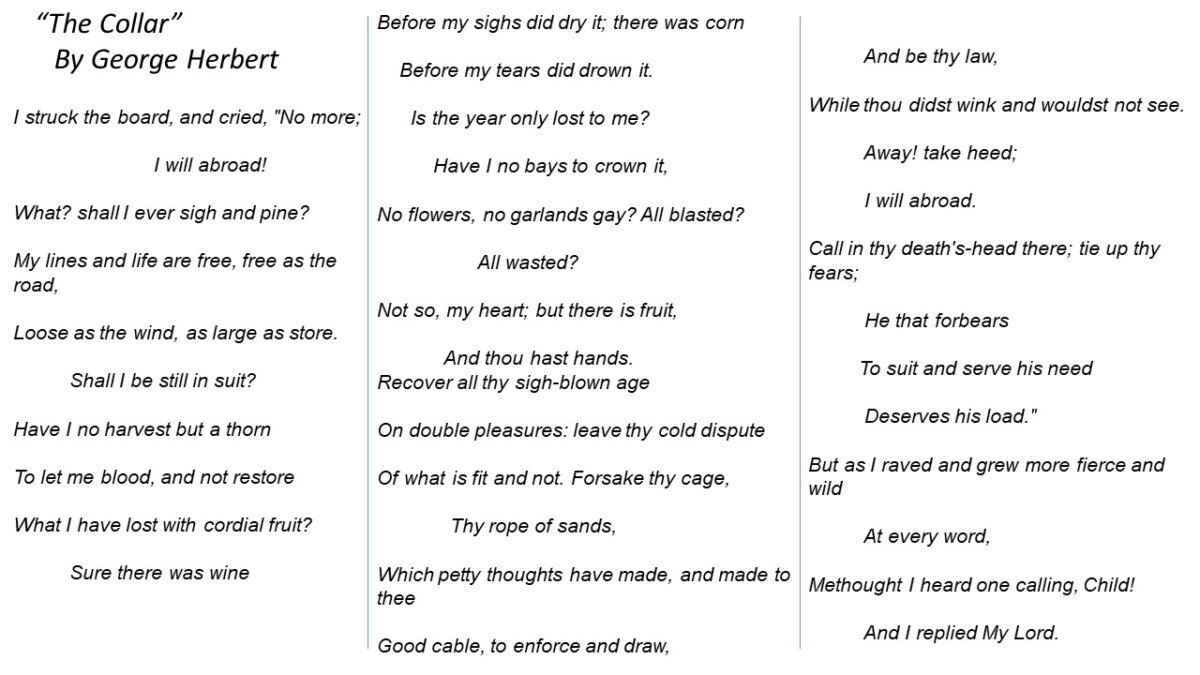
The poem has an intentionally erratic meter and rhyme scheme; the lines come tumbling over one another as the speaker rants and raves against God in an unorderly array of full rhymes and slant rhymes.
The speaker rebels against the life of service he has chosen and starts off the poem with a bang by striking the altar, the Lord’s table. He twice repeats his resolve to go abroad, to leave behind the priestly collar and go experience the pleasures he has voluntarily given up. He feels his self-imposed moral code to be a cage, a “rope of sands” which he could easily shrug off.

At the end, the speaker recognizes that he is being irrational: He “raved and grew more fierce and wild/ At every word.” This is not someone who has gained newfound happiness and freedom but rather someone who has lost his peace and his ability to reason.
The speaker’s complaint culminates in the argument that implies that he is not only denying himself pleasures but also necessities: “He that forbears/ To suit and serve his need/ Deserves his load.” Yet his real complaint is not about lacking what he needs but about what he perceives to be the folly of embracing suffering and the cross.
As he rebels against his vocation, he empties biblical images of the spiritual fruit they represent; in his musings, they become nothing more than earthly realities with no use beyond the pleasure they can bestow. He asks, “Have I no harvest but a thorn/ To let me blood, and not restore/ What I have lost with cordial fruit?” The thorn is a reference to Christ’s crown of thorns, which he has embraced with the expectation of finding some reward.
He then moves on to imagery that references the Eucharist: “Sure there was wine/ Before my sighs did dry it; there was corn/ Before my tears did drown it.” In his bitterness, the speaker denies the spiritual nourishment found in the Eucharist and reduces the bread and wine to nothing more than a means of nourishing the body. Ironically, despite his thirst for something more in life, in his present state of mind, there is nothing more to life than satisfying base appetites.
In response to all of this mental spiraling, to the complicated tangle of complaints, God restores order with the simplicity of a single word. The last four lines assume a structured meter and rhyme scheme, reflecting the speaker’s return to tranquility. With the word “Child!” God calls the speaker back to himself, reminding him of the love that lay at the heart of his vocation. He did not devote his life to the service of an arbitrary set of moral standards but to a loving Father, who gave the law to mankind only to draw man into closer relationship with himself.
The speaker’s answer of “My Lord” signals a return to the original hierarchy of beings as the speaker acknowledges his place in relation to God. For almost the entirety of the poem, his thoughts have been entirely on himself; it is only at the end of the poem that the monologue shifts to a dialogue.
His misery consists in the fact that when he is at the center of his thoughts, he has been unjustly assigned a life of servitude. When he remembers his Creator, he recalls that it is right and just that he should sacrifice and serve rather than be served. Not only does service become more palatable when freely undertaken in service of the beloved, but it becomes the means by which man frees himself from subjugation to his own appetites.
The speaker finds true freedom does not consist of being able to do whatever he pleases. Rather, freedom is the ability to choose what is good. The speaker is most free and most at peace when he is not a slave to his passions, when he is able to recollect his identity as a beloved son who has freely chosen to take Christ’s yoke upon himself.
The “collar” in the poem shifts from a constraint upon the speaker to the Caller who beckons the speaker to a higher way of living, not according to the law of self-indulgence but according to love. God does not give a direct answer to the many complaints about the speaker’s burden, about sacrifice, or about the difficulty of his calling; he simply replies with love. God reminds the speaker of his identity and shows that true freedom is found in the fulfilment of that identity as beloved child.