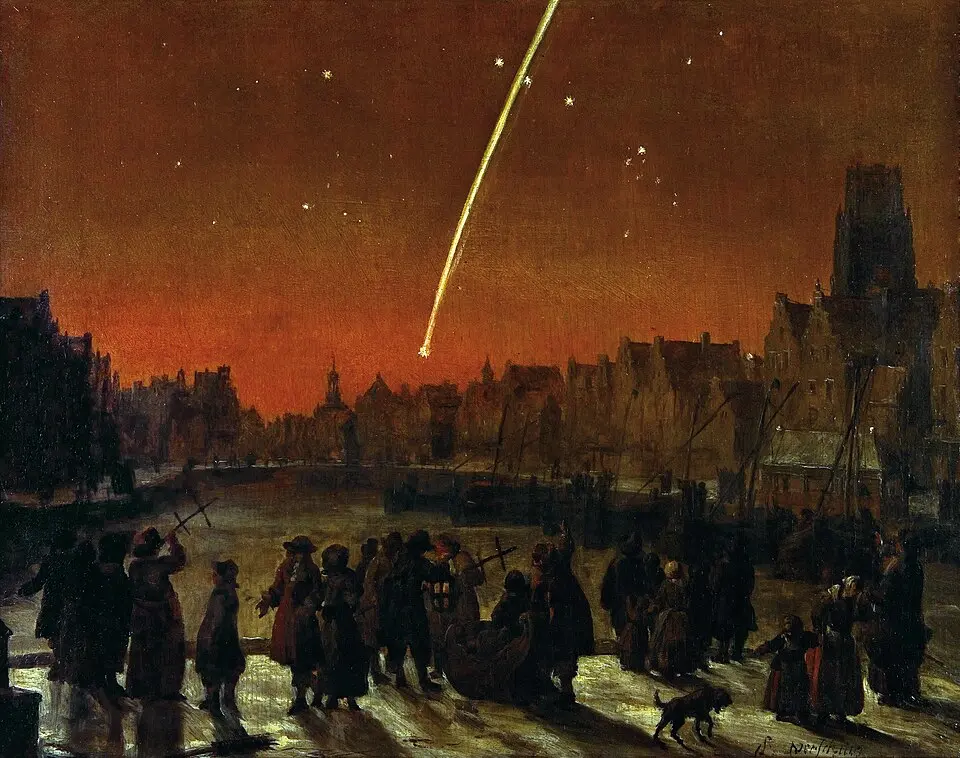
Though people throughout the ages have beheld the light of the same moon and stars, these that have been read in a myriad of different ways. They seem to take on new shades of meaning in the eyes of every witness.
In many of these perceptions, the luminaries have been personified. Where one reads a cold, indifferent ruler, another sees a personable, comforting guide. In all cases, the lights of the night sky seem not only lively but alive, too.
For this reason, poets have long turned to the theater of the night sky as an endless font of inspiration. The lights of the night sky, unlike the simple sincerity of daylight, seem to hold an impenetrable mystery that must be entered into and wrestled with in poetry.
Stars
Alone in the night On a dark hill With pines around me Spicy and still,
And a heaven full of stars Over my head White and topaz And misty red;
Myriads with beating Hearts of fire The aeons Cannot vex or tire;
Up the dome of heaven Like a great hill I watch them marching Stately and still.
And I know that I Am honored to be Witness Of so much majesty.
“Stars” by Sara Teasdale (1884–1933) uses sparse words to paint a crowded sky, as though the poet is loath to intrude upon the silence of the night. Teasdale uses personification to depict the stars as timeless, tireless beings that march across the heavens, lofty in state and stature. The speaker notes the disparity between herself and the stars: She is alone in the shadow of the pines, and they are in myriads, burning in a brilliant array of colors.The operative word in the poem, the only one that stands entirely alone, is “witness”: The speaker is still and solitary, simply observing the stars’ movement. Though she does not outwardly move, her own heart is moved to a posture of gratitude and humility, seeing the “beating hearts of fire” above her.
The repeated rhymes of “hill” and “still” in the first and fourth stanzas point to a vague similarity between the speaker on the earthy hilltop perfumed with pines, and the stars marching up the “hill” of the “dome of heaven.” The pines are still, and even the stars in their stately march appear still while they slowly traverse the sky. However, as they march across the heavens and across aeons, they are so far beyond the solitary, mortal witness that they inspire not only wonder but also a sense of reverence.

Silver
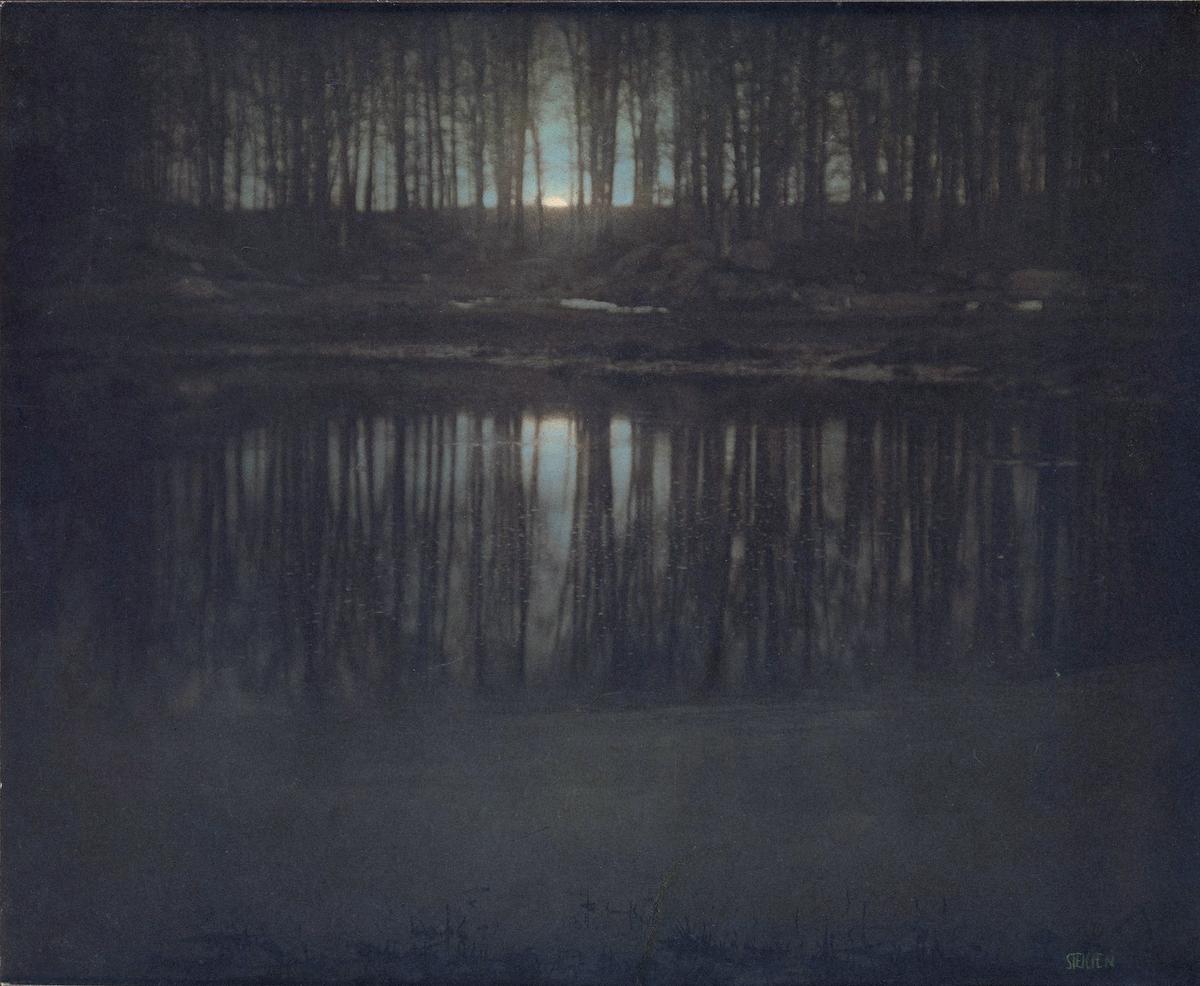
Slowly, silently, now the moon Walks the night in her silver shoon; This way, and that, she peers, and sees Silver fruit upon silver trees; One by one the casements catch Her beams beneath the silvery thatch; Couched in his kennel, like a log, With paws of silver sleeps the dog; From their shadowy cote the white breasts peep Of doves in a silver-feathered sleep; A harvest mouse goes scampering by, With silver claws, and silver eye; And moveless fish in the water gleam By silver reeds in a silver stream.
“Silver” by Walter de la Mare (1873–1956) offers a different vision of the nighttime luminaries. While Sara Teasdale’s poem paints the stars as stately and distant, indirectly moving the speaker, “Silver” depicts the moon as directly transformative, imbuing every element of the scene with silver. The word is used at least once, if not twice, in each pair of rhyming lines. The moon is personified as a mysterious figure who surveys the nighttime scene, which lies in a deep slumber blanketed by her gentle light.Aside from the moon and the scampering harvest mouse, everything in the scene is motionless; even the moon passes by slowly so as not to disturb the animals from their sleep. The word “silver” not only unites every object in the scene but also unites the couplets in the poem. The moonlight is entirely pervasive; everything, even the harvest mouse darting across the scene, assumes the moon’s reflective quality and gleams with silver.
My Star
All that I know Of a certain star, Is, it can throw (Like the angled spar) Now a dart of red, Now a dart of blue, Till my friends have said They would fain see, too, My star that dartles the red and the blue!
Then it stops like a bird; like a flower, hangs furled: They must solace themselves with the Saturn above it. What matter to me if their star is a world? Mine has opened its soul to me; therefore I love it.
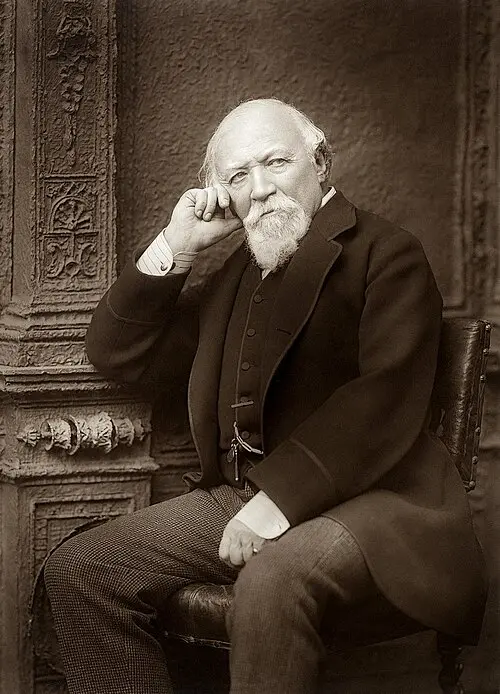
Contrary to Sara Teasdale’s majestic and aloof stars, the star in the poem “My Star” by Robert Browning (1812–1889) holds a very personal, intimate connection with the speaker. The star is extraordinary for its ability to throw cast its light and for its brilliant display of red and blue. From the speaker’s report, his friends are eager to see the star. However, it dances for him alone, and when they turn their gaze to it, like a flower it “hangs furled” as though it knows it is perceived by others.Unlike the moonlight in “Silver,” which is observable throughout the entire scene, the starlight’s singularity is visible to the speaker alone. Though Saturn is brighter and more outwardly vast, the immensity of the star’s inward being and the particularity of its light impress the speaker more. Public acclaim does not increase the value of the star; rather, the speaker loves the star because he knows it intimately.
Like the other poets, Browning uses personification in the poem, enabling the reader to easily see the correlation between human loves and the speaker’s love for the star. The poem illustrates how one falls in love with a person’s soul and their individuality, not with their superficial qualities or their value in the eyes of others.