Fine porcelain long served as a prestigious diplomatic gift, exchanged to strengthen political alliances and impress foreign dignitaries. Royal families also relied on pieces from their nations’ most celebrated manufacturers to showcase cultural heritage and support local artisans.
Among these traditions, Sèvres porcelain holds a singular place, built on royal patronage, hard-won technical breakthroughs, and genuine artistic ambition.
Origins of a Legacy
Founded in 1740 in Vincennes, France, the Manufacture de Sèvres initially produced only soft-paste porcelain, a ceramic that lacked kaolin, the clay essential to hard-paste porcelain. Softer and more susceptible to kiln distortion, soft-paste porcelain nevertheless became prized for its translucency and exceptional enamel colors.The factory moved to Sèvres, France, in 1756, and three years later, King Louis XV acquired the manufactory, making it a royal enterprise. After French deposits of kaolin were discovered, Sèvres began producing hard-paste porcelain in 1769, continuing its celebrated soft-paste wares alongside it until 1804.
Throughout the 18th century, Sèvres brought together leading specialists whose expertise advanced the art and science of porcelain production. Among its modelers was Étienne-Maurice Falconet, regarded as one of the leading Rococo sculptors of his day. Its chemists were pioneers of ground colors, enamels, and gilded decoration. Decorators, too, brought their own expertise to every piece, often marking their work in ways that recorded individual contributions and helped the manufactory track production.
Although the French Revolution devastated its aristocratic clientele, the manufactory survived by adapting its production to new patrons and emerging luxury markets. Today, it remains one of the world’s leading names in ceramics.
Innovation in Color and Design
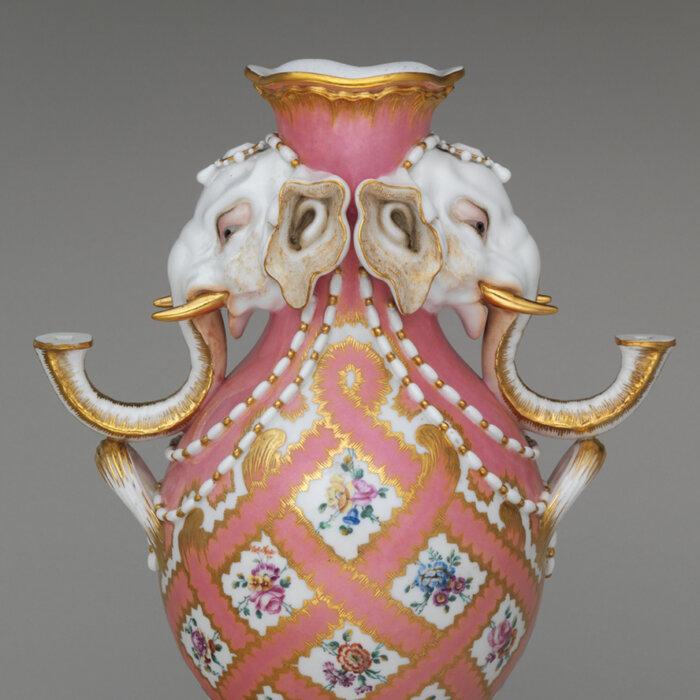
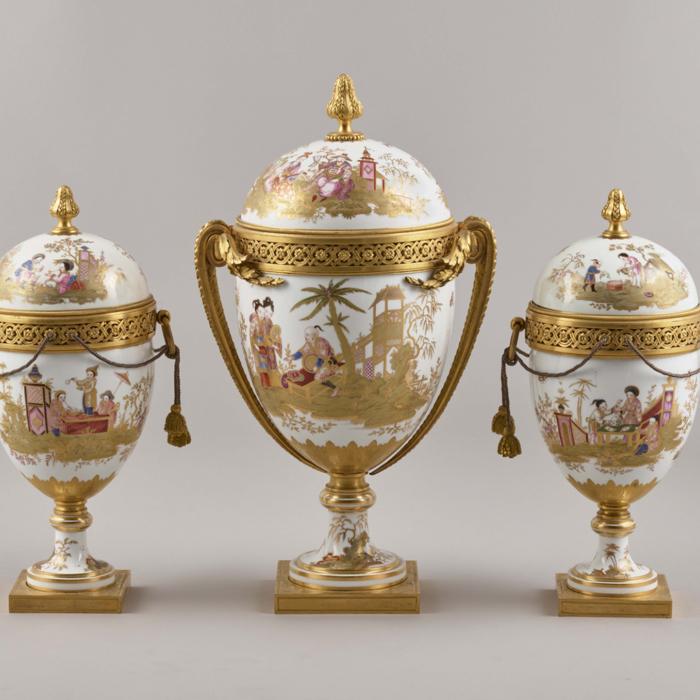
During the reign of Louis XV, the rococo style dominated the decorative arts, its pastel palette, gilded surfaces, and elaborate ornamentation appearing in everything from architecture to painting. One of the style’s most influential patrons was Madame de Pompadour, whose support for the arts helped define the visual culture of Louis XV’s court.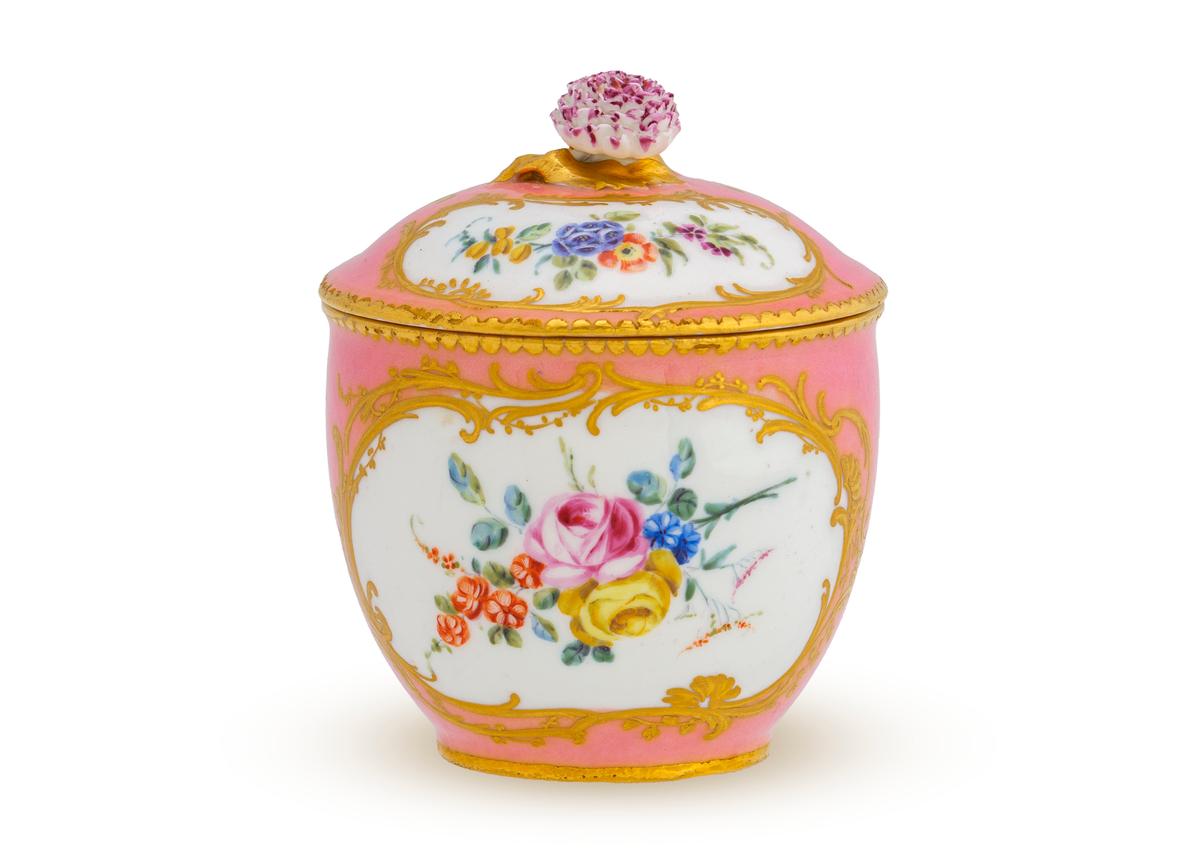
Among the highlights is a sugar bowl created for Madame de Pompadour in 1758. Its distinctive rosy pink glaze, later known as Rose Pompadour, was developed by Sèvres chemist Jean Hellot. The color was achieved by suspending microscopic gold particles within the glaze. During firing, the particles produced rich ruby and rose tones as light interacted with them, yielding a durable color that became one of the factory’s signature achievements.
Green-glazed porcelain was another factory innovation favored by Madame de Pompadour. Introduced in the mid-18th century, the shade demanded a fussy chemical process: calcined copper oxide blended into a lead-glass flux. The flux also served a practical purpose, lowering the mixture’s melting point so the enamel could fire into a glassy, saturated finish.
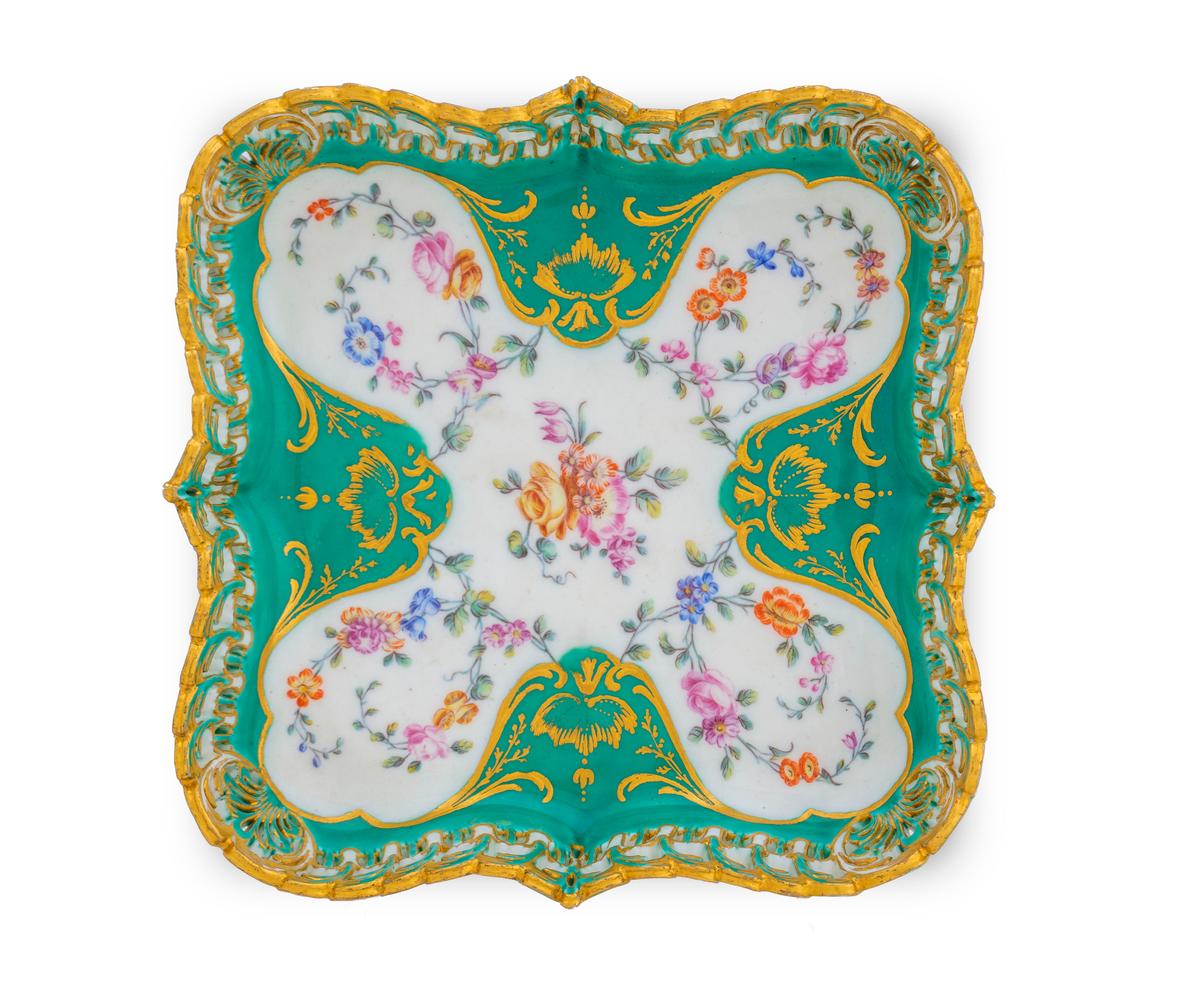
A mint-green tray from the exhibition sits squarely within this rococo idiom, both in palette and imagery. It was painted by Charles-Louis Méreaud, who was celebrated for his rococo sensibility and dense ornamentation. At the center and within four surrounding white reserves, clusters of flowers bloom in vivid, true-to-life detail. The gilding echoes the rounded curves of the foliage while harmonizing with the green ground beneath. Along the edge, a gilded basketweave pattern wraps around the tray, pierced in places to resemble finely woven metal thread.
Sèvres pieces were renowned for their intricate detail, often requiring multiple specialists and many months to complete a single work. Decorations frequently featured flowers, figures, and birds, with increasingly naturalistic depictions emerging by the late 1760s, reflecting the Enlightenment’s growing fascination with natural history and scientific observation. To achieve this level of realism, artisans turned to illustrated reference works such as English naturalist and ornithologist George Edwards’s “A Natural History of Uncommon Birds,” which featured more than 200 hand-colored plates of birds drawn from live specimens.
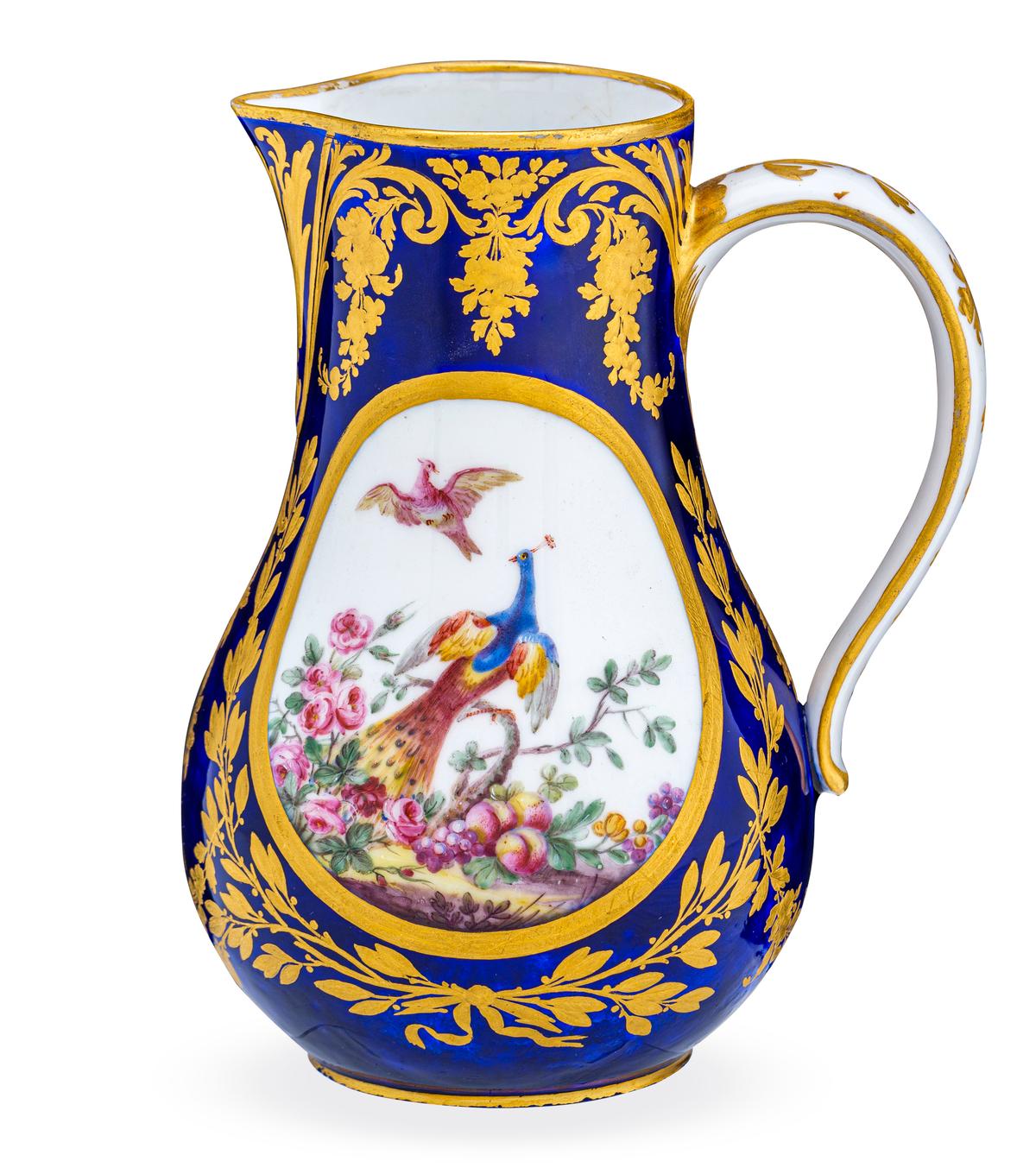
Among the works featured in the exhibition is the small “Water Jug,” which measures just 6 7/8 inches tall and 5 1/2 inches wide. The vessel is decorated with a bird inspired by George Edwards’s “A Natural History of Uncommon Birds.” Fewer than half a dozen Sèvres painters specialized in bird imagery, producing remarkably lifelike depictions through careful observation and meticulous detail. On the jug, a border of deep royal blue accented with gilded ornamentation frames the scene, drawing the viewer’s eye inward to the painting. Softly rendered foliage recedes into the background, allowing the bird’s vibrant blue, red, and yellow plumage to take center stage.
The museum explains:
“The story of Sèvres porcelain is one of artistic ambition, scientific discovery, and royal patronage,” said Mel Buchanan, NOMA’s RosaMary curator of Decorative Arts and Design. “This exhibition reveals how the factory transformed ceramic production through innovation in color, chemistry, and design while establishing an international standard for luxury porcelain that continues to inspire artists today.”