Nearly 3,000 years after it was first written, the story of “The Odyssey” continues to find new audiences. Christopher Nolan’s recent film adaptation is only the latest reminder of the epic’s enduring power, proving that Homer’s ancient tale can still command attention in the modern age.
Greek Mythology in Visual Arts
Giuseppe Bottani (1717–1784) was born in the northern Italian city of Cremona. He spent part of his boyhood in the small Tuscan town of Pontremoli before being sent to Florence, where he trained under Vincenzo Meucci and Antonio Puglieschi. He later moved to Rome, where he worked in the studio of Agostino Masucci, learning his grand manner of painting. Bottani’s output was dominated by religious commissions for churches across northern Italy.Amid Bottani’s many religious paintings, “Odysseus Transformed by Athena Into a Beggar” stands out as one of his rare explorations of classical mythology, though the work remains closely connected to the stylistic and compositional traditions that shaped his broader career.
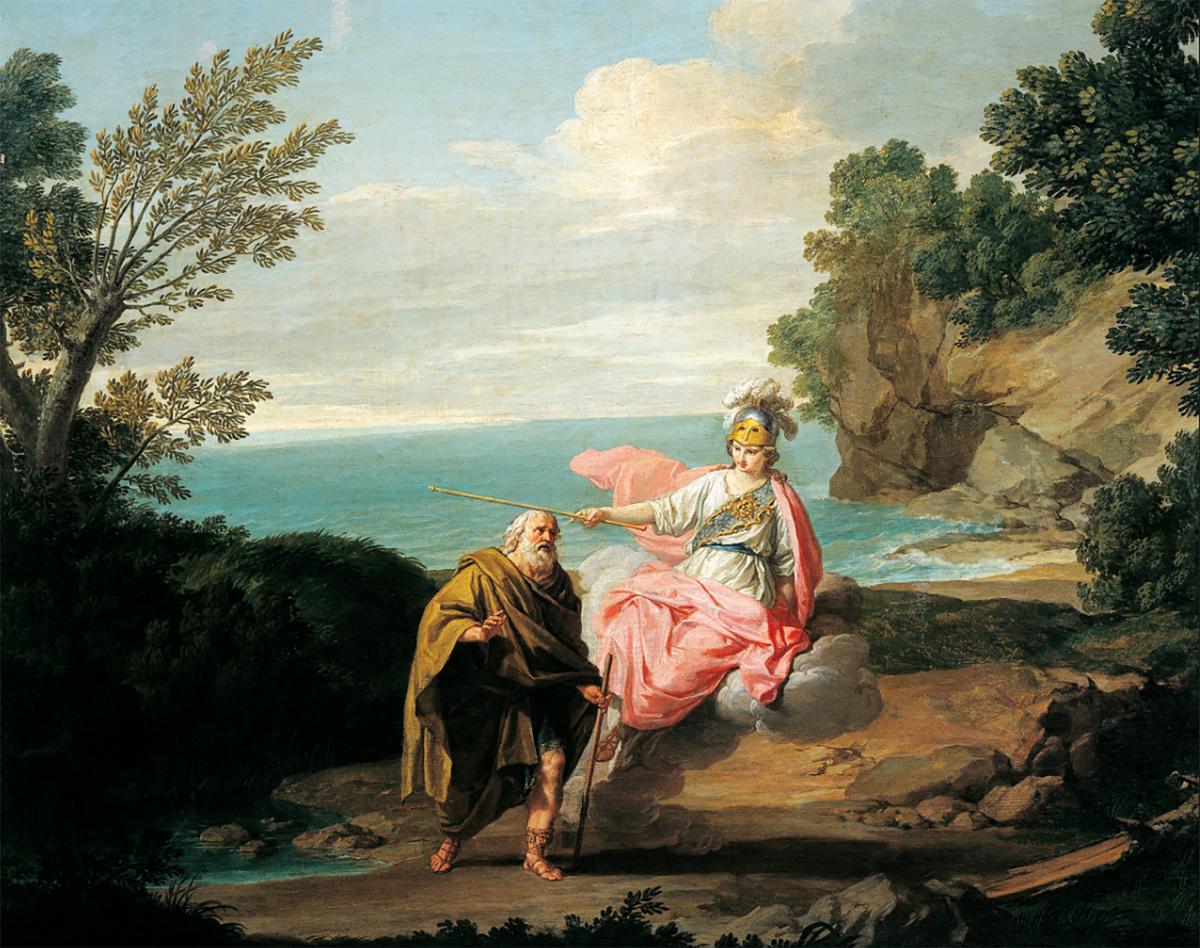
The painting illustrates a scene from Book 13 of Homer’s Odyssey in which Odysseus finally reaches the shores of his homeland, Ithaca. After 10 years of wandering following the Trojan War, Odysseus faces one more obstacle before reuniting with his wife, Penelope. Arrogant suitors have taken over his palace, draining his wealth and refusing to leave until she agrees to marry one of them. Outnumbered and unrecognized, Odysseus cannot simply walk in and reclaim his home by force.
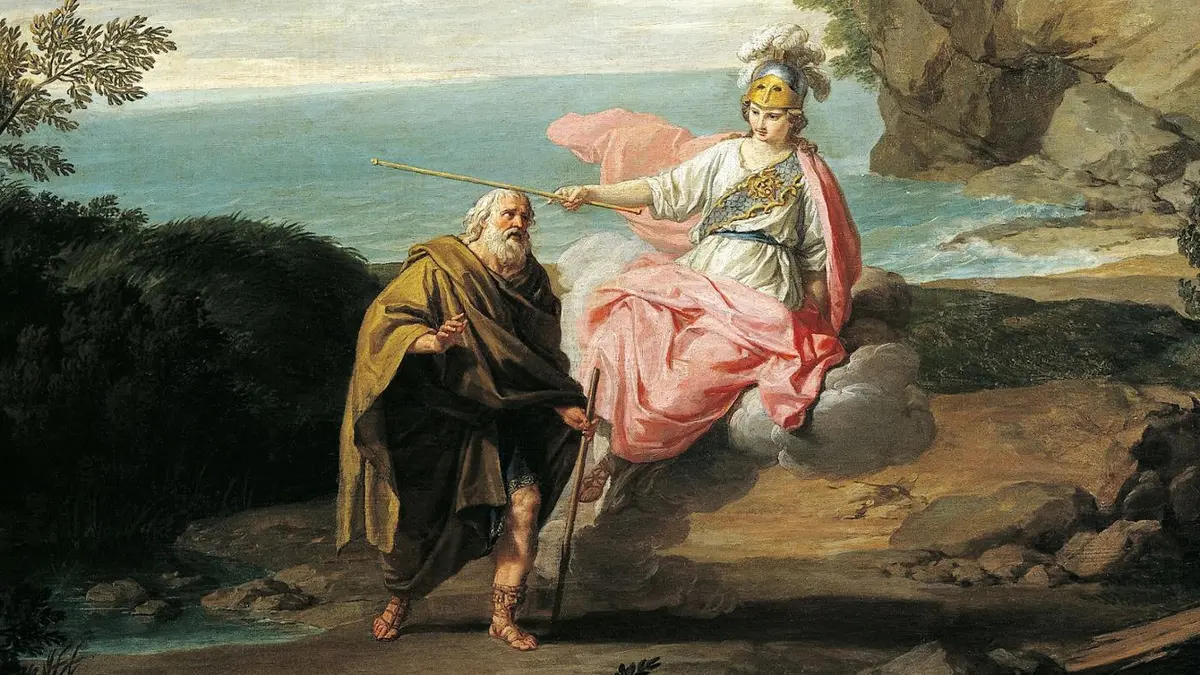
The goddess Athena, Odysseus’s protector throughout his journey, intervenes. With a wave of her wand, she disguises him as an aged beggar. She withers his skin, destroying his hair, and dresses him in tattered clothing. He carries only a staff and a worn-out sack. This transformation allows him to slip into his own household unrecognized, gather information, and eventually turn the tables on the suitors who believe him powerless.
There is a note of poetic justice in this humiliation. Much of Odysseus’s suffering on the way home had been brought on by his own pride, most famously when, having blinded the Cyclops Polyphemus, he could not resist boasting and revealing his name as he sailed away. Polyphemus, son of the sea god Poseidon, called on his father for vengeance, and Poseidon’s wrath shaped the disasters of Odysseus’s homecoming.
Odysseus’s Transformation
At first glance, a scene from Greek mythology seems an odd companion to Bottani’s religious commissions, including “The Assumption,” “Christ’s Ascension,” “The Departure of Saints Paula and Eustochium for the Holy Land,” and “The Death of St. Francis Xavier.” Yet these works share a common focus: the single, dramatic moment when a figure moves from one state of being to another through the intervention of a higher power. Odysseus’s transformation follows the same pattern. Athena’s wand functions much like divine intervention in Bottani’s sacred scenes, serving as an external force that reshapes human destiny in one decisive instant.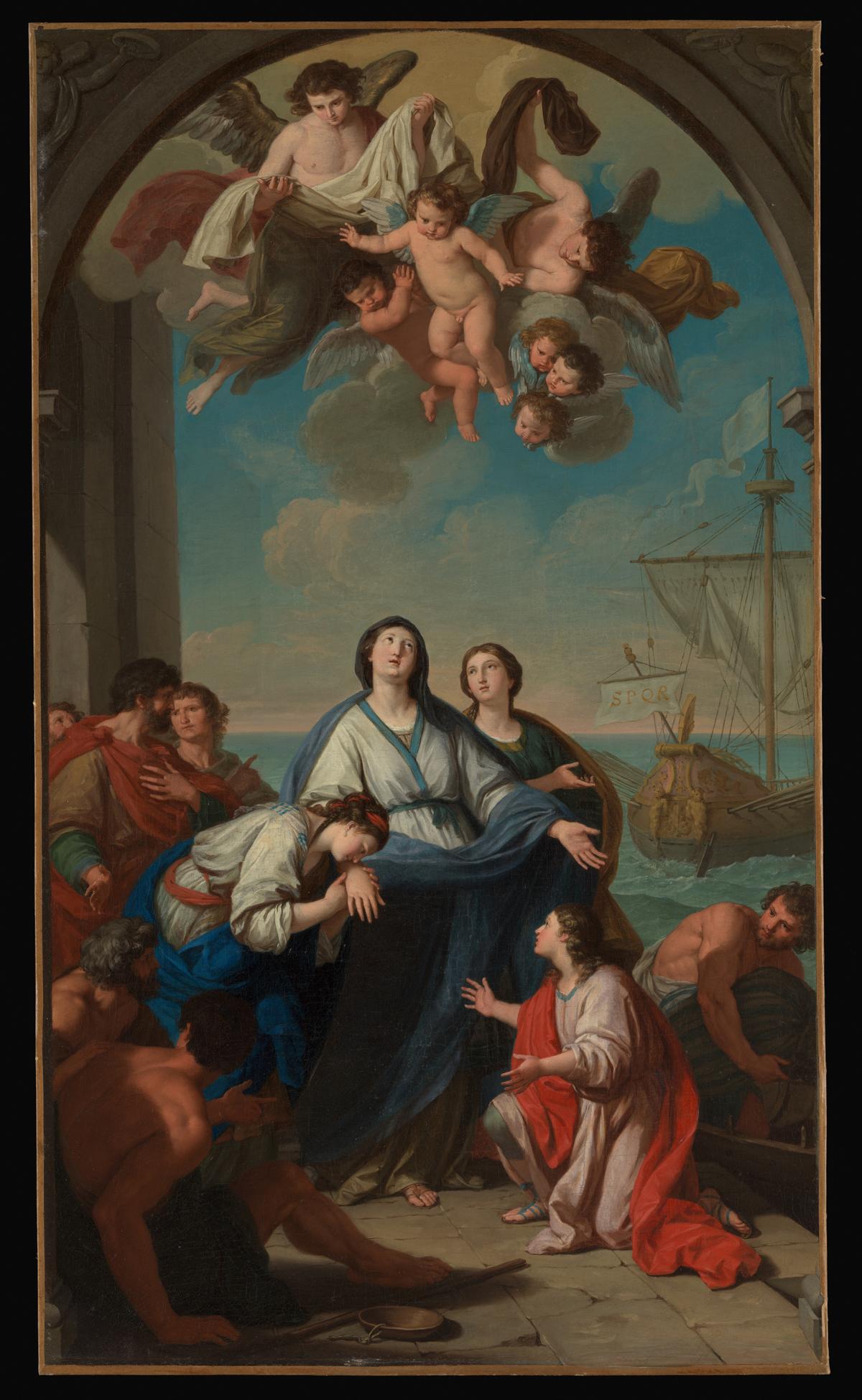
This connection reflected broader baroque themes shaped by the Catholic Church’s emphasis on emotional engagement and devotional clarity, a visual language that continued into Bottani’s career. At the same time, baroque artists continued to draw on classical mythology for subjects with similar tales. Bottani’s painting, therefore, belongs to a broader sensibility that prized the depiction of pivotal transitions: the instant in which faith, fate, or divine will visibly reorders a human life, whether the figure being transformed is a Christian saint or a hero of Greek epic. In this light, “Odysseus Transformed by Athena Into a Beggar” is less an outlier in Bottani’s career than a mythological variation on the very theme that defined his religious work.
Perhaps this is why “The Odyssey” has persisted: the sense of having to be humbled before being restored, of identity itself as something that can be stripped away and rebuilt. That is as true for an 18th-century altarpiece painter working in Cremona as it is for audiences filling theaters this summer.