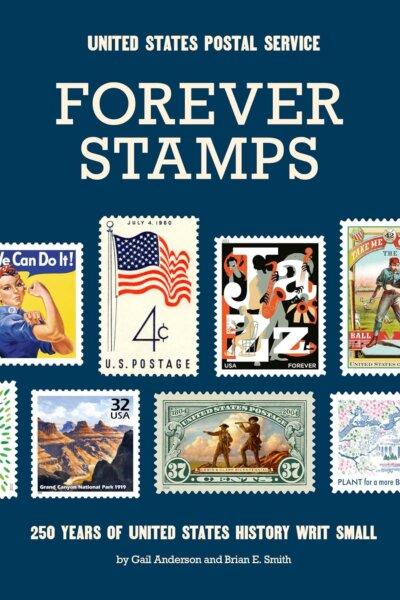
As history books go, Gail Anderson and Brian E. Smith’s “Forever Stamps” offers a boldly original concept. This new book charts American history as depicted in the postage stamps issued by the U.S. Postal Service (USPS). As a result, the American experience and the evolution of postage art design are simultaneously celebrated.
To its credit, this new book is visually stunning. The postage art is shown in vibrant blow-ups that give the reader a sterling appreciation of stamp design over the years.
In the Beginning
The first U.S. stamps were made available on July 1, 1847. The inaugural issuance consisted of a 5-cent stamp featuring Benjamin Franklin and a 10-cent stamp depicting George Washington.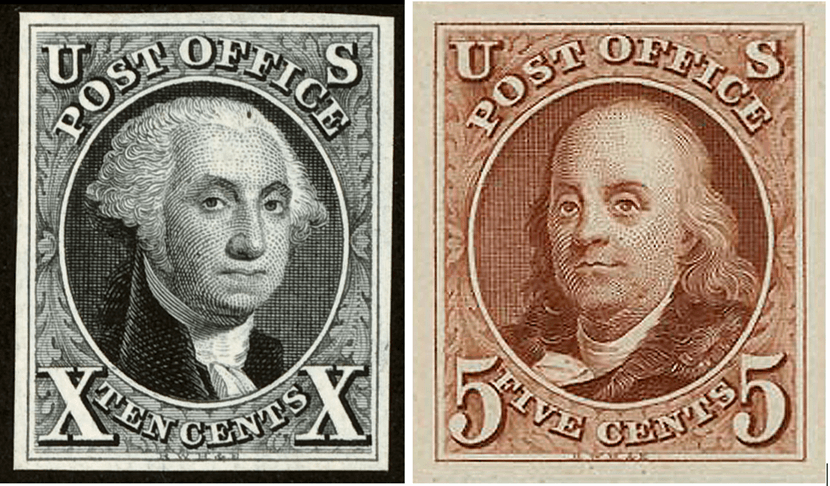
Those two stamps were the extent of available postage until a 5-cent stamp with Thomas Jefferson was printed in 1856 and a 2-cent stamp with Andrew Jackson followed in 1863. Abraham Lincoln was honored on a 15-cent stamp in 1866, one year after his assassination. This began the tradition of stamps honoring presidents being issued one year after their death.
From the 19th century into the middle of the 20th century, stamps were primarily monochromatic in format and academic in design. It wasn’t until the mid-1960s that stamps began to take on multiple colors and adopt contemporary design styles that were currently shaping American art, fashion, and décor. In the 21st century, the traditional square and rectangular stamp shapes have been joined by triangular and circular postage.
What’s Left Unsaid
“Forever Stamps” includes a photograph of the Isabella and Columbus stamp but conspicuously avoids mentioning Columbus’s name. In fact, the book never acknowledges any stamp that featured the 15th- and 16th-century European explorers who journeyed across the Atlantic.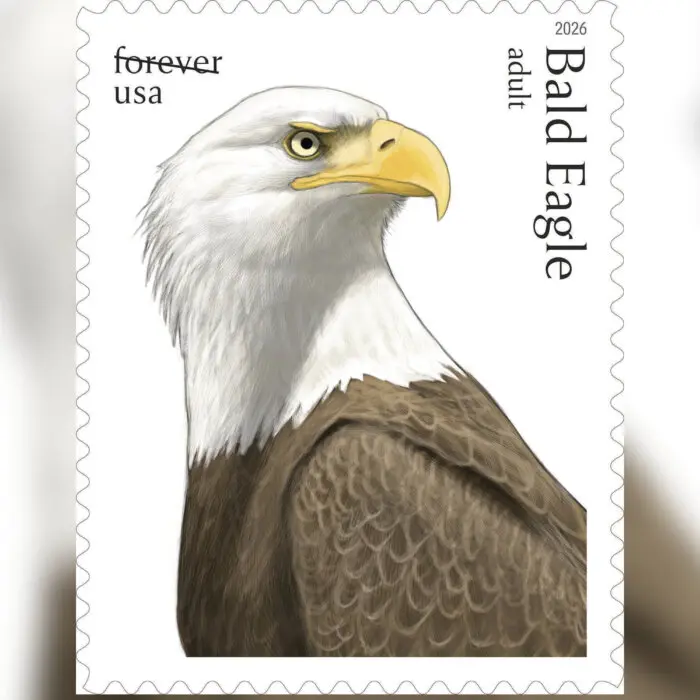
If this was done to avoid offending the nation’s Native Americans, that approach failed because they’re also mostly absent from the book. Besides a 1907 stamp with Pocahontas as the subject, the book never puts forth any U.S. stamp honoring Native American leaders and only manages to sneak in a single stamp highlighting Indigenous culture.
For anyone with an active interest in stamp collecting, it becomes very obvious what was left out of “Forever Stamps.” The aforementioned absence of Martin Luther King Jr. in a chapter titled “Activism, Change, and the American Way of Life” is certainly peculiar. It’s possible that the authors were unable to obtain permission from the King estate to use the Civil Rights leader’s image in the book. There are more than four pages of permission acknowledgements for image reproductions.
Still, that doesn’t explain the omission of the stamps honoring Sojourner Truth or Mary McLeod Bethune from that section, let alone the unlikely inclusion of 19th-century architect Robert Robinson Taylor.
Elsewhere in the book, a section on “Cultural Celebrations” offers several secular Christmas-themed stamps but ignores the annual religious Christmas stamps issued by the USPS. The book never mentions that the Virgin Mary is the woman who’s been featured on the most U.S. stamps, with 42 appearances to date.
Also left out of “Forever Stamps” are the philatelic tributes to military leaders (the Marquis de Lafayette is included in a section on the Founding Fathers), medical pioneers, faith leaders, and inventors. There’s a 1929 stamp of Thomas Edison’s first lamp, but the 1947 stamp featuring the man himself isn’t here.
Instead, too much of the book is occupied by a presentation of pop culture-themed stamps. There are sections on stamps with cartoon characters, movie stars, music figures, athletes, and artists. Granted, the USPS has placed a heavy emphasis on pop culture-inspired stamps during the past three decades, but did the authors really need to set aside four pages for Disney stamps?
What Is Included
Even if “Forever Stamps” leaves a lot to be desired as a history lesson, it’s a beautifully produced book that offers a remarkable selection of postage art. For small pieces of paper destined for the upper right corner of envelopes, the illustrations compiled for this book all deserve to be framed and admired.The authors also serve up some fascinating tidbits of postal history. Perhaps the most surprising story involves President Franklin D. Roosevelt, who began stamp collecting as a hobby during his childhood. During his presidency, Roosevelt designed six postage stamps; the subjects ranged from the commemoration of Richard Byrd’s second Antarctic expedition to a tribute to Susan B. Anthony. These rarely seen designs are included, which gives an unexpected peek into Roosevelt’s hitherto unrecognized aesthetic skills.
Also worth noting is the evolution of the 2020 stamp celebrating the 50th anniversary of Earth Day. Art director Antonio Alcalá’s evolving designs and jettisoned sketches are presented. These provide an amusing glimpse into the creative process.
If one overlooks its shortcomings as a history book and focuses intensely on the visual triumphs throughout the decades of U.S. stamp design, “Forever Stamps” can be a fun treat as a picture book that could spark new or renewed interest in stamp collecting.