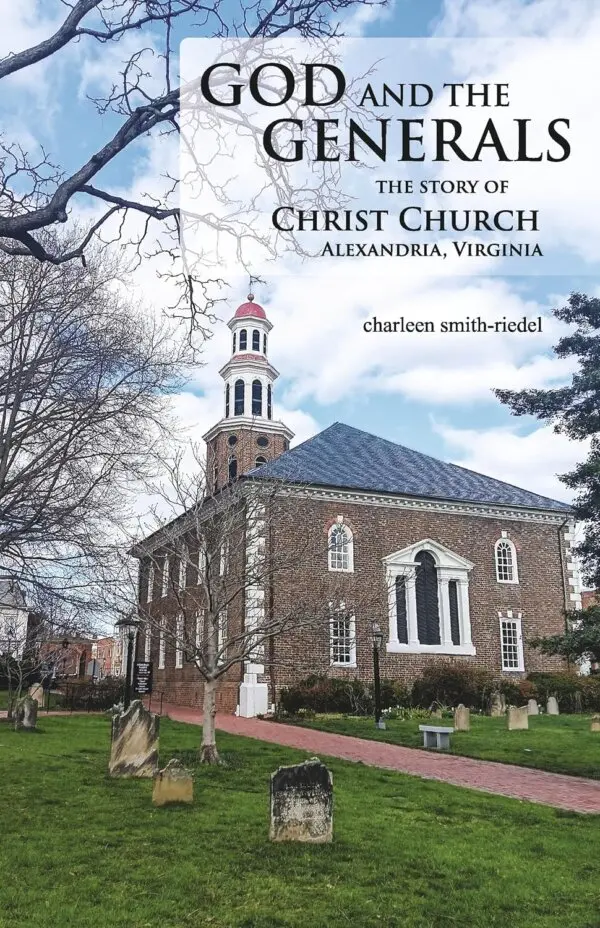
Every house of worship has its own distinctive history, but few sacred establishments can match the extraordinary story of Christ Church in Alexandria, Virginia. Beginning in the decade prior to the Revolutionary War, this Episcopal community has witnessed some of the most tumultuous events of American history.
Difficult Early Years
In 1765, George Washington recorded the vestry election votes from 334 wealthy male property owners for the new parish. The property opened behind schedule and over budget as Fairfax Church in February 1773, with Washington as one of 10 parishioners who purchased a pew for their families.The Revolutionary War years wreaked havoc on the congregation. More than half of the men in the vestry were replaced. They either went off to fight with Washington or remained loyal to the British crown and were forced to leave.
When the financially strapped church began charging rent for its pews after American independence was achieved, an infuriated Washington complained about having to pay rent on a pew he'd already purchased.
Smith-Riedel notes that the church gained national attention through several high-profile incidents; she tells of the 1810 hiring of a rector who was later revealed to be a bigamist.
The church’s attempt to retain the rights to its glebe (the land within the parish used to support the priest) inspired a landmark 1815 Supreme Court decision. The Terrett v. Taylor decision ruled that Virginia’s state government couldn’t confiscate or seize property belonging to the Episcopal Church.
The church was also a leader in the push for public education. As Smith-Riedel writes, “At a time when education was still considered a privilege, programs were formed by educators and ladies of Christ Church and other churches in town to meet the rising demand for education.”
Center of Attention
Outside of Washington, the church’s most famous member was Robert E. Lee, who was confirmed with his daughters Mary and Annie in July 1853. The author refutes the legend that Lee accepted his commission in the Confederate Army outside of the church.During the Civil War, Alexandria was occupied by Union forces, and the Northerners seized the church for their Sunday services. After the war, the church hosted the memorial service for Lee following his death in October 1870.
In the late 19th century, the church became a popular tourist attraction due to its connection to Washington and Lee. Turnstiles were installed to maintain the tourist flow.
Race and Religion
Christ Church’s relationship with Alexandria’s black community has been complex, and Smith-Riebel deals frankly with the decades of contradictory behavior.In the Colonial and post-Civil War periods, enslaved blacks were welcomed to services, albeit in pews at the rear of the church next to the community’s poor whites; black babies were baptized by the rectors. While Virginia law forbade teaching black people to read and write, the church offered Bible education to blacks through oral instruction.
After the Civil War, Alexandria’s black population chose to self-segregate and asked Christ Church for their own Episcopal house of worship. The congregation obliged and established Meade Memorial Chapel in 1870.
Over time, the church became less cordial to the black population. The author bluntly states that there’s no record of the church’s rectors or vestry voicing opposition to the outrages of the Jim Crow era. The congregation was mostly hostile to the dismantling of segregation via the 1954 Brown v. Board of Education ruling.
A 1963 sermon by Rev. Charles William Sydnor on the Civil Rights Movement resulted in several parishioners walking out of the service, followed by a Washington Post article on the brouhaha.
When the veneration of historically prominent slave owners sparked a public debate in 2017, more parishioners left after memorial tablets honoring Washington and Lee were moved to a less visible location.
Christ Church also faced the upheavals within the Episcopal faith, beginning in the post-Revolutionary War years when the relations between the Church of England and its American outposts were defined.
The church was initially hesitant about accepting women as rectors (a 1976 poll was near-unanimous in preferring all-male leadership), but in 2016, Dr. Noelle-York Simmons became its first female leader.
In the early 21st century, the congregation faced the question of the Episcopal Church’s acceptance of openly homosexual Episcopal clergy. After holding a yearlong discussion, the majority of the parish opted not to leave the national Episcopal organization, although one dissenter complained “the national church has compromised principle after principle to match [the] secular world.”
“God and the Generals” is a fascinating achievement. Smith-Riedel’s research is impeccable, and her adroit writing is wonderfully framed with a wealth of archival imagery. This marvelous book offers a truly unique perspective on American history.