From Personal Revelation to the Stage
The result of Stoppard’s discovery is “Leopoldstadt,” the last play he wrote before his death last year. It’s his most deeply personal work. While the play follows a fictional family in Vienna rather than his actual hometown in Czechoslovakia, the drama’s emotional journey mirrors aspects of Stoppard’s own life.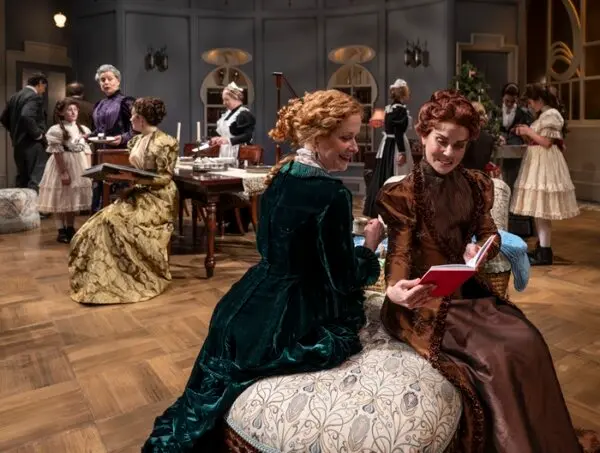
The play premiered in 2020 in London’s West End, went on to Broadway in 2022, and is now in a moving, mesmerizing production in its Chicago regional premiere at the Writers Theatre in Glencoe, Illinois.
“Leopoldstadt” stands out as Stoppard’s most eloquent and intimate masterwork. It marks an insightful shift from his previous clever plays, such as “Rosencrantz and Guildenstern Are Dead” (1966), “Jumpers” (1972), “Travesties” (1974), “The Real Thing” (1982), “Arcadia” (1993), “The Coast of Utopia” (2002), and “Rock ’n’ Roll” (2006).
While those earlier works are renowned for their brilliant wit, thoughtful theories, and philosophical introspection, this play strips away Stoppard’s witty dialogue to explore painful calamity. In “Leopoldstadt,” Stoppard goes for a straightforward, penetrating passage through history that makes a family’s approaching doom feel inescapable.
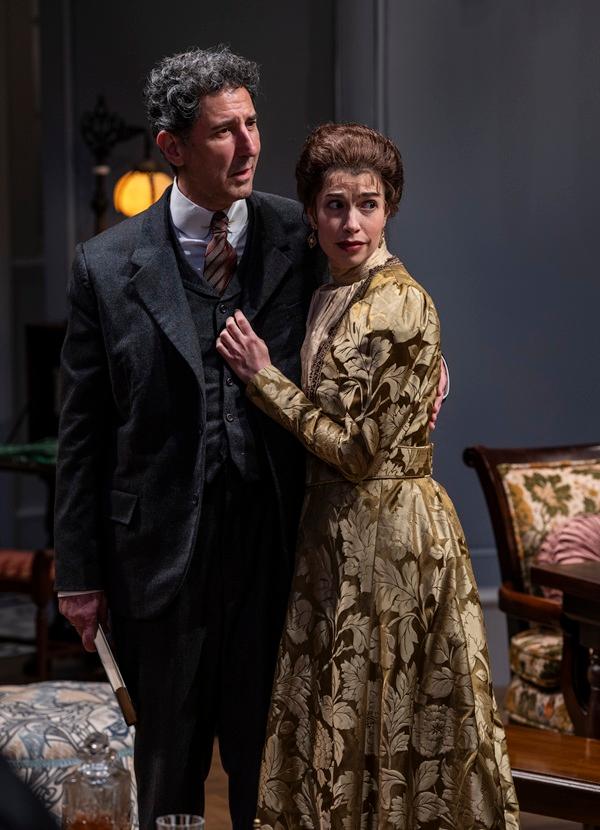
“Leopoldstadt” follows a wealthy Jewish family in Vienna, Austria, over 56 years from 1899 to 1955. It begins as the prosperous Merz family celebrates Christmas in an assimilated household at the turn of the century. It continues in 1900 as the family faces anti-Semitism, then to 1924 when it’s forced to deal with hyperinflation after World War I.
The narrative moves to the 1938 Kristallnacht destruction in which German soldiers force their way into the family home on the night of broken glass. Those Nazis forced the family to give up their property before deporting them to concentration camps. Years later, after World War II, the three surviving members of the family returned to Vienna, where they grieved the loss of loved ones.
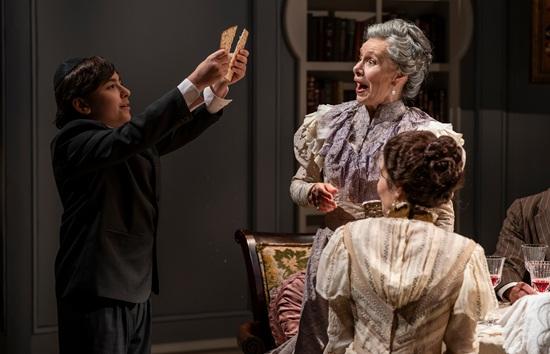
Stoppard emphasizes how easily a sophisticated, intellectual society can descend into subhuman atrocities. Vienna’s golden age of art and music is destroyed, showing that culture and civilization are not enough to protect one from mindless, ignorant hatred. The play serves as a warning about the fiction of personal safety.
A Triumph in Glencoe
The true power of the play is not in its ability to look backward but in its look forward in an attempt to alert the modern world as to the hateful pathology that seems to be sweeping parts of the world. “Leopoldstadt” is a wake-up call for today, a cautionary tale about how suddenly the unthinkable can come.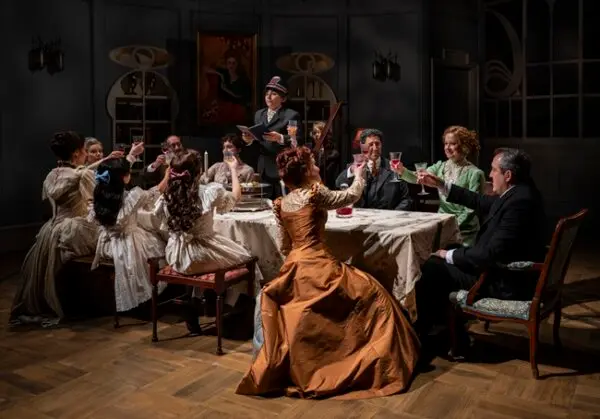
Directed with powerful poignancy by Carey Perloff, the drama moves with unrelenting, fierce emotion. Scenic designer Ken MacDonald, lighting designer Keith Parham, and costume designer Alex Jaeger come together to give the production an intense presence.
The play has a large cast of 24 performers that portray multiple roles and span multiple generations. All of the ensemble convey strong, evocative, heartrending portrayals. Some of the compelling performances include Justin Albinder as Zac/Nathan, Ian Barford as Hermann, Kate Fry as Gretl, Sam Bell-Gurwitz as Jacob/Leo, Erik Hellman as Fritz/Percy, and Sean Fortunato as Ernst.
“Leopoldstad” packs a heartbreaking, palpable gut punch long after the show’s finale. The audience reaction at the end was a spine-chilling moment of silence before breaking into thunderous applause. As I walked out of the theater, I heard comments from a few theatergoers who spoke of fear, anxiety, and concern for the possibility that what they had just witnessed could happen again.