OAK PARK, Ill.—Many believe that “Hamlet” is Shakespeare’s most thrilling work. They believe so for very good reason. The play explores revenge, corruption, mayhem, and mental angst. Indeed, it can be compared to some of our modern-day murder mysteries. The tragedy (written circa 1600), though, differs from today’s spine-tinglers because it isn’t a whodunnit.
It’s not a story in which a detective looks for physical clues such as DNA and other forensic details. Rather, the story focuses on Hamlet’s learning his father was murdered and setting a psychological trap to expose the culprit. Actually, “Hamlet” goes beyond a simple suspense drama because the audience knows who the killer is from the play’s very beginning. The tragedy focuses on the psychological cost of holding a perpetrator accountable.
Now in a fascinating revival by the Oak Park Festival Theatre in its outdoor stage at Austin Gardens, the faithful production features everything that we’ve come to expect from Shakespeare’s greatest tragedy, and more.

Masterfully directed by Peter G. Andersen, everything remains rotten in Denmark. Hamlet sees the ghost of his murdered father, becomes determined to reveal his uncle—his mother’s new husband— as the culprit, and embarks on a quest for justice that spirals into a journey of self-discovery. Shakespeare’s brilliant dialogue still captivates audiences. Hamlet is still torn between “To be or not to be” and continues to pursue “The play’s the thing/Wherein I’ll catch the conscience of the King.”
But since the production is staged in an outdoor arena, there are, of necessity, some differences between being set in a garden and an indoor theater.

August Foreman’s open-caption screens on both sides of the stage help audiences track Shakespeare’s delicious language so that not a word escapes their attention.


Costume designer Taylor Pfenning chose bold fabrics so that the characters remain distinct even as darkness falls in the Garden, scenic designer Evan Frank has built a classically inspired courtyard stage that features arches draped with billowing gauze curtains that catch the evening breeze during the ghost scenes, and Devin Cameron’s dramatic lighting design provides an eerie ambiance for the ghostly tale.
In addition, the actors use larger, more dramatic movements and project their voices to overcome the rustling trees, breezes, and the sometimes sound of a car in the distance. The actors cannot whisper because their sounds would get lost in the open air. The ensemble exaggerates its movements and faces forward so all actions are clearly visible.
Indeed, this production rises to the occasion because of its compelling performances. The cast is top-notch. Yet, the stand-out portrayal, and upon whom the play hinges, is Drew Bos; he creates a distraught and pensive Hamlet. When he’s onstage, we can’t take our eyes off the charismatic actor.
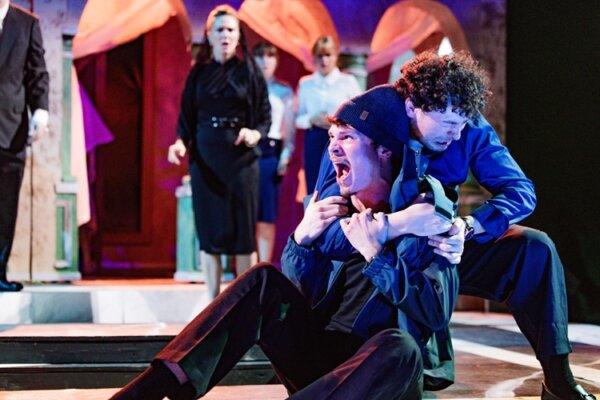
Those exceptional characterizations include: Lucas Prizant as Horatio, Gabriel Armstong as Guildenstern, Pedro Jimenez as Rosencrantz, Brenna Distassio as Laertes, Patrice Egleston as Polonius, Olive Gallagher as Ophelia, Jodi Gage as Gertrude, Josh Carpenter as Claudius, and Charls Sedgwick Hall as the Ghost, Player, and Gravedigger.
Many aspects of outdoor theater make this show even more intense and emotional. The play starts in evening daylight and ends in real darkness as Hamlet descends into disaster. When the ghost appears just as the sun melts into twilight, and as Hamlet looks up at the Austin Gardens’ night sky and says “'Tis now the very witching time of night,” the haunting atmosphere envelopes the stage, the grounds of the garden, and the audience. Later, when Hamlet says, “There are more things in heaven and earth, Horatio, than are dreamt of in your philosophy,” the nighttime setting evokes a mythical quality.
Those who appreciate Shakespeare and theater will delight in this impressive presentation. Watching this “Hamlet” is a captivating experience. Bring a comfortable lawn chair, blankets, and a picnic to enjoy the best in engaging and thought-provoking entertainment.