An aphorism or proverb can tell us that pride leads to destruction. A myth can allow us to watch a proud man destroy himself. That is the difference between wisdom as saying and wisdom as story.
Both forms are ancient, and both are necessary. The aphorism compresses truth into memorable language. The story does something different. It does not simply tell us what to think; it invites us to enter a world. It allows wisdom to unfold through character, choice, consequence, irony, reversal, suffering, and recognition. A proverb gives wisdom in a sentence. A story gives wisdom life.
With that greater complexity comes ambiguity: Stories can be read and interpreted in many different ways, in a manner that proverbs generally cannot. A more technical way of putting this is that stories are polysemous: They contain multiple meanings, which may disclose themselves differently to different readers—or even to the same reader at different stages of life.
Arjuna and Duryodhana
An Indian epic story precedes the teaching of the Hindu sacred text Bhagavad Gita. It tells of the great war between the Pandavas and the Kauravas that is approaching. Both Arjuna and Duryodhana, who represent opposing factions, seek the support of the Hindu deity Krishna. Duryodhana arrives first and waits near Krishna’s head as he sleeps. Arjuna arrives later and takes his place reverently near Krishna’s feet. When Krishna wakes, he sees Arjuna first, though he acknowledges that Duryodhana arrived first.Krishna offers a choice. One side may have his vast army. The other may have Krishna himself, unarmed and not fighting, but present as charioteer. Duryodhana wants the army. Arjuna chooses Krishna.
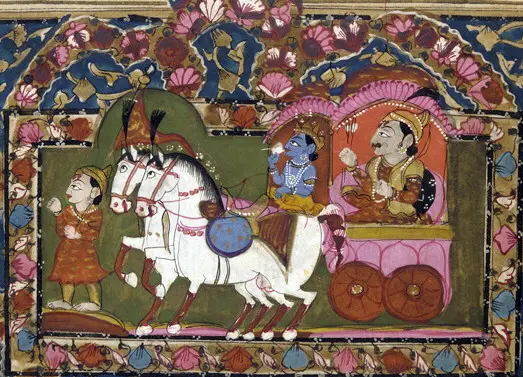
That is one of the great images of classical wisdom. Duryodhana chooses force; Arjuna chooses guidance. Duryodhana chooses measurable advantage; Arjuna chooses divine presence. Duryodhana wants what Krishna has; Arjuna wants Krishna. The difference is immense.
Other Wise Stories
That question is not confined to ancient India. Who drives the chariot of a human life? Appetite? Ambition? Fear? Resentment? Ideology? The crowd? Or wisdom, conscience, soul, God? Arjuna’s choice becomes a universal question. When power and wisdom are offered separately, which do we choose? Remember Solomon, who, when God offered him whatever he desired, chose not riches, power, or long life, but “an understanding heart” (1 Kings 3:13) and the ability to “discern between good and bad” (1 Kings 3:10).Greek myth gives us the same kind of wisdom through different images. Consider King Midas. He desires that whatever he touches turns to gold. His wish is granted. But the gift becomes a curse: food, drink, and even human tenderness are rendered lifeless by the touch of his greed. The story does not need to say, “Greed is bad.” It does something more powerful. It gives us a man who gets exactly what he wants and discovers that his desire is deadly.
Midas is a perfect myth for a commercial and technological age. We know how to monetize, optimize, measure, and accumulate. But the myth asks: What happens when the golden touch destroys the living world? What if our power to put a price on everything ends by stripping things of their true value? What if the thing we most desire turns out to be the thing that starves us? As Oscar Wilde observed in aphoristic fashion in “Lady Windermere’s Fan,” a cynic is “a man who knows the price of everything and the value of nothing.”
Or consider the Greek myth of Icarus. He and his father, Daedalus, escape imprisonment by means of wings fashioned from feathers and wax. Daedalus warns the boy not to fly too near the sun. Icarus, intoxicated by flight, rises too high; the wax melts, and he falls. The common moral is “do not fly too high,” but the story is subtler than that. It is not against flight. Flight is the means of liberation. The danger is freedom without discipline, invention without humility, possibility without proportion.
This, too, speaks urgently today. Our civilization flies constantly nearer the sun. We extend our powers through technology, science, artificial intelligence, finance, medicine, and communication. Much of this is marvelous. But Icarus asks whether we have the wisdom to govern the very powers we create. Daedalus possesses technical skill; Icarus lacks moral measure and that distinction may be one of the defining problems of modernity.
Then there is Oedipus, perhaps the most terrifying of all Greek wisdom stories. Oedipus is clever; in fact, he may be the cleverest man alive, since no one else can solve the riddle of the Sphinx. He solves the riddle and saves Thebes. Nevertheless, he cannot solve the riddle of himself. He seeks the cause of the pollution afflicting the city and discovers that he himself is its source. He has fulfilled the very prophecy he tried so hard to avoid.
Oedipus teaches us that intelligence is not the same as self-knowledge. A person may be brilliant and yet blind. He may solve public problems while remaining ignorant of his own condition. This is why the Delphic command, “Know thyself,” is not a decorative motto—more like a diamond-hard aphorism!—but a warning. The human being is dangerous when cleverness outruns self-knowledge.
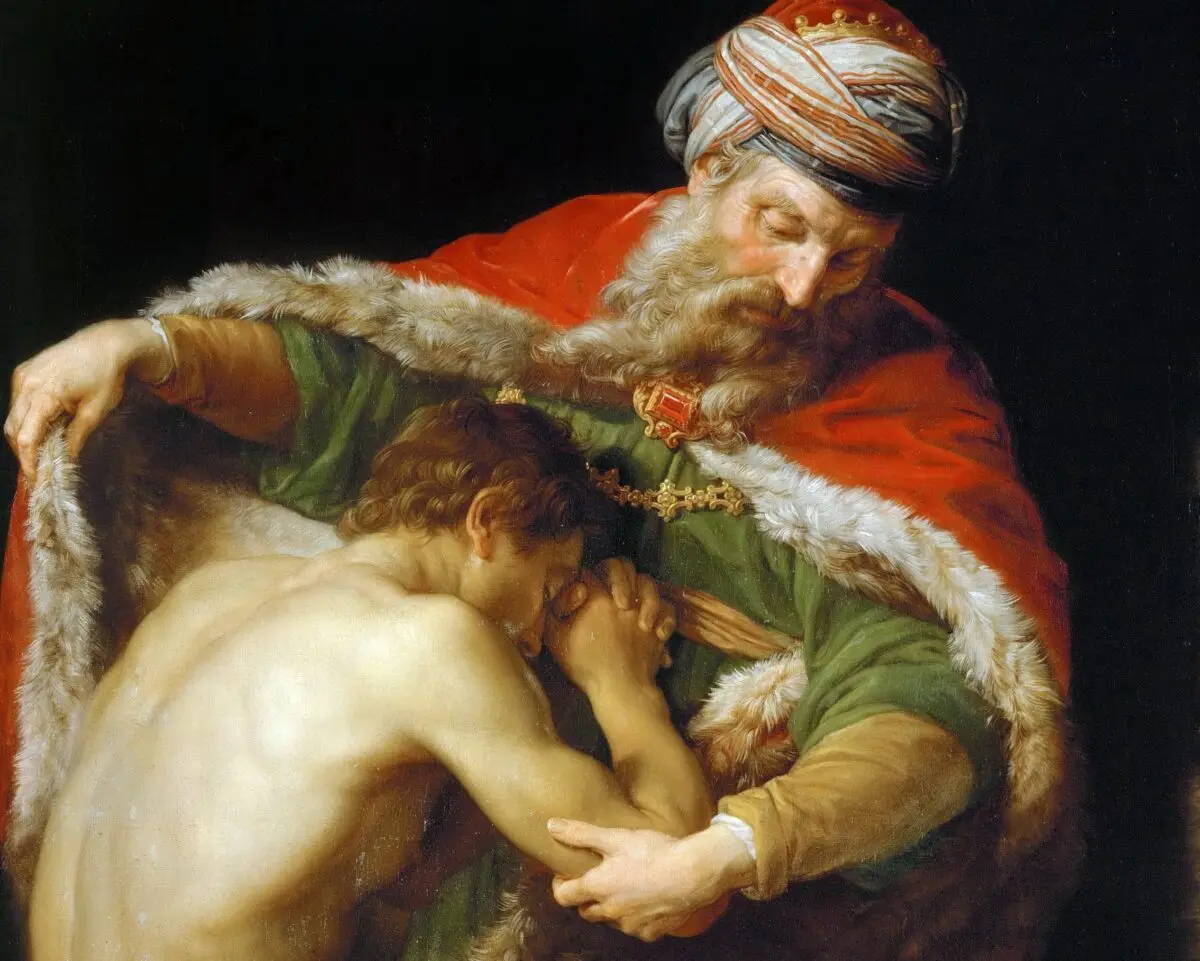
The Biblical tradition gives us narrative wisdom of equal power. The parable of the Prodigal Son is often read as a simple story of sin and repentance. But it is deeper than that. The younger son is lost through appetite, waste, and rebellion. The elder son is lost through resentment, self-righteousness, and his inability to rejoice. The father’s mercy exposes both. The story refuses to let us divide the world neatly into sinners and respectable people. Both sons need restoration.
The Good Samaritan is equally brilliant. Jesus is asked, “Who is my neighbor?” Instead of offering a definition, he tells a story. A wounded man is ignored by those who might be expected to help and rescued by a Samaritan, a member of a despised group. The parable reverses the original question. It is not, “Which people qualify as my neighbors?” but, “Am I willing to become a neighbor to the person in need?” The story does not merely answer the question; it transforms it.
Perhaps the Book of Job is the greatest wisdom narrative of all because it resists simplification. Proverbs often teaches that righteousness leads to blessing and wickedness to ruin. Job asks what happens when the righteous suffer and no explanation is adequate. The friends of Job offer conventional answers. They defend a tidy moral universe. But Job’s suffering breaks open a deeper mystery. Wisdom here is not an easy formula; it is reverence before a reality too large for our explanations.
Words That Live On
Stories also protect wisdom from premature certainty. A maxim or aphorism can be seized too quickly, flattened into advice, or used as a slogan—something we are perhaps more familiar with today in the form of the “meme.” A true story resists that. We cannot exhaust Oedipus, Job, Arjuna, or the Prodigal Son. They change as we change. We return to them at different ages and discover new meanings because we ourselves have become new readers.The modern world has not lost stories, but it has often lost the habit of reading them wisely. We consume narratives as entertainment, ideology, escapism, or “content.” The ancients did something more demanding. They allowed stories to judge them. They asked: Where am I in this tale? Am I Midas, starving amid my gold? Am I Icarus, confusing possibility with permission? Am I Oedipus, solving every problem except the problem of myself? Am I the elder brother, outwardly obedient but inwardly loveless? Am I Duryodhana, choosing the army? Or am I Arjuna, choosing the charioteer?
Classical wisdom survives because the human condition has not changed. Our instruments are new; our temptations are ancient. We still trade the soul for success, mistake power for truth, confuse cleverness with wisdom, and seek to master the world while remaining strangers to ourselves. The great stories remain because they know us. And if we read them rightly, they do more than inform the mind: They awaken the soul. Put another way, they bring us back to life—real life.