We have reached the 12th and final Labor of Herakles, and with it, the whole cycle comes to its darkest and most dangerous point. Earlier Labors required courage, ingenuity, restraint, endurance, and the restoration of order in a world constantly threatened by chaos. Herakles has faced the Nemean Lion, the Hydra, the Ceryneian Hind, the Erymanthian Boar, the Augean Stables, the Stymphalian Birds, the Cretan Bull, the Mares of Diomedes, the Girdle of Hippolyta, the Cattle of Geryon, and the Apples of the Hesperides.
The Ultimate Boundary
He has traveled to swamps, mountains, deserts, foreign kingdoms, the edge of the western world, and the garden of immortality. But now he must go further still. His final task is not to confront a beast in the world, nor to retrieve a sacred object from the margins of it. He must descend into Hades itself and bring back Cerberus, the hound of the dead.This is why the 12th Labor is so climactic. It is not merely another adventure but the logical culmination of all that has preceded it. The hero who began by facing death symbolically in the form of the Lion must now face death literally. The monster is no longer in the forest, the marsh, the sky, the stable, the mountain, or the western island. It stands at the gates of the underworld.
To enter Hades and return was already almost beyond imagining; to bring out its guardian was more extraordinary still. Since Zeus established the order of the cosmos, the boundary between the living and the dead had been one of its most inviolable laws. Herakles’s success, therefore, earns him the aura of one who has achieved the impossible and the epithet ‘glorious victor’.
Cerberus, the three-headed dog of Hades, has already been the subject of a previous article of mine, where I explored his symbolism as a figure of Time: past, present, and future, devouring all things. I do not want simply to repeat that discussion here. But it is enough to recall that Cerberus is no ordinary guard dog. He is the boundary-marker between the living and the dead, the creature who permits entry into Hades but prevents escape. In other words, he enforces the final law of mortal existence. Everyone may enter death; no one may leave.
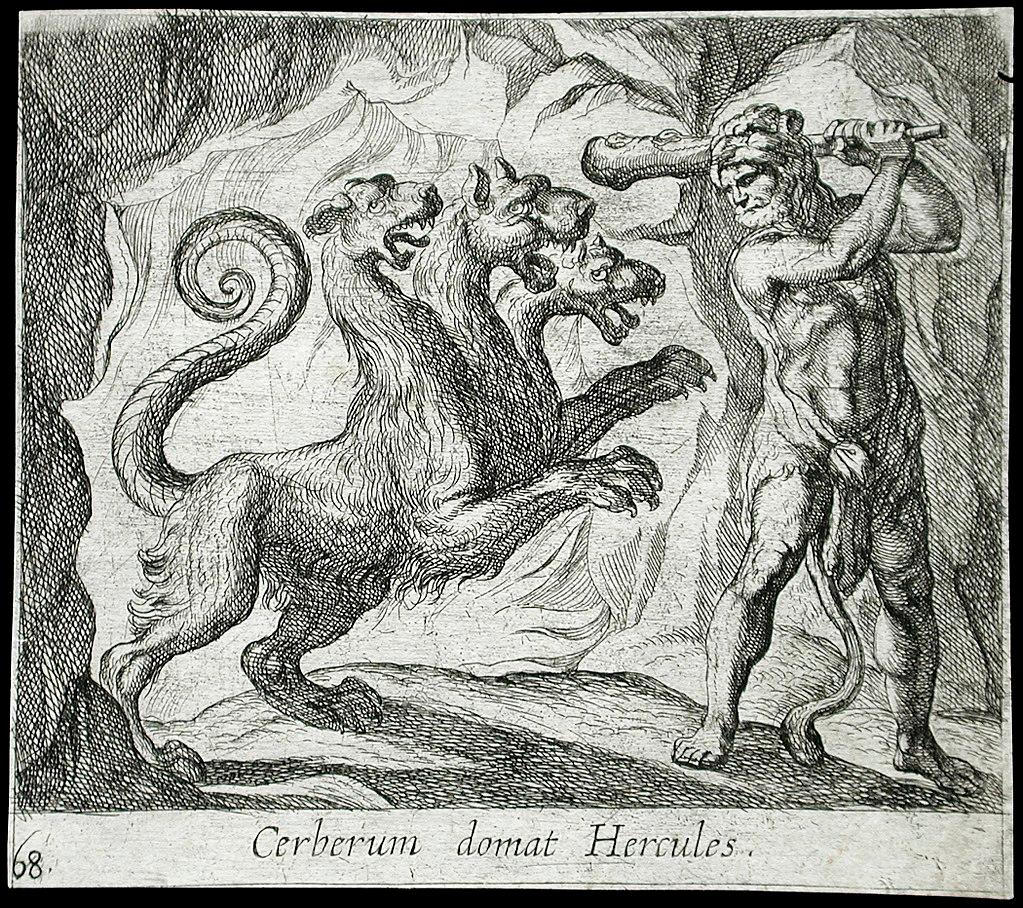
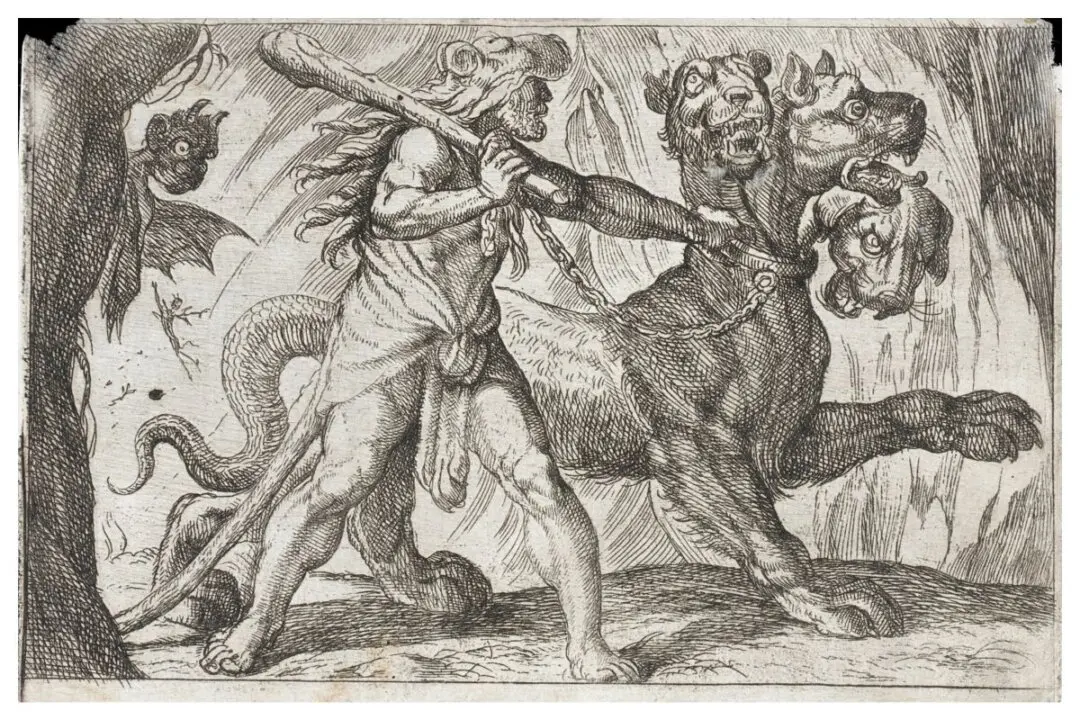
Hercules overcomes Cerberus, in Greek mythology. Public Domain
Ancient and modern writers alike have understood this asymmetry. Virgil puts it magnificently: “It is easy to descend into Avernus. Death’s dark door stands open day and night. But to retrace your steps and get back to upper air, that is the task, that is the undertaking.” More recently, British explorer Colonel Percy Harrison Fawcett is reported to have said during his 1921 Amazon explorations: “The exit from Hell is always difficult.” Getting in is one thing; getting out, another.
This gives the Labor its extraordinary force. Herakles is not being asked to kill Cerberus. Nor is he asked to destroy Hades or overturn the underworld. He is commanded to enter the realm from which no living man is expected to return, master its guardian, and bring that guardian temporarily into the light.
What does this mean? It means that this is not rebellion against death in any crude sense. Herakles is not seeking to annihilate death itself. He must face the deepest limit of human life, but he must not destroy the structure of the cosmos—the order Zeus established. Indeed, Hades himself permits the attempt, but on one condition: Herakles must subdue Cerberus without weapons. That condition is critical because it suggests that the liberation of the soul cannot depend upon any technology, instrument, or external power. Naked we enter the world, as Job says, and naked we must depart it.
Weaponless in the Underworld
Throughout the Labors, Herakles’s weapons have mattered. His bow and poisoned arrows, his club, his physical strength—all have enabled him to overcome numerous foes. But in the final Labor, he must relinquish the ordinary instruments of conquest. No arrow dipped in Hydra’s blood can help him here. No spear, sword, or club will do. The hero must descend into death and overcome its guardian by sheer force of soul. His lion skin is permitted, but that is not a weapon. It is the fruit of an earlier victory, a protective sign of courage already won. This is the final purification of heroism. The Labor is not only physical but spiritual.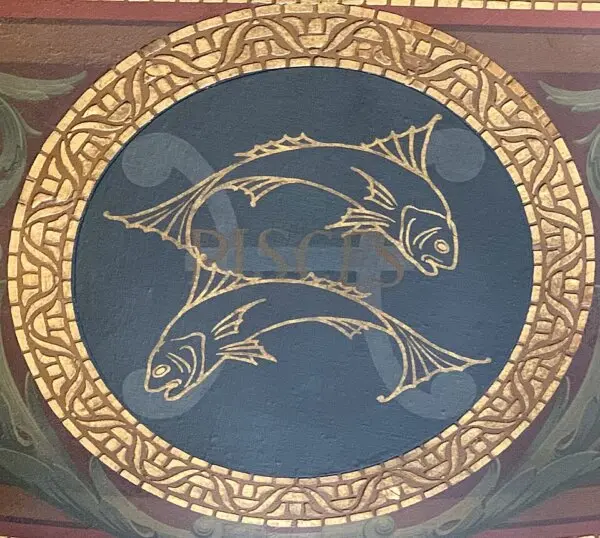
In the 12th Labor, Herakles enters the realm of Pisces—the sign of dissolution and transcendence—to face death itself.AnotherGypsy/CC BY SA-4.0
Symbolically, this final Labor belongs to Pisces, the last sign of the zodiac and the sign associated with dissolution, sacrifice, compassion, and the crossing of boundaries between worlds. Pisces is water at its most mysterious: not the marsh of the Hydra or the dark appetite of Scorpio, but the vast oceanic realm in which forms dissolve, and the soul approaches what lies beyond ordinary identity. It is the sign of endings, but also of transcendence. Its two fish, swimming in opposite directions, suggest the final paradox of the cycle: descent and ascent, death and return, dissolution and renewal. It is striking, too, that the fish became a symbol of the early Christians, whose own central hero also descends into death and, in the language of the Creed, into hell itself. In Christian tradition, this becomes the Harrowing of Hell: the victory of life entering the kingdom of death.
How fitting, then, that the 12th Labor should involve descent into the underworld. The whole zodiacal and moral cycle of the Labors has moved from assertion to surrender, from force to wisdom, from conquest to passage. Leo began with the Lion and heroic courage; Pisces ends with Cerberus and the encounter with death.
Between the two stands the whole education of the soul. This is why the Piscean symbolism is so apt. Pisces is a water sign, and water has always suggested depth, feeling, dissolution, mystery, and the hidden currents of the inner life. Traditionally, the deepest life of the soul is located not in calculation, or the head, but in the heart—the seat of courage, sorrow, compassion, and love. Thus, as the cycle reaches its end, Herakles is tested not merely in strength or intellect, but in the depths of the heart. He must enter the realm where all human defenses dissolve, and where only the soul’s deepest courage can endure.
The myth also tells us that before descending, Herakles is initiated into the Eleusinian Mysteries. This detail is easy to overlook, but it is profoundly important. The mysteries were concerned with death, rebirth, and the hope that existence was not exhausted by mortal decay. Herakles cannot enter Hades merely as a brute adventurer. He must be prepared. He must be ritually and spiritually made ready for the encounter.
And we should not miss the feminine principle of life embedded here. On the one hand, Herakles undertakes the Labors because of the enmity of Hera, queen of heaven; on the other, his entry into Hades is prepared through mysteries sacred to Demeter and Persephone. Persephone, queen of the underworld, is not merely Hades’s wife but the goddess of return, seasonal renewal, and life emerging from darkness. Herakles’s initiation, therefore, places him under the sign not only of death, but of possible rebirth.
This too distinguishes the final Labor from the earlier ones. Strength may get a man through many dangers, but it cannot by itself prepare him for death. For that, initiation is required—a change in consciousness, a purification of vision, a recognition that the underworld is not simply a place of horror but a realm of profound truth.
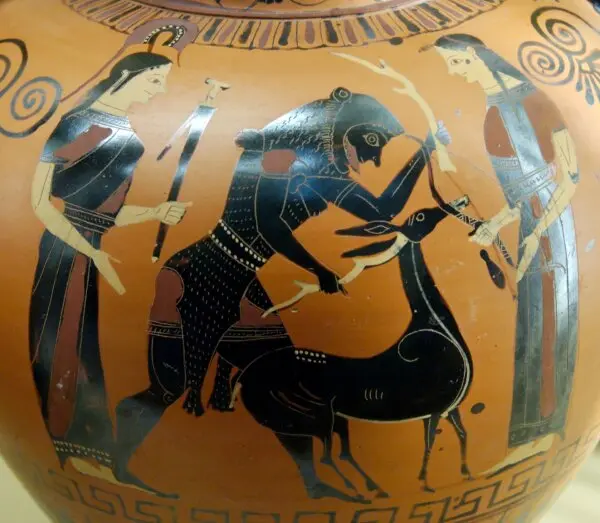
An amphora dating from circa 540 B.C. to 530 B.C. depicting Herakles. Public Domain
Confronting the Shadows of the Underworld
When Herakles enters Hades, he encounters not merely darkness but memory, sorrow, and the unresolved burdens of human life. In some versions, he meets the shades of the dead, including figures from earlier myths. He rescues Theseus, who had been trapped in the underworld after attempting, foolishly and arrogantly, to seize Persephone. The contrast is instructive. Theseus descends in presumption; Herakles descends under command, with permission, discipline, and purpose.There is a great difference between violating the underworld and entering it rightly. This is another of the Labor’s central lessons. Herakles does not storm Hades as an invader. He does not overthrow the king. He respects the order of the place even as he temporarily crosses its boundary. Once again, the son of Zeus is not destroying order but fulfilling it. His greatness lies not in breaking the cosmic structure but in moving through it without being destroyed by it.
Perhaps even more significantly, he meets Meleager, one of the few shades who does not flee from him. Meleager has died in tragic circumstances, and his story moves Herakles to tears—one of the rare moments in the mythic tradition where the hero’s grief is so openly displayed. Their encounter has consequences. Herakles swears that, if he returns to the upper world, he will marry Meleager’s sister, Deianira. This is truly one of the stings of Hades: for the wife chosen in the underworld will later become, however unwittingly, the agent of Herakles’s death. Irony is piled upon irony. The hero, whom no monster or man can finally defeat, will be undone by a woman’s love, and the deception derived from the poisoned legacy of his own past violence.
In the final part of this story, we will follow Herakles into Hell and look at what happens when he comes before the thrones of Hades and Persephone.
What arts and culture topics would you like us to cover? Please email ideas or feedback to [email protected]