This is a crucial moment in the myth, because it shows once more, as earlier Labors have, that Herakles’s deepest achievement is not disorder, but order. He does not overthrow Hades. He does not challenge the king of the dead for sovereignty. He does not attempt to empty the underworld or abolish its function. Instead, he asks permission to take Cerberus temporarily into the upper world.
In doing this, Herakles recognizes the lawful structure of the cosmos. Zeus rules the sky; Poseidon rules the sea; Hades rules the dead. Each realm has its proper boundary, and even the greatest of heroes must acknowledge it. The son of Zeus is not licensed to wreck the order his father established. His greatness lies in passing through the deepest limit without destroying it.
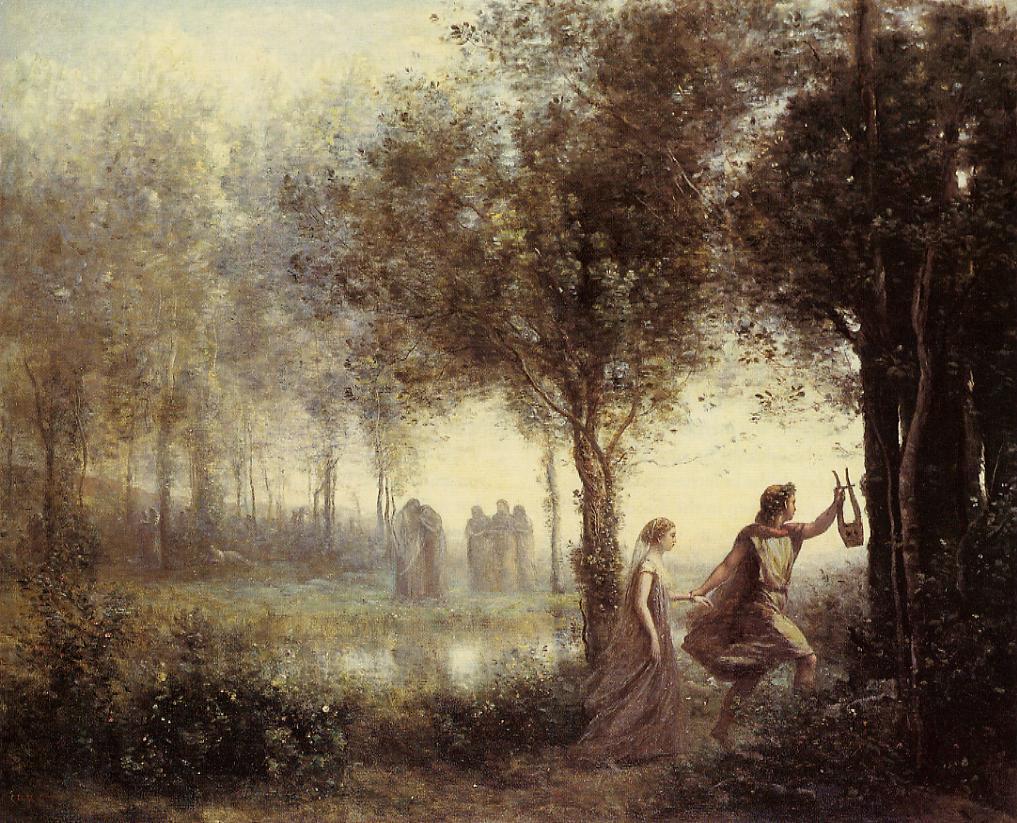
Yet the encounter is not without wonder. In Diodorus Siculus’s account, Persephone welcomes Herakles “like a brother,” and it is by her favor that he receives Cerberus in chains and brings him up from Hades. The phrase is quite remarkable when you think about it. In the kingdom of death, where all ordinary human bonds have been dissolved, the hero is received not as an intruder but almost as kin. This is surely more than courtesy.
Herakles has been prepared by the Eleusinian Mysteries, sacred to Demeter and Persephone; and now the queen of the underworld recognizes in him one who has entered the realm rightly.
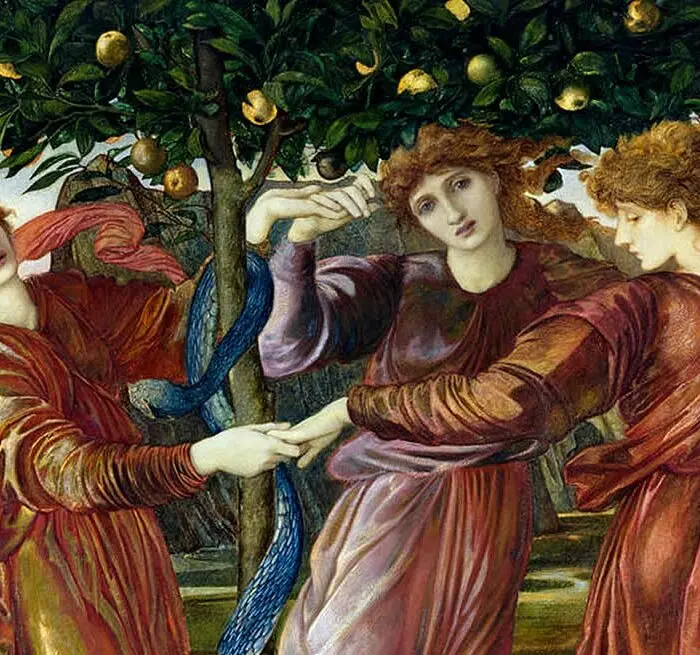
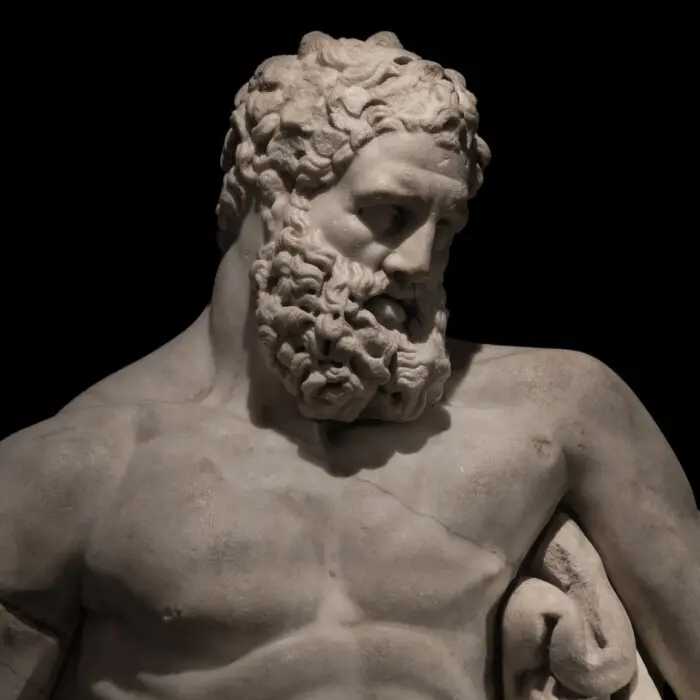
Nor is Persephone passive. In Apollodorus’s account, when Herakles wrestles Menoetes, the herdsman of Hades, and breaks his ribs, Persephone intervenes and asks that Menoetes be spared. In Diodorus’s version, it is by the favor of Persephone that Herakles receives Cerberus in chains and brings him up to the light. Thus the feminine principle returns at the decisive moment. The enmity of Hera, queen of heaven, drove Herakles into the Labors; the favor of Persephone, queen of the underworld enables him to complete them.
This is one of the great symmetries of the story. At the beginning, a goddess opposes him. At the end, a goddess receives him. One queen drives him into suffering; another queen permits his return and release from suffering. The underworld, then, is not simply a place of horror. It is also the place where judgment, mercy, memory, and hidden kinship are revealed.
Hades agrees to the attempt, but imposes the famous condition: Herakles may take Cerberus only if he can subdue him without weapons. This is the hinge on which the whole Labor turns. Throughout the twelve Labors, Herakles has learned to use many kinds of power: physical force, intelligence, restraint, endurance, creativity, and moral judgment. He has used the club, the bow, the Hydra’s blood, the rattle of Athene, and the wisdom of divine or semi-divine guides. But here, at the gate of death, the usual instruments fall away. No external weapon can conquer the last enemy. The hero must face Cerberus with nothing but himself.
And yet he is not alone. In many versions of the myth, Herakles is aided or guided by Hermes and Athene. This, too, is significant. Hermes is the psychopomp, the guide of souls, the god who moves between worlds and crosses boundaries that others cannot cross. Athene is wisdom, clarity, and divine strategy. Their presence suggests that the descent into death requires both guidance and wisdom. Courage alone is not enough. One must know how to cross and how not to be lost.
Facing the Monster
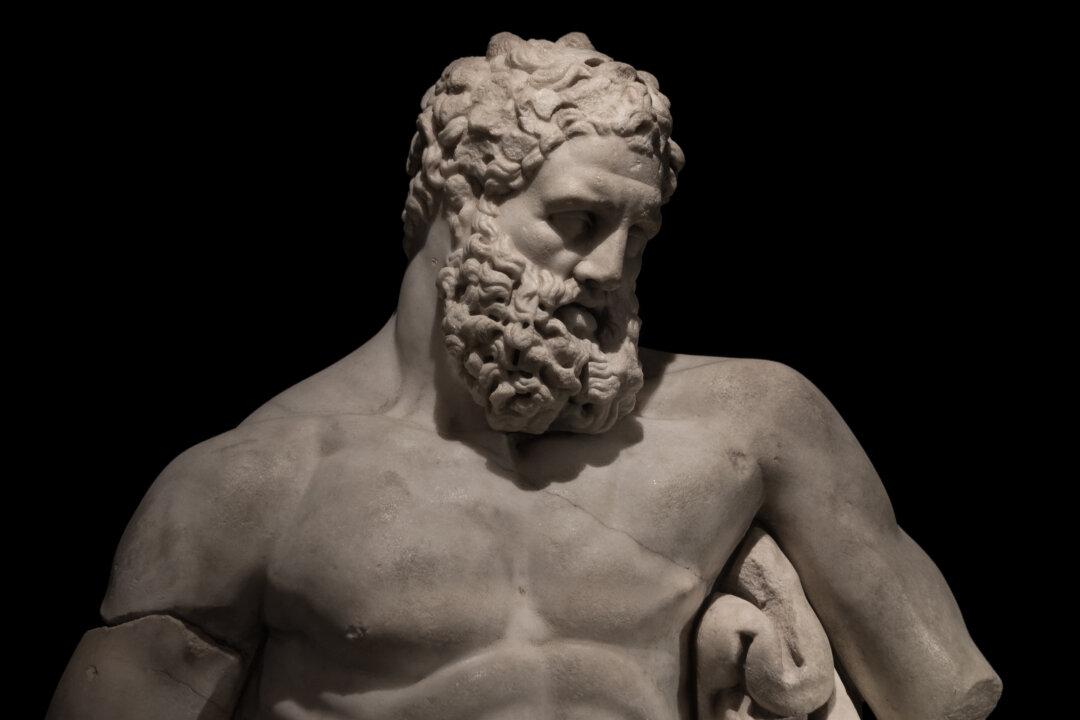
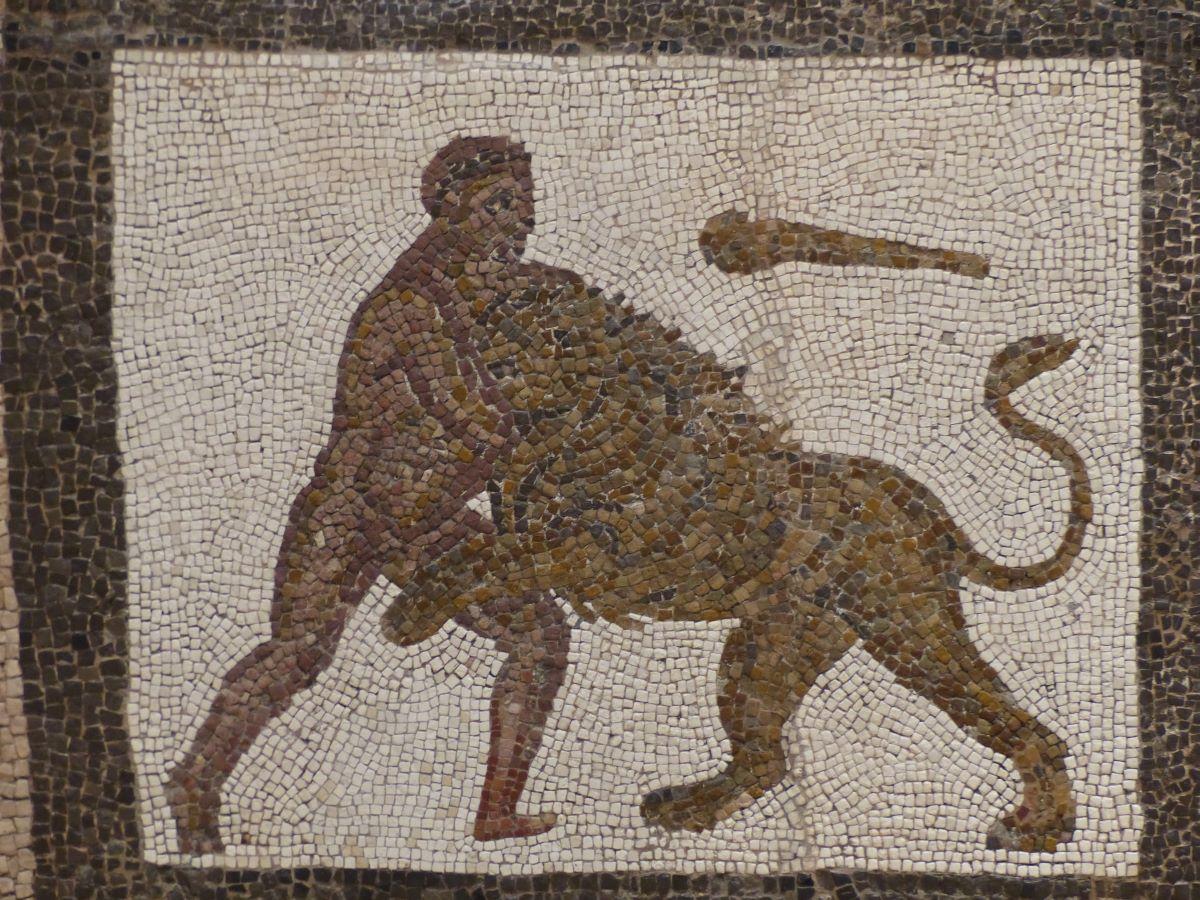
Cerberus, the monstrous hound of Hades, stands as the guardian of the threshold. His three heads, as I have discussed in an earlier article, suggest past, present, and future: time itself, devouring all things. But here, in the drama of the final Labor, Cerberus is more than a symbol. He is the living terror of the boundary that no mortal may pass in reverse. He is the growling, ravenous fact of death.Herakles seizes him. The image is among the most powerful in all mythology: The hero wrapped in the indestructible skin of the Nemean Lion, wrestling the hound of Hell with his bare hands. Here, the first Labor returns within the last. The Lion’s pelt—not a weapon, but a protective covering—won at the beginning of the cycle, protects him at the end.
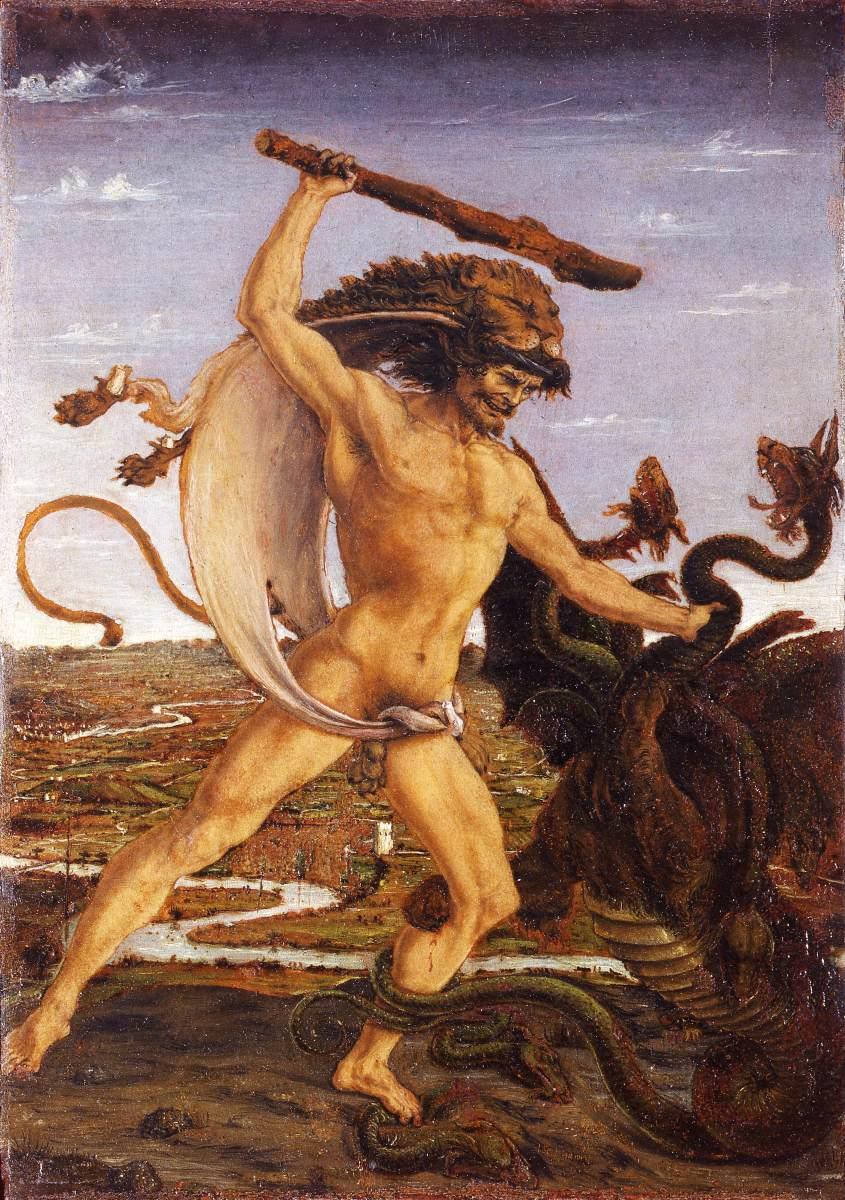
And this is especially fitting, since Cerberus, the Hydra, and the Nemean Lion all belong, in one form or another, to the same monstrous family of Typhon and Echidna: the brood of chaos resisting the ordered cosmos of Zeus. Thus, one defeated monster becomes the defense against another. Evil, once mastered, is made to serve the good. The courage that began the journey becomes the armor by which Herakles survives its culmination. Nothing truly learned is wasted, for earlier victories become later safeguards.
Even so, the struggle is terrible. Cerberus bites savagely. Its serpent-tail lashes. Its monstrous mouths snap and tear. The point is important: Herakles is not immune to death’s violence merely because he is heroic. He suffers the encounter; he is wounded by it. The hero does not transcend death by pretending it is harmless, but by enduring its assault without surrender.
This is perhaps the deepest lesson of the scene. Courage is not invulnerability. It is the capacity to remain present when the thing we fear most fastens its teeth upon us. Eventually, Herakles subdues Cerberus. He binds him and drags him upward, out of the darkness, into the realm of the living. For a moment, death—our ultimate darkness—itself is brought into the light.
The effect on King Eurystheus is almost comic but also profound. The king who devised impossible tasks in order to destroy Herakles cannot endure the sight of their fulfilment. He hides in terror, as he has done before. The man who commanded the descent cannot bear the return. This is one of the ironies of the Labors: Those who casually demand confrontation with ultimate realities often have no capacity to face those realities themselves.
Herakles, by contrast, has looked directly into the underworld and come back. But he does not keep Cerberus: Herakles returns the hound to Hades. Death is not abolished; the boundary remains; the cosmos is not overturned. Cerberus resumes his proper function as guardian of the dead. And yet everything has changed.
The Takeaway
And so it is with us. Human beings cannot avoid death by strength, technology, wealth, or reputation. Naked we enter the world, as Job says, and naked we must depart it. But the fact of death need not reduce life to futility. On the contrary, rightly understood, death gives urgency, seriousness, and shape to life. It asks what kind of soul we are forming before the final threshold arrives.This is why the Labor completes the whole Heraklean cycle so perfectly. The first Labor, the Nemean Lion, taught Herakles to face fear and transform it into protection. The last Labor teaches him to face death and return with deeper knowledge. Between those two stand all the other forms of disorder: chaos, appetite, rage, corruption, poisonous noise, broken trust, and the burdens of endurance. Each Labor has educated some faculty of the hero. But the final Labor gathers them all into one test. Here strength, courage, reverence, wisdom, endurance, and spiritual preparation converge.
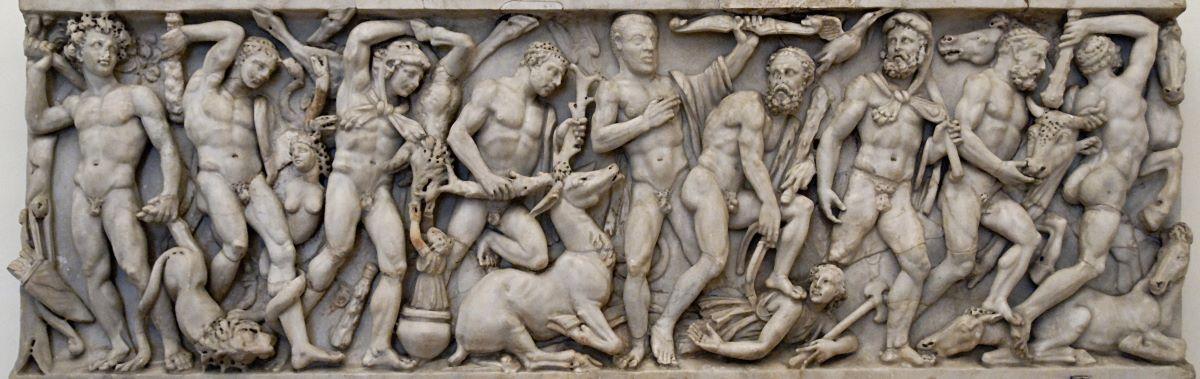
Nor should we miss the Christian resonance, though the myth remains Greek. Herakles’s descent into Hades inevitably recalls the later Christian image of Christ descending into Hell and harrowing it. The difference is important: Herakles does not redeem all souls (though he does actually redeem or release Theseus who is trapped there) or conquer death in the Christian sense. But the pattern is suggestive. A divine son descends into the realm of death, confronts its power, and returns to the light. Myth here spills into the domain of theology.
For Herakles himself, this final Labor foreshadows his own destiny. He will not remain merely a hero of great deeds. After further suffering, betrayal, and death by the poisoned garment of Deianira, he will be raised to Olympus and join the immortals. The man who entered Hades and returned has already begun to outgrow ordinary mortality. Thus, the Labors end where all true wisdom must eventually lead: at the border of death.
Cerberus goes back to Hades. Herakles returns to life. The cosmos remains ordered. But the hero has changed. He has passed through the darkest threshold and discovered that the soul, prepared by courage and purified by suffering, need not collapse before death’s gate. And that, perhaps, is the final meaning of the Twelve Labors. Herakles has not merely cleaned stables, slain monsters, captured beasts, or retrieved sacred objects. He has enacted the education of the soul from raw strength to spiritual courage. He began by mastering fear in the world outside him; he ends by confronting the death that awaits every human destiny.
The final victory, then, is not possession, domination, or even escape. It is return—the return of the hero who has seen the darkness, honored the order of the cosmos, and come back bearing the knowledge that death is real, but not sovereign over courage. Perhaps this is why the pattern remains so modern. Tolkien understood it perfectly in Bilbo’s great adventure: “there and back again.” The hero must leave the familiar world, pass through darkness, and return changed—bringing back not merely survival, but wisdom.