NAPERVILLE, Ill.—The audience’s jaw-dropping shrieks of laughter began as the character Max Bialystock stood outside a theater lamenting the fate of his production that was closing after only one night. He didn’t understand why “Funny Boy,” his reinvention of Shakespeare’s “Hamlet,” received lousy reviews such as “it was the worst show ever” and “everyone dies at the end; they were the lucky ones.”
The wildly satirical and politically incorrect musical, written by Mel Brooks and Thomas Meehan, centers on Max Bialystock, a loser on Broadway who yearns for success, and his business partner Bloom, a neurotic and unhappy accountant. Bloom has the bright idea that someone could make more money producing flops than box-office hits.

Inspired by the possibility of making a fortune, they read through piles of plays looking for a truly awful one—the kind of play that will offend everyone, the kind of play that everyone will hate, the kind of play guaranteed to close within hours of opening. They believe they have found such a work with “Springtime for Hitler—A Gay Romp with Adolf and Eva at Berchtesgaden.”
The play was written as a love letter to Hitler by Franz Liebkind (Myles Mattsey whose comic German caricature is a hoot). Once Max and Leo get the rights to the play, they have to find the world’s worst director. They don’t have to go too far to come up with Roger DeBris, portrayed in an over-the-top romp by John B. Boss.
Brooks wrote 17 of the songs and lyrics himself, outlandishly insulting everyone from Broadway performers, to Germans, to the Irish, to Nazis, and to Hitler. He even makes fun of Swedes. The blonde Swedish receptionist in the show has the tongue-twisting moniker of Ulla Inga Hansen Benson Yansen Tallen Hallen Svaden Swanson. She’s played by Amelia Tam and stands out with “When You Got It, Flaunt It.”


The show heavily mocks the entertainment industry and the concept of success. Max and Leo try their hardest to create an absolute failure, yet the public turns it into a massive hit anyway. It suggests that public taste is unpredictable, or possibly that they have no taste, and showbiz success is often accidental.
At its core, the musical is a classic buddy story. Max Bialystock is a cynical, corrupt older man while Leo Bloom is a timid, repressed accountant. Through their shared scheme, Max learns to genuinely care about someone else, and Leo finds the courage to break free of his boring life. They ultimately choose friendship over money.

A Sidesplitting Comedy
Directed in Vaudevillian-style exuberance by Jeffrey Cass, the action moves from hilarity to hysteria. Ariel Mozes sets an intimate stage, whose backdrop images convey various locations.Susan Stroman’s original dance numbers (from 2001) were reprised by Mary Grace Martens, who choreographed a racy group of elderly women clicking up their heels and dancing with their walkers, as well as a parade of German dancers who are ridiculously costumed by Cheryl Newman.
Although everything about this show is top notch, it all comes together perfectly due to the palpable chemistry between the two main characters: Max Bialystock and Scott Kelley deliver burlesque antics that recall the song-and-dance clowns of yesteryear. As Bialystock’s partner-in-crime Leo Bloom, Michael Metcalf almost steals the show with his blue-blanket desperation.
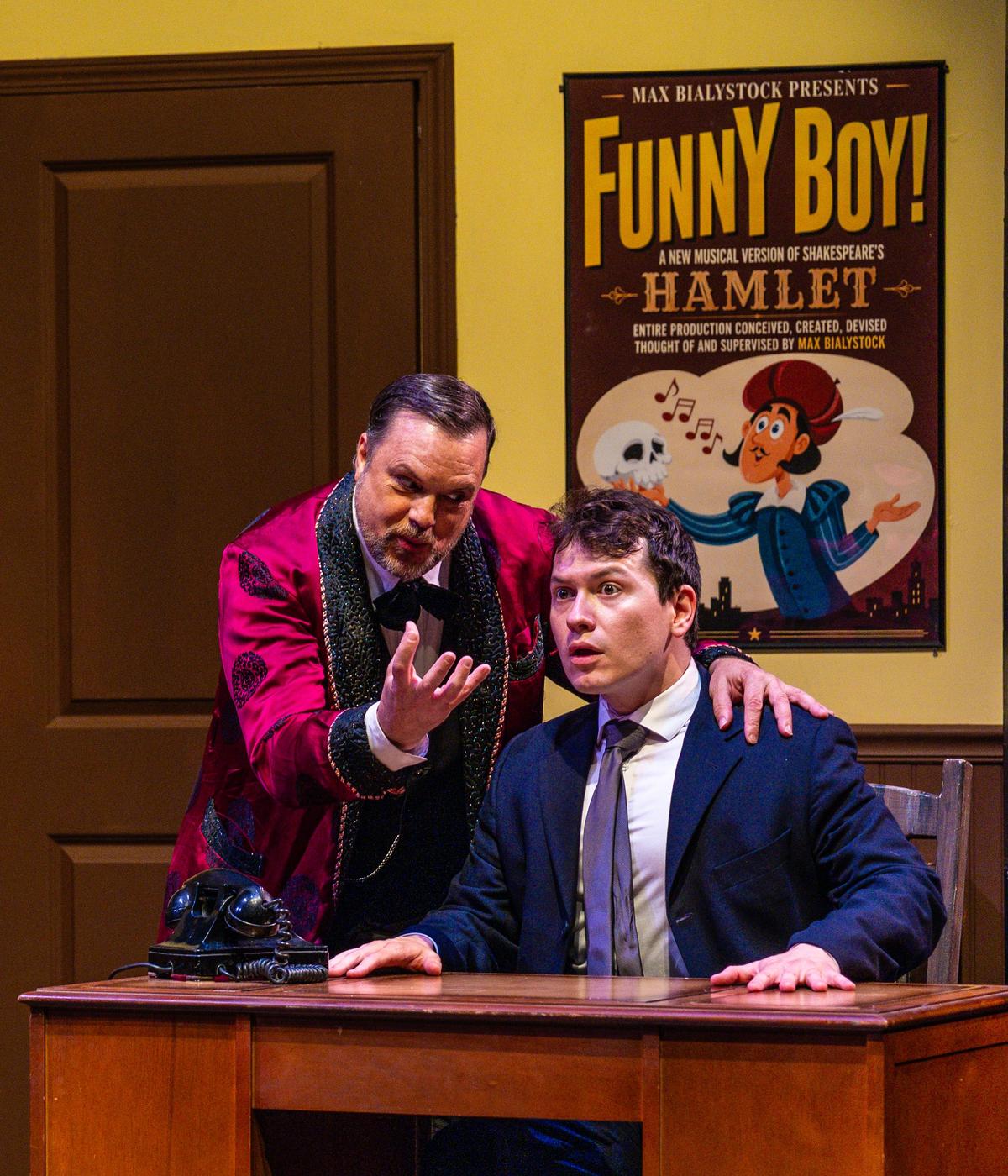
Beneath the offensive jokes and campy humor, the musical contains a few underlying themes. In a 2001 CBS “60 Minutes” episode, Brooks stated that his goal was to strip Adolf Hitler of his postwar mystique by laughing at him. Comedy and ridicule can be used as weapons to disarm, disempower, and defeat terrifying historical figures and ideology.
Brooks succeeded in that attempt, as the howling sound of laughter filled the theater auditorium from an audience that looked to be rolling in the aisles.