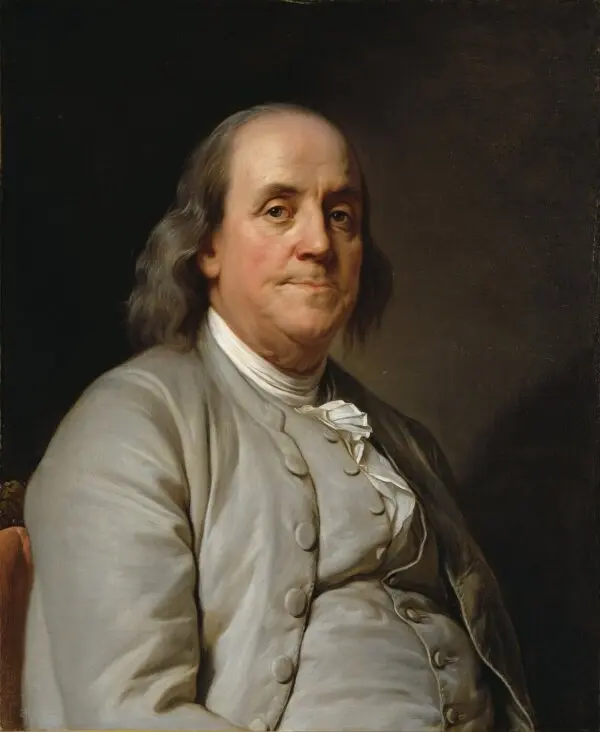
Ben Franklin never wrote or said, “A penny saved is a penny earned.” What he did write in 1737 in “Poor Richard’s Almanac” was the less catchy “A penny saved is two pence clear.”
While we remember Franklin as an inventor, a statesman, a signer of the Declaration of Independence, and a wise guide in shaping our Constitution, he was also a model of American frugality. He wrote about the value and practice of thrift in his essay “The Way to Wealth” and in his “Autobiography,” and lived in accordance with what he wrote. Unlike Thomas Jefferson and some other debt-plagued American Founders, Franklin died a wealthy man.
Americans a century ago remembered and honored that frugality. In 1920, Charles Towson, a Scranton, Pennsylvania YMCA leader, prevailed upon the organization to support and broaden National Thrift Week, a program founded in 1916. The chosen kickoff date was January 17, Ben Franklin’s birthday.
Thrift vs. Consumerism
Beginning around 1900, various thrift movements were emerging across the United States. The aims were sometimes different—the Women’s Christian Temperance Union, for instance, latched onto the movement as a vehicle to encourage men to spend their wages on their families rather than on booze—but in general, these groups battled what they regarded as rampant consumerism. The U.S. Treasury Department offered its support, so that when the YMCA launched its Thrift Week the government enthusiastically joined hands in its promotion.Though National Thrift Week was popular and gained many supporters, the Great Depression began to erode it. To help pull the nation out of its hard times, Franklin Roosevelt’s government called for more consumerism and less frugality. Moreover, a week devoted to saving money seemed a bit pointless in a decade of poverty and sacrifice. Nevertheless, National Thrift Week endured until 1966, when consumerism and prosperity finally buried this holiday.
Yet for many, frugality remained a virtue. Plenty of grandparents living today, for instance, can remember their own parents, children of the Depression, insisting that they restrict long-distance phone calls and turn off the lights when leaving the room. And with the onset of the 21st century and its ups and downs in the national economy, many Americans are fighting back against high rents and inflation by tightening up their purse strings.


Self-Discipline
In his 1920 National Thrift Week Proclamation, Governor of Massachusetts Calvin Coolidge, himself noted for his personal frugality, recognized both the YMCA and “Benjamin Franklin, who by precept and example became a teacher of the virtue of thrift.” Declaring that “thrift and economy lie at the basis of civilization,” the proclamation then states that the practice of economizing can “strengthen the character of our citizenship by the exercise of self-control and self-denial ...”. As president, in 1925, Coolidge circled back to this theme while delivering an address in Chicago, “The ultimate result to be desired is not the making of money, but the making of people. Industry, thrift, and self-control are not sought because they create wealth, but because they create character.”Denial of the Self
Coolidge includes self-denial among the flowers of thrift. Franklin in “The Way to Wealth” never uses those words, but spends a good portion of his essay arguing its case. He points out, for instance, the cost and folly of vanities like fancy dress, expensive food and drink, and fashion, spending far too much for what we might call keeping up with the Joneses. Quoting extensively from his own “Poor Richard’s Almanac,” he offers such axioms as “Pride is as loud a beggar as want, and a great deal more saucy.”At one point, Franklin writes, “What madness must it be to run in debt for these superfluities!”
Americans in the 21st century are all too familiar with this madness. The self-denial advocated by Franklin runs counter to the spirit of our age, taking a back seat to self-absorption. Some might argue that denial isn’t even in the car. Put thrift in the driver’s seat, however, and we have a tool for curbing this hyperfocus on the self.
Of course, when misapplied or deliberately twisted, thrift can become a form of self-obsession and greed, creating Scroogelike misers or spongers who leech off others. A skinflint hoards money for its own sake, but real thrift can include the virtuous side of largesse, as in a grandparent who spends little on personal goods, but who delights in being generous and having fun with the grandkids.
Putting Time in a Bank
“But dost thou love life,” wrote Ben Franklin in “The Way to Wealth,” “then do not squander time, for that’s the stuff life is made of … If time be of all things the most precious, wasting time must be, as Poor Richard says, the greatest prodigality, since, as he elsewhere tells us, lost time is never found again, and what we call time-enough, always proves little enough ...”.To Franklin, thrift meant husbanding our minutes, hours, and days with even greater care than we give to our money.
Here perhaps is the most striking lesson we might learn from old-fashioned thrift, particularly in our age of screens, distractions, and entertainments.
While we rarely think about it, we link time and money together in our language, as in “I spent a lot of bucks during that time we spent at the beach.” In addition, we hear “Time is money,” which is often taken to mean that wasted time diminishes our chances of earning more money. Yet the deeper meaning of this three-word aphorism is that time, like money, is precious.
And yet, many Americans, even those who keep a close watch on their checking accounts, credit cards, and debt, spend time as if it came from an inexhaustible bank. Add up the data, for instance, and the average American spends about a day a week on a mobile phone. Throw in the hours spent watching movies, sports, news, and more on television, and those screen hours add up even higher. Here we might think of that adage, “No one on his deathbed ever said, ‘I wished I’d spent more time at the office.’” When death comes knocking on the door, will anyone say, “I wish I’d spent more time on my phone”?
Just as thrift in finances and resources allows us more freedom for simple pleasures, the guardianship of time allows us to spend hours away from work and other necessities of life, enjoying the company of those we love or the activities dear to our hearts.
Time is money. The thrifty will guard and spend both commodities wisely and well.