This copy is for your personal, non-commercial use only. Distribution and use of this material are governed by our Subscriber Agreement and by copyright law. For non-personal use or to order multiple copies, please contact The Epoch Times Reprints.
In this latest installment in our ‘When Character Counted’ series, we meet the Prussian soldier who gave America a step up in its war for independence.
The inauguration of George Washington as the first president of the United States in 1789. Also present are (from left) Alexander Hamilton, Robert R. Livingston, Roger Sherman, Mr. Otis, Vice President John Adams, Baron Von Steuben, and General Henry Knox. Original Artwork: Printed by Currier & Ives. MPI/Getty Images
On February 23, 1778, Baron Friedrich Wilhelm Augustus von Steuben (1730–1794) rode into George Washington’s encampment at Valley Forge.
To imagine this scene provokes a certain grim comedy of contrasts. Decked out in full military regalia, this newcomer to America with his parade-ground voice and imposing presence immediately commanded the attention of the soldiers around him. Years later, then 16-year-old private Ashbel Green recalled the baron as “the perfect personification of Mars. The trappings of his horse, the enormous holsters of his pistols, his large size, and his strikingly martial aspect, all seemed to favor the idea.”
Von Steuben may have called to mind the Roman god of war, but the poorly clad troops who greeted him surely appeared more like dirty, stick-thin castaways on some barren island than soldiers. Though they were approaching the third anniversary of the battles of Lexington and Concord, many of these soldiers were undisciplined, unfamiliar with battlefield drill, and lived in filth and squalor.
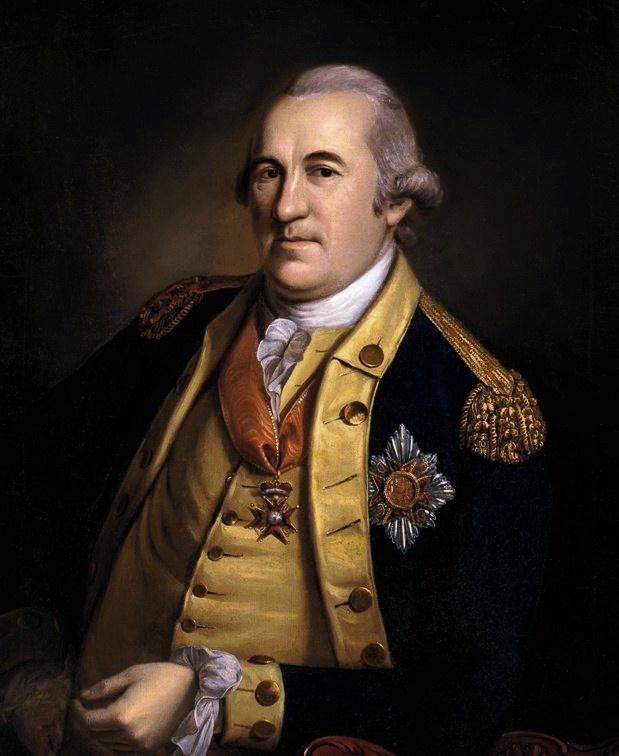
A portrait of Baron Friedrich Wilhelm von Steuben, 1780, by Charles Willson Peale. Von Steuben took a ragtag group of colonials and turned them into a unified army. Public Domain
The Baron’s Two-Pronged Campaign
Though Washington and von Steuben communicated through a translator—the general spoke no French, and the baron had never learned English—Washington quickly took the measure of the man, appointed von Steuben inspector general, and asked him to assess the army.
In his book about Valley Forge, “Washington’s Secret War,” historian Thomas Fleming wrote that what von Steuben found “was nothing less than appalling. He was confronting a wrecked army. A less courageous (or less bankrupt) man would have quit on the spot.”
Though he was in great need of money, von Steuben had taken this assignment from Congress as a volunteer under the conditions that he would be paid only if the Continentals won the war. Some force other than financial need caused him to swallow his doubts about these ragamuffins and take control of the army in two arenas.
The first had to do with sanitation. The soldiers relieved themselves as they saw fit, and often the animals whose flesh they’d eaten were left to rot where they lay. Von Steuben set the men to work digging latrines, placing them far away and downhill from the cooks’ kitchens and wagons. This immediately improved the health of the men and became the standard for American armies in the field.
But it was his drill regimen, accompanied by his thundering curses in German and broken English, that made a new army of this motley crew. Von Steuben started with 100 men, a model company to whom he taught the basics of close-order drill, the fundamentals of rapid firing and bayonet charges, and tactical maneuvers. He then dispersed these men among the rest of the soldiers, overseeing them as they taught others the skills he had taught them.
An Edwin Austin Abbey painting of Baron Steuben drilling American troops at Valley Forge in 1778. Public Domain
The following summer, this hands-on education paid off handsomely at the Battle of Monmouth. The now organized and disciplined Americans stood firm against British shot and cold steel. Though neither side could claim a victory, at day’s end the Americans held the field. Given their past record in battle, this was a major accomplishment, and one for which von Steuben deserves much credit.
Becoming American
Though initially dismayed by the deplorable condition of the army he found at Valley Forge, von Steuben quickly came to admire the spirit of its soldiers. In a letter to a Prussian friend, he touched on an important difference between these Americans and their European counterparts: “The genius of this nation is not in the least to be compared with that of the Prussian, Austrians, or French. You say to your soldier ‘Do this and he doeth it’; but I am obliged to say [to the American soldier]: ‘This is the reason why you ought to do that: and then he does it.’”
The soldiers took to von Steuben as well. His fierce curses became a source of entertainment, and the dinner parties he hosted for his officers proved popular.
At the behest of Washington, the baron began putting together an instruction manual based on his ideas. In 1779, he published “Regulations for the Order and Discipline of the Troops of the United States.” Known popularly as the “Blue Book”—the printer had it bound cheaply in blue paper due to a shortage of supplies—this manual differed from its British counterpart in that it stressed skill and talent rather than social class in its hierarchy of leaders. The “Blue Book” was used until the War of 1812 and has continued to influence other manuals down to our present day.
Von Steuben remained with the army until Cornwallis’s surrender at Yorktown. Granted a tract of land by the governor of New York in recognition of his services—Congress followed up with a lifetime annuity in 1790—the baron lived out the rest of his days on that wooded estate, popular among the locals and the well-to-do of New York City, and still struggling, usually because of his own financial mishaps, to keep the wolf from the door. He is buried on a piece of the land he owned, still known today as the “Sacred Grove.”
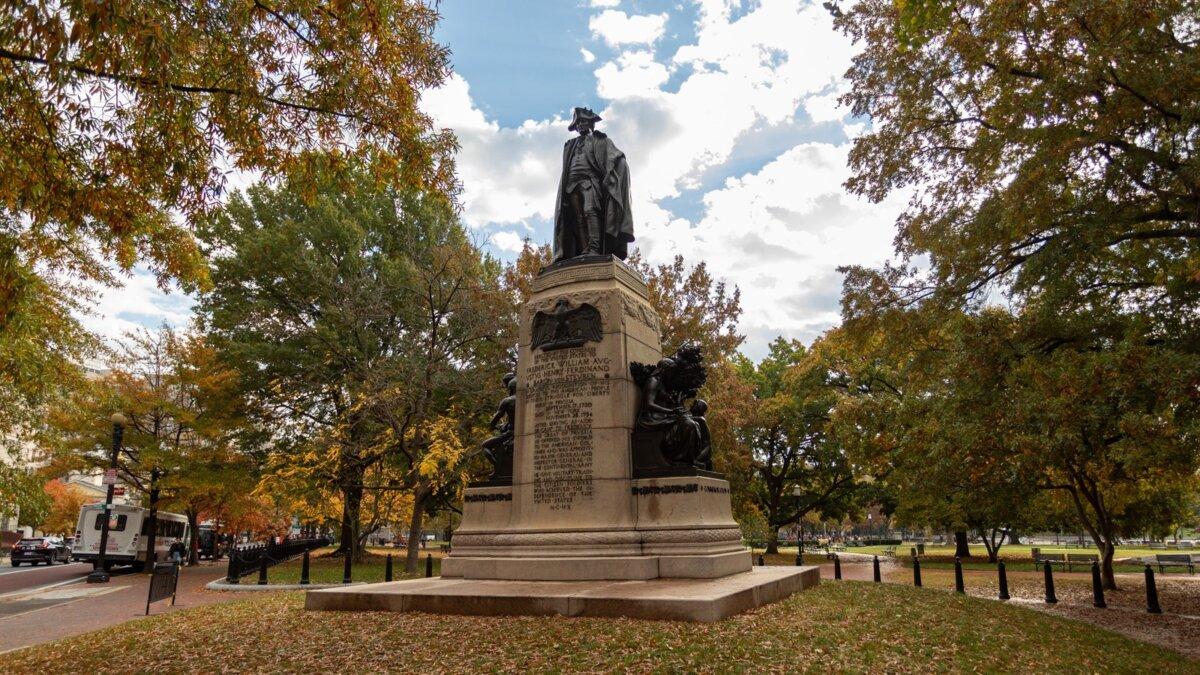
Statue of General von Steuben, Valley Forge National Historical Park, Penn. National Park Service. Public Domain
There’s a certain irony in von Steuben’s American success story. When he had arrived from Europe hoping for a command and payment from the Continental Congress, he had never served as a general, as some believed, but only as a captain, and he’d left the Prussian army more than a decade earlier. After spending 11 years as a German prince’s court chamberlain, a decline in his employer’s fortunes cost him that position, and like millions of others since then, he came to America looking for a new start.
One man’s loss is another man’s gain, goes the old saying. In this instance, Baron von Steuben’s personal misfortune was America’s gain.
What arts and culture topics would you like us to cover? Please email ideas or feedback to [email protected]
Jeff Minick has four children and a passel of grandkids. He has written two novels, “Amanda Bell” and “Dust on Their Wings,” as well as “Learning as I Go” and “Movies Make the Man.” You’ll find more of his writing at JeffMinick.substack.com.