Repair technicians have been saying it for years, and the data are catching up. Appliances built in the 1970s generally lasted 30 to 50 years. Today, washing machines, ovens, fridges, and dryers get replaced about every decade.
Association of Home Appliance Manufacturers trade group data show appliance lifespans dropped from 11 to 16 years in 2010 to nine to 14 years by 2019. The problem compounds at the point of sale: Unlike consumers in France, American buyers have no standardized repairability label to consult before purchasing.
Quick Answer: How Do I Know if an Appliance Is Repairable Before I Buy It?
Pre-purchase repairability auditing is difficult in the United States because no mandatory scoring system or database exists for appliances sold here. Your most accessible tools are iFixit teardown guides, independently produced and searchable by model number, and a manual check of third-party parts availability at retailers like RepairClinic, PartSelect, and AppliancePartsPros before you commit to a purchase. Avoiding models with app-dependent core functions is often the single most protective decision you can make without specialized research.Why Modern Appliances Fail Faster
Two design trends drive the compressed lifespan most households now experience with their appliances:Sealed Components
Manufacturers have moved toward glued enclosures, proprietary fasteners, and soldered-in parts that make internal access expensive or impossible.Software Dependency
Appliances with Wi-Fi modules, touchscreens, and app connectivity carry a second lifespan clock alongside their mechanical one. When a manufacturer discontinues a companion app or stops pushing firmware updates, a functionally sound machine can become operationally useless.France Has a Repairability Index. America Does Not
Since January 2021, France has required manufacturers of washing machines, smartphones, laptops, televisions, dishwashers, and other appliance categories to display a mandatory repairability score from 1 to 10 at the point of sale.The index is part of France’s effort to combat planned obsolescence and transition to a more circular economy. No equivalent standard exists in the United States, and no federal legislation currently requires appliance manufacturers to disclose repairability information to consumers before purchase.

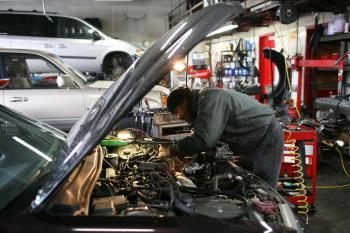
A joint report by the Public Interest Research Group and iFixit found that 89 percent of appliance repair professionals have at least occasionally been unable to find manuals when needed, and 93.5 percent reported difficulty finding necessary schematics.
Your Right to Repair Is Expanding
State-level legislation is beginning to address this access gap. California, Minnesota, New York, Oregon, and Colorado have all passed Right to Repair laws requiring manufacturers to provide the parts, tools, and information needed to fix phones, tablets, laptops, appliances, and other consumer products.Oregon’s law, which took effect Jan. 1, 2025, is the first in the nation to restrict parts pairing, a practice that requires replacement parts to be authenticated using manufacturer proprietary software before they will function.
The Financial Case Against Smart Appliances
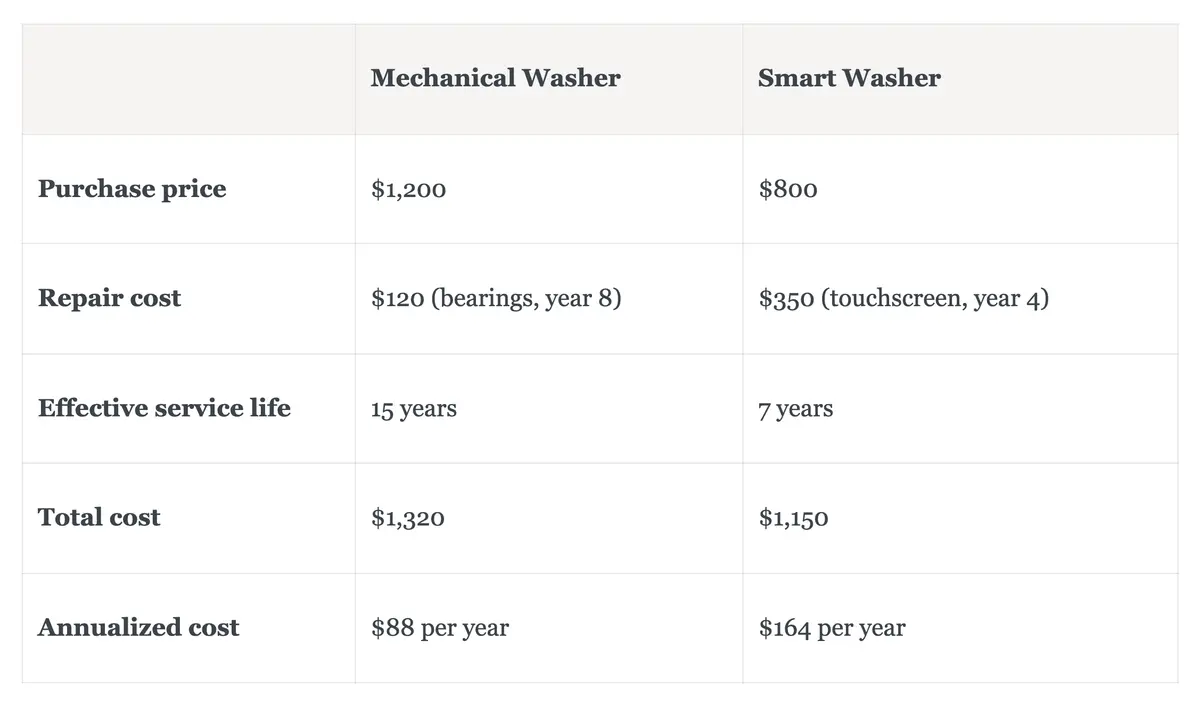
Smart features add Wi-Fi modules, touchscreens, and app integration to fundamentally mechanical products. While these features can be very useful, a problem that can arise is asymmetric lifespan: A quality mechanical washer may run reliably for 15 years, while its software ecosystem may reach end-of-life far sooner.J.D. Power reliability data show owners who actively use Wi-Fi features report roughly 92 problems per 100 appliances, far above the rate for non-connected models.
How to Check Third-Party Parts Availability
Before committing to any major appliance, search the specific model number on eBay, Amazon, RepairClinic, and PartSelect. Households with appliances from international brands such as Samsung, LG, Bosch, and Thermador often face the longest repair waits, with single circuit boards sometimes taking months to arrive.By contrast, domestic brands like Whirlpool, KitchenAid, GE, and Frigidaire generally experience fewer delays because their distribution networks within the United States are stronger and better stocked.
- Washing machines: water inlet valves, door seals, pump motors, control boards
- Refrigerators: compressor start relays, door gaskets, fan motors
- Dryers: heating elements, thermal fuses, drum belts
- Dishwashers: pump assemblies, door latches, control panels