When their father dies, Felicia and her brother Bruno are each left an inheritance. Felicia is given a silver ring and a pot of pinks, which a noble lady gave to her father and instructed him to give to Felicia. Bruno, on the other hand, gets the rest of his father’s possessions.
Having grieved their father’s passing, Felicia expects to seek solace in Bruno, but immediately finds him to be cruel. He forbids her to sit on his chair or partake in his things and only gives her eggshells to eat.
Saddened by his treatment, Felicia seeks solace in her pot of pinks. She admires the beauty of her flowers, saying, “Beautiful pinks, you are so sweet and so pretty, you are the only comfort I have left. Be very sure that I will take care of you.”
Yet, as she stands admiring her pinks, she realizes that they need water. So she grabs her pitcher and goes to get water from the fountain.
While at the fountain, Felicia sees a beautiful, noble woman arrive with several attendants. They spread a canopy for the lady and set food before her. The whole scene is wonderful, even the wind and trees provide a soft song to comfort the lady.
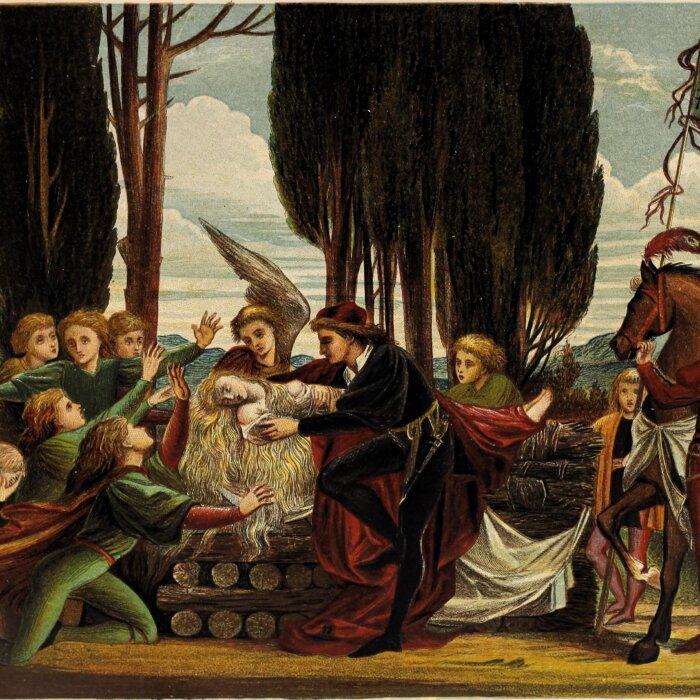

Felicia stands to the side, marveling and watching in silence and awe, but she doesn’t remain unseen for long. The beautiful lady notices her and bids her to come forward and even offers her some food. The kind lady then asks Felicia why she is at the fountain so late.
Felicia tells the lady of her wonderful pinks and how much she loves them. She explains that she came for water for her pinks and, as proof, holds up the pitcher. But Felicia suddenly starts. For her plain pitcher “[has] turned to gold, all sparkling with great diamonds, and the water, of which it was full, was more fragrant than the sweetest roses.”
A Royal Inheritance
Upon returning to her room, Felicia discovers that Bruno not only took her pot of pinks, but also replaced the pinks with an ugly cabbage. Greatly upset, Felicia throws the cabbage out the window and grieves the loss of her beautiful flowers.The next day, she sets out to find her flowers. Yet, while looking outside, she stumbles upon the cabbage, which she threw outside the night before. And, to her great astonishment, she discovers that the cabbage can talk. It tells her, “If you will be good enough to plant me by my comrades again, I can tell you where your pinks are at this moment.”
When Felicia looks for the pinks, she finds much more.
Through this fairy tale, children can see that, when they uphold virtue and kindness, they not only help others around them, but also become like royalty.
Just as Felicia’s pitcher becomes golden when she seeks to water her flowers, so children, when they practice kindness and virtue, bejewel their souls with beauty, grace, and truth. Such jewels outweigh and outshine any monarch’s crown.