Thomas Crane and his cousin Ellen Elizabeth Houghton illustrated a collection of children’s books: “At Home” (1881) (to which fellow illustrator John George Sowerby also contributed), “Abroad” (1882), and “London Town” (1883). In this children’s series, Crane and Houghton’s illustrations demonstrate an eye for detail and an attentive awareness to those beautiful moments in the great bustle of life’s adventures.
Adventures Abroad
“Abroad” welcomes the children by encouraging them to use their imagination as it takes them to foreign lands. Crane and Houghton present the reader with a color lithograph of three children packing their travel trunk with their maid. Packing can be very stressful, especially with little children, but the illustration captures the sweet moment when the children offer to pack their treasures, while the maid supervises.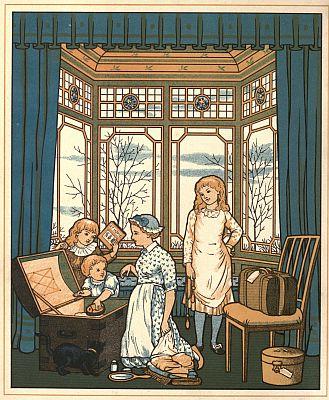
Crane illustrated the details, while Houghton beautifully drew the figures in the picture. Both artists emphasized the beauty of this scene by organizing details with well-defined shapes and lines. The picture’s measured quality, along with the wonderful blues, greens, and golden yellows, captures a wonderful, calm moment despite the hectic nature of travel.
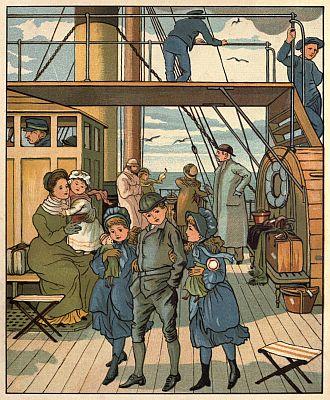
Later in the book, Crane and Houghton illustrated another moment, titled “Crossing the Channel From Folkestone to France,” which shows a family on the deck of a steamboat, the captain at the hem, sailors manning the deck, and other passengers milling about. The family stands front and center, a perfect image of familial happiness. The children’s teacher, Miss Earle, holds the youngest, while the three elder children walk arm in arm, enjoying each other’s company.
Adventures at Home
Both “At Home” and “London Town” contrast the foreign travels foreign travels found in “Abroad” with domestic adventures by showing British families enjoying wonders closer to home. In “London Town,” Crane and Houghton illustrated “Lowther Arcade,” which presents a market full of an assortment of curiosities and toys. Stalls and stores stretch far down the hallway of a large building, and each store has several customers peering at items.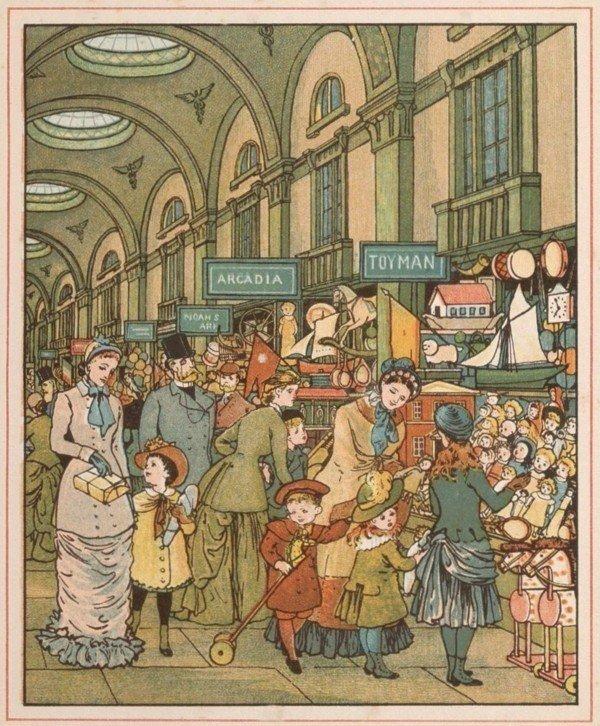
In this lithograph, the artists used perspective and vanishing lines to convey the vast depth of the Arcade, as well as many different colors to portray the unimaginable variety of goods. Yet the repetitive nature of the arches and windows in the Arcade establishes an overarching order, and, beneath these arches, Houghton used the foreground to show families smiling as they enjoy the allure of each new shop. They illustrated the multitude of choices and simultaneously showed the wonder to be found in such a stimulating place.