When considering the political and military history of 19th-century Europe, historians typically deem several moment the most pivotal: the French Revolutionary Wars (1792 to 1802), which gave way to the Napoleonic Wars (1803 to 1815); the Revolutions of 1848; and the Franco-Prussian War of 1870, which led to the establishment of the German Empire. However, observers, at least from the American perspective, often overlook one event: the very brief Austro-Prussian War of 1866.
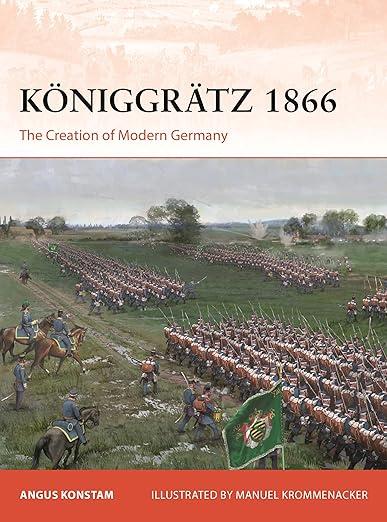
This war was a milestone in consolidating the confederation of German states into an empire, and the most important moment during this approximately three-month war was the Battle of Königgrӓtz. Renowned historian Angus Konstam, in his new study “Königgrӓtz 1866: The Creation of Modern Germany,” highlights how this immense military struggle propelled Prussia toward European superiority.
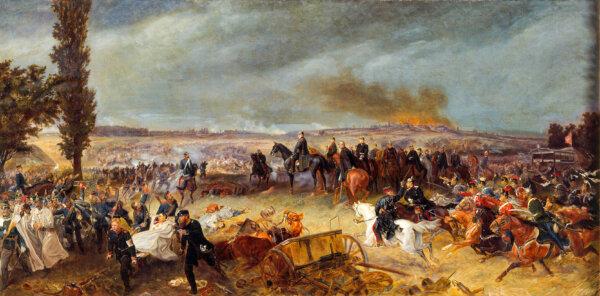
This battle was the largest in European history up to that time, eclipsing the famous Battle of Leipzig. Approximately 440,000 soldiers fought. Although Prussia won handily, it was certainly not a foregone conclusion. The author contends this battle was the largest in European history up to that time, eclipsing the famous Battle of Leipzig (though certainly debatable).
An Unavoidable War
Konstam lays the groundwork for how this power struggle evolved between the Austrians and Prussians. During the 1814-1815 Congress of Vienna, the leaders of the allied powers against Napoleon laid out a plan for Europe once the French dictator was defeated. The plan, which divvied up lands to the powers, was an effort to secure lasting peace on the continent. After the Battle of Waterloo and Napoleon’s exile, Prussia received portions of the Rhineland and large areas in Saxony and Duchy of Warsaw (today’s Poland). Austria received the Balkans, much of northern Italy, Tyrol, and lands near Salzburg. The peace lasted for approximately 50 years.Konstam uses an interesting quote from the Austrian emperor Franz Joseph, which helps summarize the ultimate reason behind the Battle of Königgrӓtz, specifically, and most battles in general. “How can one avoid war when the other side wants it?” This other side—Prussia—was led by two of the century’s most famous people: Otto von Bismarck and Helmuth von Moltke. Bismarck and Moltke, along with their monarch, King Wilhelm, actively sought war with Austria.
The Austrian End
Konstam’s book makes it clear that Prussian leadership did not overly worry about Austria’s historical dominance. The war with the Danes demonstrated how how Prussian military technology and tactics far surpassed those of their Austrian allies. The author doesn’t indicate whether the Prussians were intentionally studying their ally’s lack of military complexities. Regardless, fighting alongside an ally to discover their weaknesses is one of the most interesting military concepts. Certainly devious, but incontrovertibly brilliant.
The tactical and technological disparity was fatal to the Austrians and their allies. As Konstam states, “[B]y the evening of July 3, 1866, Austria’s military reputation lay in tatters.”
The destruction of this once vaunted reputation did not take long. It was a relatively short road of small battles and skirmishes along places like Gitschin, Trautenau, and Swiepwald, to reach the climax: the Battle of Königgrӓtz. Soldiers gave names to moments in these battles, such as The Battery of the Dead and The Lane of Death, which help demonstrate just how lopsided this brief war was. By the end of this pivotal battle, according to Konstam, “The Prussians had suffered less than a quarter as much as their opponents.”
Long-Term Impact
The author hints at the disaster’s far-reaching and long-term effects. It emboldened the Prussians to take charge of the German Confederation, leading to the Franco-Prussian War, which lasted twice as long as the Austro-Prussian struggle, and was about as disastrous for the French. That war resulted in France’s loss of Alsace-Lorraine, a region bordering France and Germany that would play a role in World War I and World War II.Upon reading Konstam’s study, one can make connections—from geographic locations to particular soldiers—between this 1866 struggle and the epic wars of the first half of the 20th century.
‘Königgrätz 1866: The Creation of Modern Germany’ By Angus Konstam Osprey Publishing: June 16, 2026 Paperback, 96 pages
What arts and culture topics would you like us to cover? Please email ideas or feedback to [email protected].