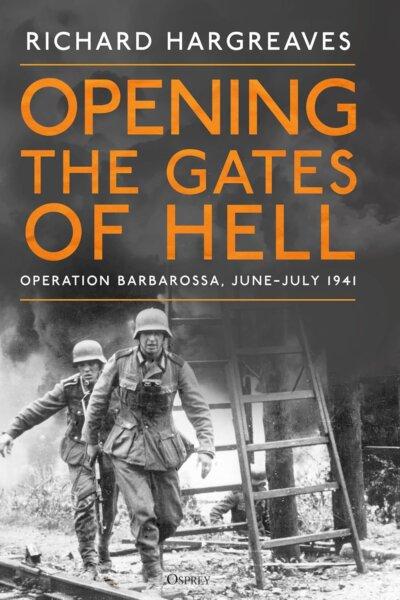
In the opening pages of Richard Hargreaves’s new book, “Opening the Gates of Hell,” the German military officers are issued what would, as the author notes, “go down in history as criminal orders.” The Germans were on the verge of invading the Soviet Union in the waning days of June 1941. Adolf Hitler had called upon his high command to conduct a “war of extermination” against the Russians. High command issued its orders, which guided the German troops’ conduct. “We would be insulting animals if we were to call the features of the slave-drivers [Bolsheviks]—a high percentage of them Jewish—animal-like,” the orders postulated. “They are the embodiment of the infernal, the personification of the insane hatred of all that is noble in mankind.”
Hargreaves notes that many of the German officers were greatly troubled by the orders, concerned that such “guidance” would create a lack of discipline among the troops. The author quoted a rightfully worried military chaplain, “Dreadful! No investigation of soldiers who commit crimes against the civilian population. I am deeply shaken. Where will it end? Where will it all lead? It means the disintegration of all order.”
Split Along the Border
Hargreaves pulls the reader into the opening days of what eventually exemplified the violence and brutality of World War II in Operation Barbarossa. He has rifled through the archives of the German, Russian, and various other states in order to present an up-close and very personal perspective of the Nazi operation. But this book is not simply a military perspective. It is also, and most disturbingly, a civilian perspective.As Hargreaves indicates, the night before the initial attack, “160 divisions stood ready to strike along a 3,000-kilometer front (’the greatest build up of forces in history’).” He then quotes Joseph Goebbels, who wrote in his diary, “Everything which could be done has been done. Now the fortunes of war must decide.” In Moscow, Stalin surmised rather belatedly, “I think Hitler is trying to provoke us. He surely hasn’t decided to make war?”
This dichotomy between decisiveness and uncertainty is the opening salvo for what would lead to the most unimaginably violent days of WWII. Even when the Germans began their invasion, the Soviets remained in disbelief. Some believed it had to be a training exercise. As the author chronicles the opening hours of Operation Barbarossa, it appears that the Nazis will do to the Soviets as they had done to the Polish, the Danish, the Norwegians, the French, Belgians, Dutch, Yugoslavians, Greeks, and Cretans.
The Gates of Hell?
How does a military attack open the gates of hell? In America, we often refer to the lines of Civil War generals Robert E. Lee, who stated, “It is well that war is so terrible, or we would grow too fond of it,” and William Tecumseh Sherman, who stated succinctly, “War is hell.” Certainly any military conflict is hellish. But the terminology takes on a different connotation in this instance. The difference is between a figurative hell and a literal hell. Of course, this may appear to be an attempt to split hairs, but rest assured, it is not.Readers of this review are, I assume, aware of the frightening, yet typical results of an invasion: gunfire, bombing, plundering, and at times, rape and murder. These—the latter being most reprehensible in an era of international law (which applied during WWII )—are expected, even if decried. So yes, hell—but more figurative than literal.
Hargreaves’s book demonstrates a literal hell. As the operation’s hours progress page-by-page, that hell becomes more literal. It becomes, and I choose no hyperbole here, demonic. The descriptions of torture and violence in these pages are too much to even repeat in this review. They aren’t indescribable. They are unbelievable. Unconscionable is putting it too mildly.
The Gates of the Human Heart
I flinched my way through this book, disturbed by what I read. For readers of this review, “Opening the Gates of Hell” may appear as a book to be avoided. It’s an account of war so grotesque as to be unreadable. But I would disagree. It’s an opportunity to peer into the heart of darkness. It’s a testament to the scriptural claim that “the heart is deceitful above all things and desperately wicked: who can know it?” It’s a reminder of how quickly humanity can cave in on itself.It’s a call for reflection. While while we rightfully highlight and pinpoint the wicked cruelties of Hitler and Stalin, we only need to look inward to know that the lowly, the average, and the seemingly powerless are also capable of unimaginable cruelty. This book is a reminder of just how horrid war can be and how quickly the gates of hell can be opened within each and everyone of us.