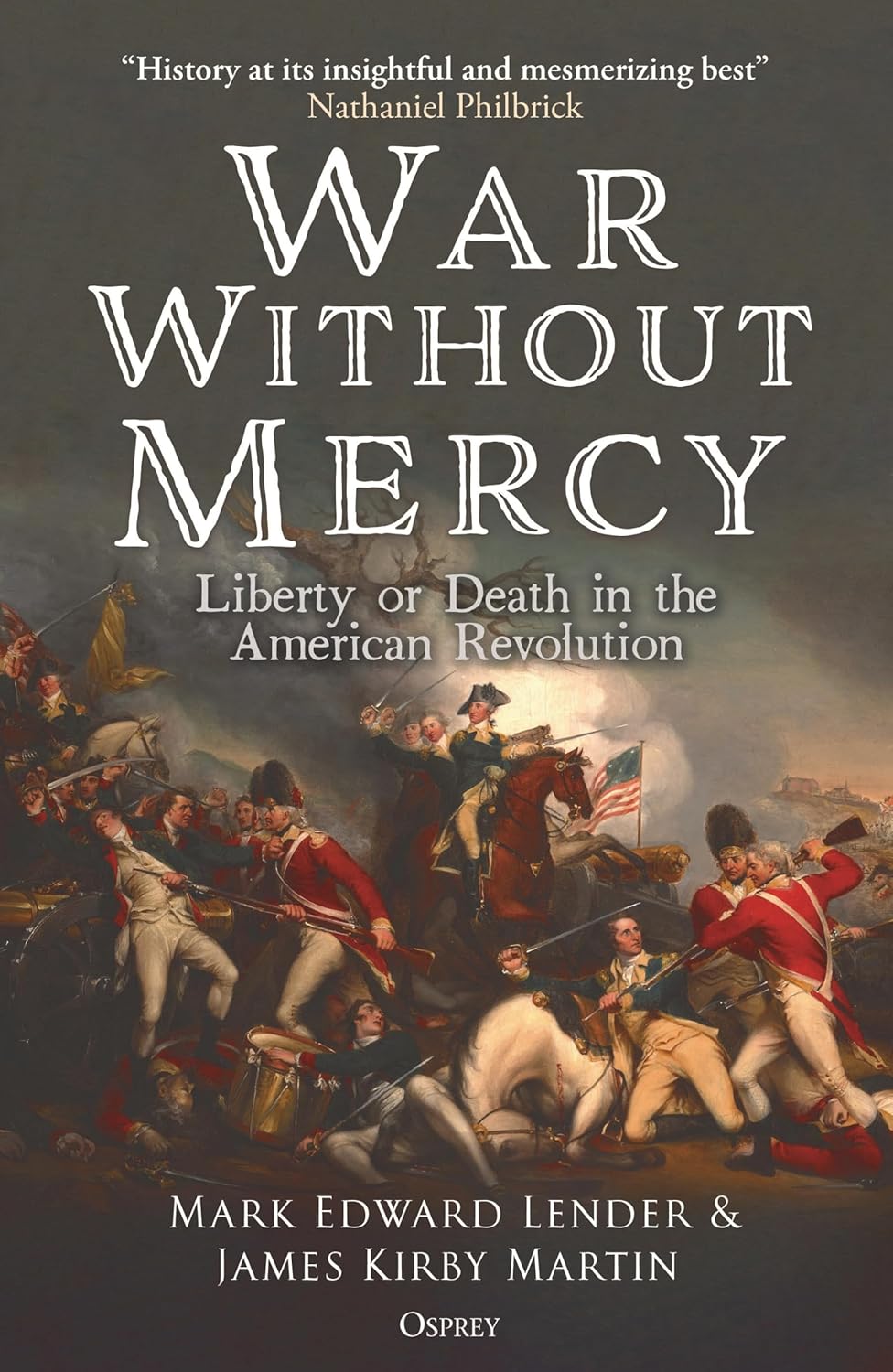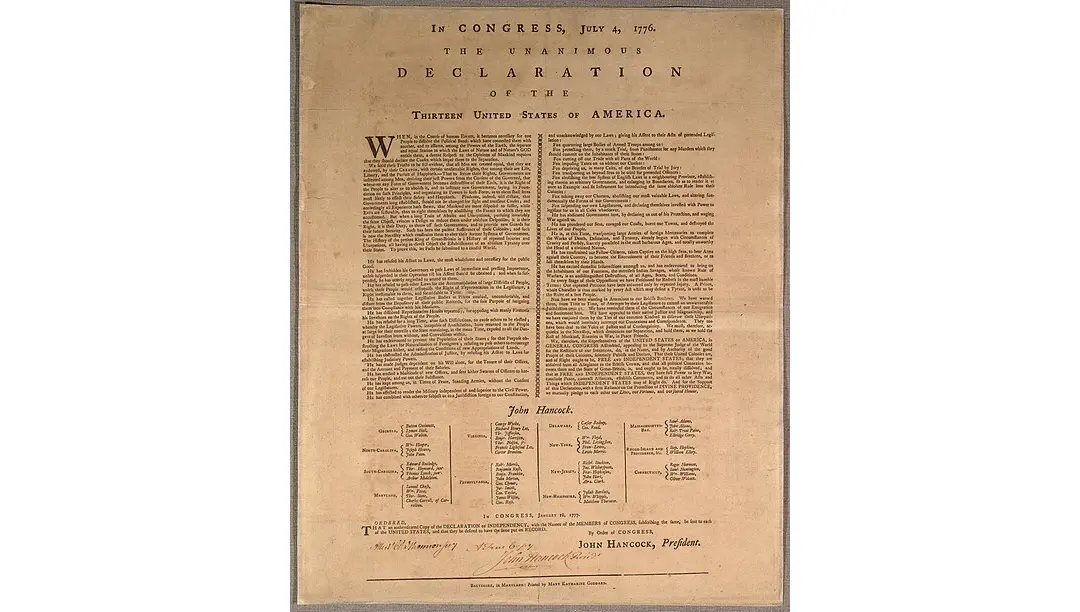
The image and title combination for Mark Edward Lender and James Kirby Martin’s new book is striking. The image—John Trumbull’s painting entitled “The Death of General Mercer at the Battle of Princeton, January 3, 1777”—depicts a battle scene from the American Revolution. The book is titled “War Without Mercy.” Traditionally, the American Revolution is seen as a war between civilized combatants who, as often as possible, abided by what the authors identify in Latin as “jus in bello,” which translates as “justice in war” or “fighting justly.”
Certainly, the soldiers of the Continental Army, labeled rebels by King George III, are historically known as ragtag. They needed training, not just with weapons and maneuvers, but also in how to treat property, civilians, and prisoners of war. Despite the mutual animosity between the Continentals and the professional British soldiers and sailors, cruelty was a rarity, and torture practically nil.
Lender and Martin note that although the most important battles of the war were fought between the Continentals and British soldiers, far and away a majority of conflicts were fought by the unprofessional soldier. The authors cite a study conducted for the American Revolution Bicentennial, which counted the number of known land and naval actions from 1775 to 1783, an admittedly conservative count. The authors state, “Significantly, of the 1,331 land actions, fewer than 100 involved the regular armies as the primary opponents. … Roughly 93 percent of revolutionary engagements were primarily the business of local militias, irregular forces, tribal groups, or even families defending individual homesteads.”
‘Distrust, Fear, Hatred’
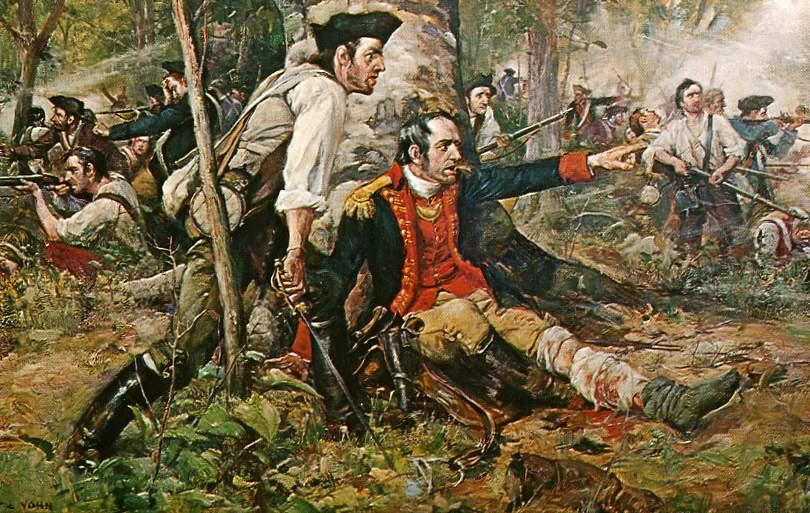
Of course, the American Revolution was not simply a forceful break from a monarchical government located across the Atlantic Ocean. It was also a civil war between fellow Americans who chose to rebel against the king and Parliament and those who remained loyal to the monarchy. As the authors suggest, what made the violence between these groups so egregious was a profound “psychological disconnect.” Loyalists could not understand why their neighbors wished to start a war for independence while the patriots could not understand why their neighbors wished to remain under the yoke of the king. between neighbors.
This disconnect seemed to afflict everyone, as the authors cite a contemporary minister who surveyed the collapse of his local community, stating, “Everywhere, distrust, fear, hatred, and abominable selfishness were met with. Parents and children, brothers and sisters, wife and husband were enemies to one another.”
Grisly Affairs
As demonstrated in the book, it is the post-battle actions that make a number of these depictions disturbing. Those actions indicate the disdain that neighbor had for neighbor. Pillaging, rape, torture, and executions were conducted on numerous occasions. Additionally, mere rumors of such actions proved enough to keep the Americans—of both patriot and loyalist stripe—in constant fear.Fear between the Americans and Native Americans was palpable for good reason, as the authors note. “Both sides [Patriot and Native Americans] pillaged and burned, killed, and took prisoners (whose fate could be worse than death). ... All the while ‘incidents of bloodshed and atrocity became the norm.’”
The war did not solely create disunity among the British subjects, but also among the Native Americans. The authors argue that the Battle of Oriskany, which witnessed the tribes fighting each other, ultimately ended the “ancient bond of unity” between the Six Nations.
Insightful and Disturbing
As the authors make clear, the War for Independence was viewed as an “existential threat” by “irregular forces” unguided by the rules of warfare (“jus in bello”), resulting in “the desperate and inhumane consequences of an existential struggle for victory”—indeed, a “war without mercy.”“War Without Mercy: Liberty or Death in the American Revolution” presents an essential dimension of the conflict. At times graphic and disturbing, the book demonstrates that alongside the Revolution’s heroics and attempts to wage a civilized war with honor and integrity were episodes that proved very much the opposite. This is an intriguing and insightful read for those interested in the American Revolution.