This copy is for your personal, non-commercial use only. Distribution and use of this material are governed by our Subscriber Agreement and by copyright law. For non-personal use or to order multiple copies, please contact The Epoch Times Reprints.
Five U.S. Air Force service members killed in Afghanistan are carried to their final resting place by horse-drawn caisson during a funeral at Arlington National Cemetery on Jan. 21, 2004. The U.S. military plans to phase out most of its ceremonial cavalry units but will keep the horses that transport caskets. Jim Varhegyi/U.S. Air Force via Getty Images
“Here comes the cavalry!” These words have become an idiom for the arrival of much needed assistance at decisive moments. Their historical origin testifies to the importance horses and their riders have played in military history, including that of the United States.
The arrival of horses on the battlefields of the ancient world caused a military revolution. The increased power, speed, vantage point, and flexibility of mounted units gave armies a distinctive advantage in many tactical situations. Slower, more unwieldy foot soldier units had to brace for the sudden strike of unexpected cavalry charges from any direction. For foot soldiers, the awe-filled spectacle of heavily armored cavalrymen thundering down on them in storm clouds of dust must have turned blood cold.
One of the earliest pieces of evidence for the use of horses in warfare, a Sumerian illustration, dates from around 2500 B.C. and depicts horses pulling wagons or chariots. By 1600 B.C., chariots had become common, especially in the East. Several centuries later—by about 900 B.C.—warriors were frequently riding horseback into battle, and developments in tack—the emergence of saddles and stirrups—made cavalry units increasingly effective.
“The Standard of Ur, War Side,” circa 2600 B.C. from the tomb of Queen Pu-Abi. The mosaic is one of the first artifacts to depict the military use of horses. Public Domain
The use of armed horsemen in war began to change with the introduction of gunpowder in the late Middle Ages and early Renaissance. The heavy warhorses of knights were replaced with lighter, faster-moving detachments. Still, horses remained an important force in armed conflicts into the 19th century and even—in a more limited way—into the 20th century.
The American Military Horse
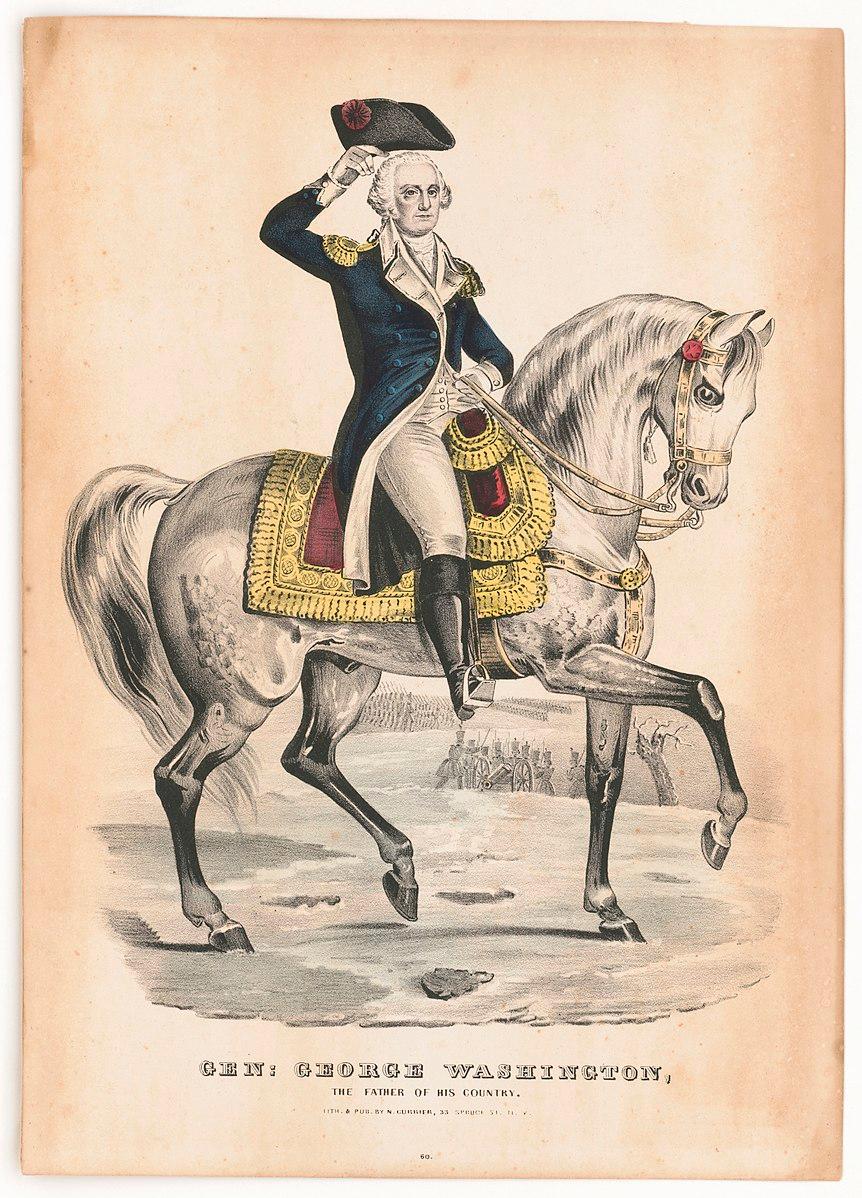
George Washington was known for this horsemanship. Public Domain
The United States military has long cherished its equine component, and the contribution of horses and horsemen stands out in bold relief on the timeline of the nation’s history.
The Continental Army launched the Revolutionary War with virtually no cavalry, but they soon established mounted regiments. They made use of cavalry throughout the war, although the terrain and tactical situation tended to better suit infantry, especially in the densely wooded northern colonies where the war was first kindled.
Several units consisted of mixed light infantry and light cavalry troops. President George Washington impressed Thomas Jefferson with his horsemanship. He considered Washington the best rider of his time, and paintings of the general astride his beautiful Blueskin grace the walls of many an art gallery.
The formal structure of the U.S. Cavalry emerged in a more pronounced way during the westward expansion of the mid-1800s. Their mission was to help protect the pioneers crossing plains and deserts; the vast expanses of the American West were much better suited to horsemen than foot soldiers, who couldn’t cover the arid stretches quickly enough to be effective.
At the onset of the Civil War, the Union Army fielded a substantial cavalry force. Roughly 3 million horses participated in the American Civil War, serving multiform functions, including transportation, communication, reconnaissance, and combat.
“Battery of Light Artillery en Route,” 1882, by William B.T. Trego. Public Domain
At the beginning of World War I, multiple nations employed large numbers of cavalry, but the death of the cavalry charge was not far away; new tactics and technological advancements in weaponry rapidly transformed the nature of warfare. Trenches, barbed wire, and machine guns rendered cavalry attacks virtually useless in most situations. Troops continued to use horses for transportation, but they were no longer the deadly weapon they had once been. As The American Museum of Natural History put it:
“Millions of horses died in World War I, even though by the end of the war their status had been reduced from leaders of the charge to a supporting role. The clash between old-fashioned ways of warfare and the newer technologies of death led to poignant sights like horses wearing gas masks, horses pulling guns larger than themselves, and horses lying dead next to heaps of mortar shells.”
What ultimately busted through the stagnant stalemate of trench warfare was not the cavalry charge of yore but the new, mechanized machine of death—the tank, which rumbled, slowly but surely, across the scorched and desolate no-man’s-land of European battlefields.
Surprisingly, even after the effectiveness of “mechanized cavalry” (tanks) had been demonstrated in WWI, an intense debate simmered in the U.S. military over whether to continue using horses or to transition to tanks. But the move toward tanks was inevitable, especially as the technology improved.
French dragoons in column near Montmort-Lucy (in the Marne) in September 1914. Gallica Digital Library. Public Domain
The last cavalry charge conducted by the U.S. military took place during World War II, on Jan. 16, 1942, when the 26th Cavalry Regiment attacked and scattered Japanese troops near the village of Morong in the Philippines. Apart from this, horses were used elsewhere in WWII, but primarily for transportation.
In more recent history, a small contingent of U.S. Special Forces, known as “Horse Soldiers,” used horses to fight in the rough terrain of Afghanistan following the 9/11 attacks. They collaborated with Northern Afghan militias against the Taliban. Otherwise, in the contemporary military, horses serve mostly ceremonial functions.
The Remaining Horse Units
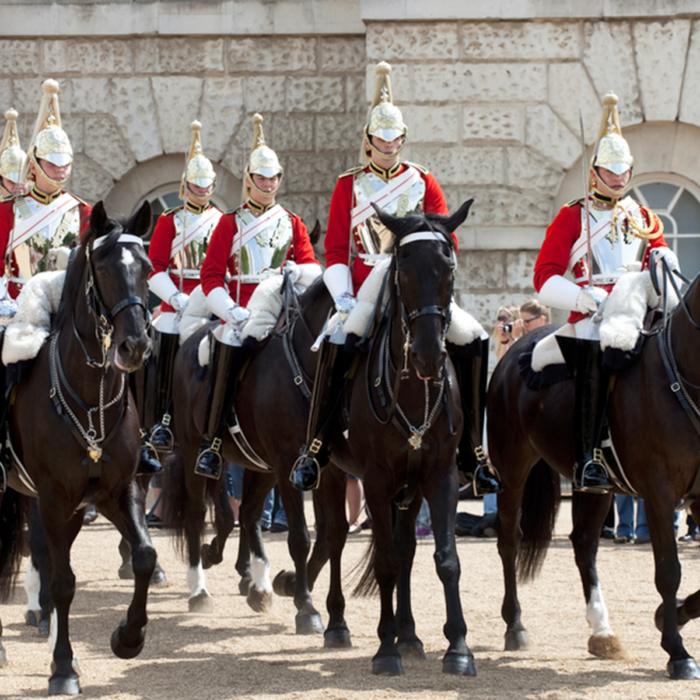
The small number of remaining horse units in the U.S. military dignify military funerals and parades. Within just the past few months, however, the military has decided to eliminate even these ceremonial units—at least most of them. Of the Army’s 236 horses, mules, and donkeys, it will be giving away 141 of them.
The Army hopes to save roughly $2 million per year by downsizing its equine units and may also be responding to recent investigations that uncovered neglect in the care of the animals. The deaths of some army horses in 2022 led to an assessment by the Army’s Public Health Command-Atlantic, which found “dry and moldy feed, cramped and unsanitary living conditions, and inadequate veterinary oversight,” according to Military.com.
This is a rather tragic ending to a long and glorious tradition within the U.S. military. The courage of horse and rider has repeatedly turned the tide of battle throughout American history, and the words “Here come the cavalry” have made hope spring again into the hearts of our troops on not a few desperate occasions. The silhouette of the American cavalryman or cowboy astride his trusted steed is a fundamental part of the American mythos; to it we owe much of what our country has been able to accomplish. But today, it’s increasingly an image of a bygone era.
What arts and culture topics would you like us to cover? Please email ideas or feedback to [email protected]
Before becoming a freelance journalist and culture writer, Walker Larson taught literature and history at a private academy in Wisconsin, where he resides with his wife and daughter. He holds a master’s in English literature and language, and his writing has appeared in The Hemingway Review, Intellectual Takeout, and his Substack, The Hazelnut. He is also the author of two novels, “Hologram” and “Song of Spheres.”