Every discipline of learning has a textbook that is essential for acquiring a certain skill. This hallmark tool is used so widely throughout a field of study that it becomes a joke. It can even be a subject of dread among students past and present. For young opera students, the overused and under-liked volume is “Twenty-Four Italian Songs and Arias of the Seventeenth and Eighteenth Centuries” (“24 Italian Songs and Arias”).
Anyone who has seriously studied classical singing at a university or even at a high school level is doubtless familiar with the recognizable yellow G. Shirmer volume. It includes a collection of simple two- or three-page songs with Italian words and comically inaccurate “singable” English translations.
The memorable and somewhat simplistic nature of these titles make them a natural choice for American students trying to sing in the language of opera for the first time. The book even comes in two registers, for medium-high voice or medium-low voice, so no one is excluded.
Because these songs are so closely associated with the practice rooms of American music schools, you'll rarely hear them outside a vocal major’s undergraduate recital. As a result, few professional singers in recent generations have included any of these songs in their concerts or albums.
However, the ubiquitous “24 Italian Songs and Arias” is just the watered-down highlights of a much larger collection of Italian songs, “Arie Antiche.” Compiled at the end of the 19th century by Alessandro Parisotti, this three-volume collection features 100 masterpieces by the greatest geniuses of Italian opera in the 17th and 18th centuries.
Ancient Songs
In Italian, the name “Arie Antiche” means antique or ancient songs. The full title of the collection is “Arie antiche: ad una voce per canto e pianoforte,” or “Ancient Arias: For One Voice for Singer and Piano.” When these books were compiled about 125 to 140 years ago, the music featured was already at least a century old, if not two.

The three volumes were published in Milan in 1885, 1890, and 1900, respectively, by the famous publisher G. Ricordi. The first two volumes featured 30 songs each, and the third featured 40 songs. You can easily find online copies of these full volumes, either in their original Italian or in the English translation produced later by G. Schirmer.
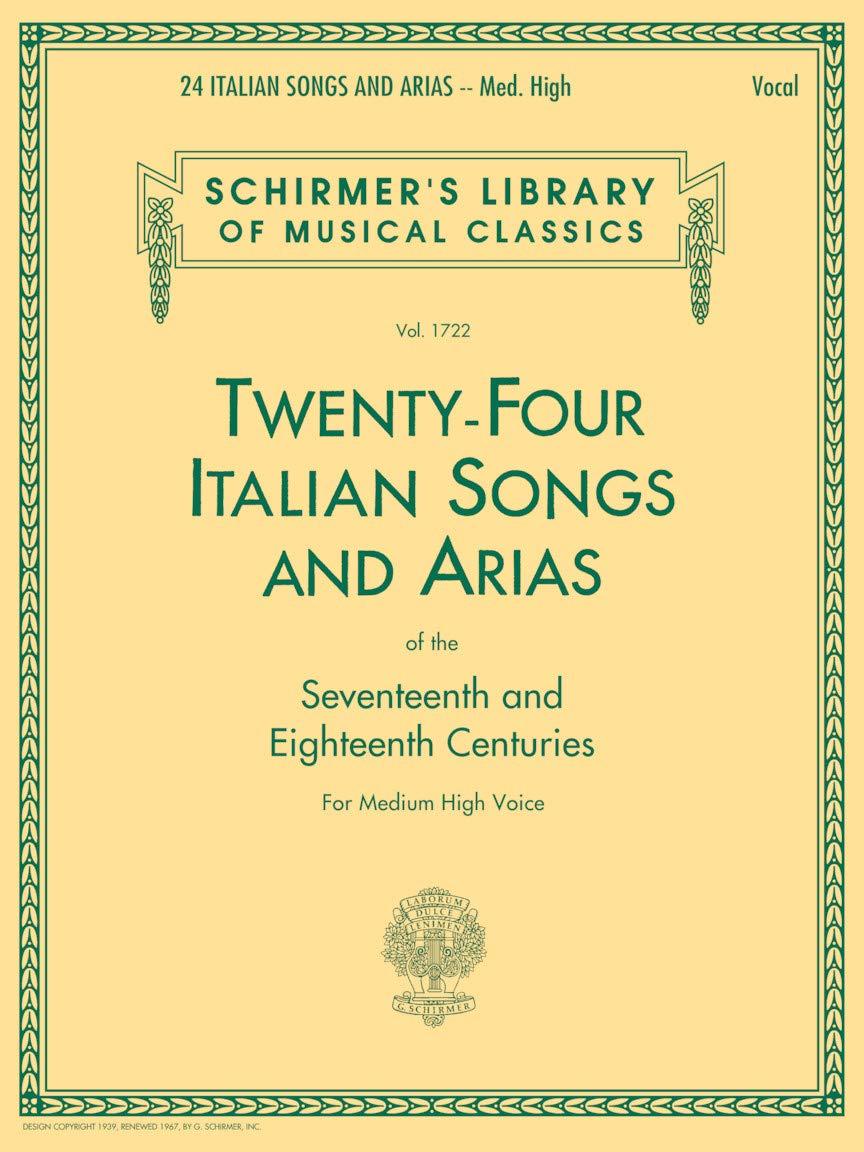
In 1894, the first two volumes were typeset in New York by G. Schirmer with translations by Theodore Baker, whose translations are still in the “24 Italian Songs and Arias.” G. Schirmer first published the “24 Italian Songs and Arias” in 1894, drawing selections from Volumes 1 and 2.
While the original “Arie Antiche” included biographies of all the composers, this American collection only featured the composers’ birth and death years. In 1991, Alfred Music published a revised version of this collection, entitled “26 Italian Songs and Arias: An Authoritative Edition Based on Authentic Sources.”
Parisotti, Editor or Composer?
The man behind these volumes was Parisotti. He was born in Rome in 1853, where he would also die in 1913. Parisotti’s life in music involved working as a composer, arranger, and teacher, but his compilation of other composers’ music in the “Arie Antiche” has far outlasted anything he wrote himself.He deserves credit for popularizing the work of earlier composers in the late 19th and early 20th centuries. However, in recent years, his three-volume compilations have been criticized for their historical inaccuracy by music purists. Parisotti didn’t merely collect these arias and reproduce them as accurately as possible. Instead, he made them more palatable to the music tastes of his day.
In 1880, he became secretary of the Accademia di Santa Cecilia, a Roman hub of music research as well as education. While there, he wrote a treatise on musical acoustics, aesthetics, and psychology as well as composing sacred choral works. This position gave him access to the musical records and resources that would lay the groundwork for his three volumes.
A Valuable Contribution
Parisotti, his “Arie Antiche,” and the derivative “24 Italian Songs and Arias” are not likely to be taken seriously by sticklers for musical integrity and historical accuracy, particularly Baroque enthusiasts. However, when historical authenticity is set aside, Parisotti’s liberal editing of his 100 selections must be rationalized as a valuable contribution to classical vocal music in its own right.Nevertheless, the “ancient arias” probably became much more popular and beloved because of his adapting them to more contemporary classical styles. They could have remained dusty relics in those days before musicology and musical history were prioritized, and they were thoroughly revived and appreciated.
Each song in the “Arie Antiche” is a gem of music, poetry, and history, from the popular 24 selections featured in the Schirmer collection to obscure opera excerpts that didn’t make the cut. Every melody is simplistically beautiful, and the poems are full of timeless wisdom about life, love, and nature.
Join me in this series as I explore each aria in this fascinating collection, discovering its history, translation, and recordings.