
Norman Rockwell’s Narrative Skill and Hyperrealism

December 28, 2010 Updated: May 3, 2011

Epoch Times Photo
Norman Rockwell (1894–1978) was a master of narrative painting and illustration. His works, which appeared on the cover of The Saturday Evening Post from 1916 to 1963, told enduring tales of American life. Rockwell captured the intimate moments of family life—a heated political discussion between husband and wife at the breakfast table or a little boy discovering a Santa Claus suit in his father’s dresser.

Epoch Times Photo
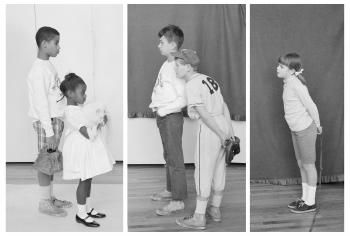
Rockwell also captured the poignant moments in the history of the nation. In “New Kids in the Neighborhood,” African-American children and Caucasian children stand beside a moving van, examining each other with curiosity. One feels that after sizing each other up without hostility, the children will soon forget any inhibitions or feelings of division their parents might have and become fast friends.

“[Rockwell’s] intricately conceived narrative paintings, reproduced as illustrations in The Saturday Evening Post and other mass circulation magazines, were immediately understood by a vast audience of readers who saw themselves reflected in the stories he chose to tell,” reads the opening caption to an exhibition at the Brooklyn Museum titled Norman Rockwell: Behind the Camera.

On display until April 10, 2011, the Brooklyn Museum exhibition not only presents Rockwell’s iconic works, but also opens up the artist’s whole process of composition.

Rockwell’s Hyperrealism

Rockwell achieved the amazing degree of realism for which he is famous by working from photographs—sometimes over 100 photos for one painting. No detail is extraneous in his work. Every facial expression, every object is part of the greater narrative.

“What Rockwell did not have on hand he bought, borrowed, or rented—from a simple dime-store hairbrush or coffee cup to the chairs and tables from a NYC Automat,” reads one of the exhibition captions. Every prop fit the time and place of the scene to a T.

Rockwell would have his photographers take photos from several different angles of the arch of a wrist or the curve of an ankle, even of a cigarette butt, to exact the greatest realism.

As photography became a popular art form, many artists gave up on realism—no artist’s hand could replicate reality more precisely than a photo—and moved further toward the abstract. Rockwell, however, viewed the medium as a tool for painting a true-to-life picture.

“[Rockwell’s] hyperrealism lay at the heart of his appeal,” reads the caption at the entrance to the exhibit.

Anyone who has looked at a Rockwell illustration and felt amazement at its photograph-like quality of precision knows there is something about the skill of a human hand, rather than a machine, producing such a likeness that delights the heart. The artist imbues a part of himself in the work; he adds something subtle but poignant.

Rockwell As Director

The Brooklyn Museum exhibition displays Rockwell’s works alongside the photos that inspired and informed them. Rockwell is shown not only to have great skill in painting and drawing, but also to be a master photography director.

In a video that is part of the exhibition, his son Peter Rockwell describes the artist’s enthusiasm in directing his models. He would use his own elastic face to show the models what expressions he was looking for, his son says.

Rockwell’s illustrations do indeed display a wide range of facial expressions, which are an integral part of his narrative. One sees in the face of Rockwell’s characters not only the thoughts and feelings of the moment, but also often a whole story that leads up to that moment.

In “Soda Jerk,” some young women flirt with a shop clerk over milkshakes. A young man in the corner of the painting looks on with a slightly wounded and somehow resigned expression. His whole personality and history are revealed in this one look. He’s not the assertive type—more the kind to hang back. Maybe he has a crush on one of the girls and sees his hopes dashed—not that he ever thought they’d come to fruition.

A Piece of History

One photo on display at the museum was not part of the background work leading up to a painting or illustration but a complete work in itself. “Closing Up a Summer Cottage” was commissioned by Eastman Kodak in 1957 for its Colorama advertisement display that remained in the main concourse of Grand Central Terminal until 1990. Rockwell designed and directed the photo with a Long Island cottage as the backdrop.

Off to the far left of “Closing Up a Summer Cottage,” a farewell between a young man and woman recalls a summer’s romance. Grandma sits waiting in the car, leaning out to direct the exasperated father as he packs up the station wagon.

The mother carries an armload out of the cottage while smiling adoringly at her children. The little ones are still in their bathing suits, except for one dressed in shirt and bowtie who takes a photo of the others.

The family dynamic is instantly perceived. The whole story of the family’s summer at the cottage is captured in a single scene, from the canoe atop the car to the television antenna being removed from the roof. It’s a scene many of the commuters in Grand Central Terminal could likely relate to.

One visitor to the museum’s exhibit writes on the Brooklyn Museum’s website that he “engaged with a Rockwell I didn’t know existed.”