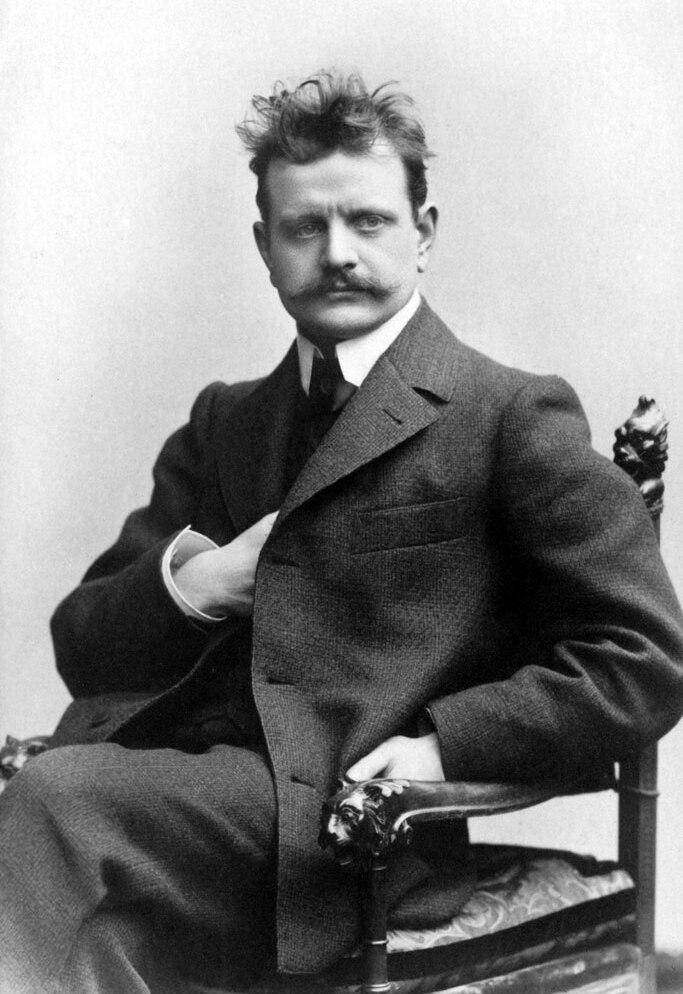
At the snowy hills of Southern Finland lay Ainola, home to Jean Sibelius. Widely considered Finland’s greatest composer, Sibelius is credited with defining the nation’s musical identity. His tone poem “Finlandia” became the country’s unofficial anthem of resistance, and his symphonic work “Kullervo” drew influence from Finnish mythology, elevating folk traditions into high art. Yet his later years were fraught with creative struggle, making one of the most fascinating stories in music history.
Prior to his death in 1957, the Finnish composer lived in his country home, away from the capital of Helsinki. He spent decades in seclusion from the musical public, having not completed a major work in 30 years. This wasn’t for a lack of effort. He had promised an Eighth Symphony to conductor Serge Koussevitzky and the Boston Symphony Orchestra, but the score never arrived. In 1945, he burned a great number of his manuscripts, the vestiges of the Eighth likely among them.
This seclusion would be dubbed the “Silence from Jarvenpaa,” capturing the imagination of the public and fueling speculation about the decades-long drought. There were several factors, from the composer’s health struggles and alcoholism to the rise of avant-garde atonalism, which was diametrically opposed to Sibelius’s own harmonic language.
Above all, it may have been Sibelius’s relentless self-criticism and perfectionistic standards that kept him from completing new works. He is said to have regularly destroyed manuscripts he found unsatisfactory, refusing to release any work that didn’t feel fresh or meaningful. The lack of a published Eighth Symphony would serve to strikingly highlight his final symphonic testament, his Seventh Symphony.
Symphony No. 7 in C Major
Today’s recording of Jean Sibelius’s Symphony No. 7 is by Leonard Bernstein and the Wiener Philharmoniker.(Listen)
Sibelius’s Symphony No. 7 is unique in that it is a single movement work. Throughout his career, Sibelius gradually moved away from the German and Russian Romanticism of his youth, refining musical forms into a distinctly personal style.The work opens with a timpani roll on the note of G while the strings ascend in a C Major scale. The scale is interrupted by a distant A-flat minor triad, which resolves—in a manner wholly reminiscent of Wagner’s “Tristan and Isolde”—into a F Major chord. From here, the hints of German Romanticism vanish, and the Nordic landscape comes into full view at 1:37 with a wistful motif in the flutes.

Sibelius was famous for his organic development of musical ideas, blending moments together seamlessly from section to section. While most composers relied on contrasting dynamics or tonal textures to create excitement, Sibelius built his music through spontaneous variations of musical fragments.
Winds and strings exchange fragmented motifs, maintaining the music’s cold, enigmatic character. The harmony stays stagnant, yet builds steadily. From 4:08 to 6:35, the warm tone of the strings envelop the listener, painting images of the Finnish landscape. The brass finally arrives, a trombone choir that blends into the texture.
Sibelius’ symphonic concept greatly contrasted that of his contemporary Gustav Mahler. While Mahler expanded the symphony to massive proportions, Sibelius elected to condense and tightly pack his music into one never-ending whole. At 9:02, the scale of the opening returns, this time resolving into a capricious accelerando. The energy increases as the violins and flutes flutter until 12:27, when the lower strings devolve into an ominous rumble underneath dark brass chords. At 14:10, the horns erupt with a dark, rhythmic figure.
By 16:08, the mood brightens. Soaring violin melodies trade with the oboe and cellos, before a sudden tremolo interruption leads into a new section. The final climax begins at 19:30. The music twists and morphs, until at 20:35 the trombone enters with a melancholic figure. The energy rises until a glorious summit at 22:17, after which the violins lead a descent into a mournful conclusion.