After Ludwig von Beethoven died in 1827, a thorough autopsy confirmed what had long been apparent about his health. His auditory nerves were “shriveled and marrowless,” while the neighboring arteries were “dilated to more than a crow’s quill, and like cartilage.” By then, his hearing loss was unmistakable. He had been completely deaf for almost a decade, following a gradual decline that began as early as 1800.
Beethoven’s deafness remains one of the most compelling topics in music history, as he continued composing masterpieces despite his loss. The Imaginative Conservative website shares an unsent letter known as the Heiligenstadt Testament, where he revealed his inner turmoil. In the throes of despair, he wrote: “I would have ended my life—it was only my art that held me back. ... It seemed to me impossible to leave the world until I had produced all that I felt was within me, as if my art had been entrusted to me by God.”
Beethoven went on to become one of history’s most influential composers. His late works, including the Ninth Symphony and the Missa Solemnis, have come to symbolize the resilience of the human spirit, touching audiences with their emotional depth and profound humanity.
Yet even among these achievements, one work stands out. According to biographer Edmund Morris, Beethoven thought of this piece as “his most perfect single work.” In published essays, Schumann said it stood on “the extreme boundary upon which all that has hitherto been attained by human art.” Franz Schubert, hearing it for the first time on his deathbed, reportedly asked: “After this, what is there left for us to write?”

A portrait of Beethoven. Here is painted holding the score for "Missa Solemnis." Public Domain
That work is the String Quartet No. 14 in C-sharp Minor, Op. 131. Premiered posthumously, it was unlike any string quartet that had come before. Instead of the standard four-movement structure, he crafted a seven-movement tour de force, with each movement integrated seamlessly into the next to create a cohesive whole. Even with an abundance of movements, the quartet is often considered a pinnacle of the genre, firmly extending its traditions into the Romantic era.
String Quartet No. 14 in C-sharp Minor
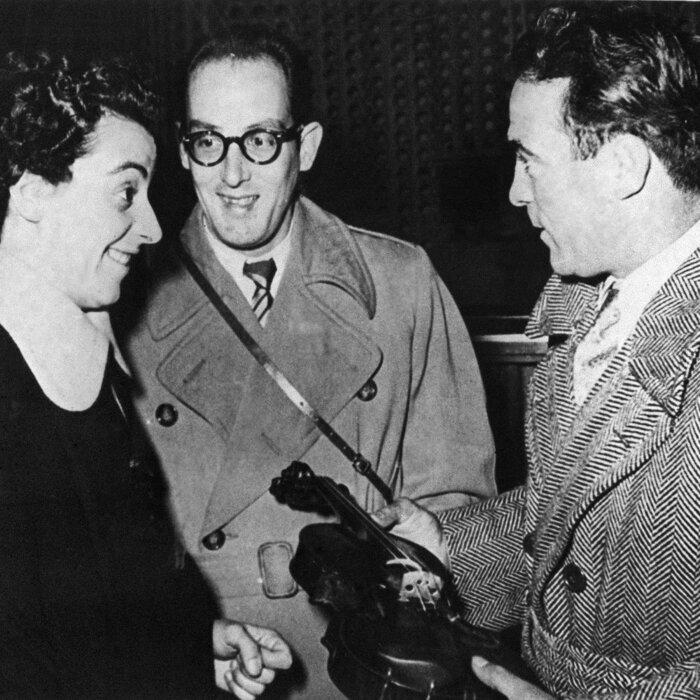
The recording here is of the first movement of the Beethoven String Quartet in C-sharp Minor, Op. 131, Adagio ma non troppo e molto espressivo, performed by the Busch Quartet.Solemn and austere, the first violin enters with a forlorn subject that is repeated by each member of the string quartet in a fugue. A fugue is a musical form in which a subject, a short musical idea, is repeated voice by voice and then developed through counter-subjects and modulating episodes.

Unlike many of Beethoven’s other compositions, which begin with bold, dramatic statements, this movement is slow and meditative. While most string quartets of the time began with a fast movement in sonata form, meant to showcase a composer’s technical prowess, this fugue exhibits an inner, almost spiritual energy. Beethoven once joked that the piece was “patched together,” yet the interplay between instrumental voices in this movement is remarkably intricate, with chromatic phrases creating a sense of endless unfolding.
As the subject evolves through inversion (turning the melody upside-down) and rhythmic variation, the music concludes on a suspended chord that flows before ebbing. As Richard Wagner describes it, the Adagio ma non troppo is “the saddest thing ever said in notes.”
What arts and culture topics would you like us to cover? Please email ideas or feedback to [email protected].