This copy is for your personal, non-commercial use only. Distribution and use of this material are governed by our Subscriber Agreement and by copyright law. For non-personal use or to order multiple copies, please contact The Epoch Times Reprints.
The Thomas Jefferson Building, which faces the Capitol Building, is four stories tall at its midsection, with a copper-topped dome positioned in the structure’s center. Exact symmetry is evident in the careful placement of pairs of capital-topped Corinthian columns, arched windows with capstones, and vertical rectangular windows topped with decorative pediments. At its main entrance, the granite building also features a split staircase upstaged by bronze fountain sculptures of the Court of Neptune, featuring the Roman god of fresh and sea water as well as sea nymphs. Studio Melange/Shutterstock
One of the most significant U.S. buildings, the Thomas Jefferson Building is larger than an acre or an average city block. Looming large in the heart of Washington, the building named after Founding Father and third President Thomas Jefferson houses the main library in the Library of Congress complex. The building is grand in scale and design, sporting the highly decorative beaux arts architectural style, which gained prominence in 19th-century Paris.
The building conveys the eclecticism associated with France’s 19th-century beaux arts architecture. The style drew inspiration from ancient Roman and Greek models and incorporated elements from Renaissance and baroque architecture, which is especially opulent in terms of materials and design.
In 1873, as was common with public buildings, Congress funded a design competition for the structure, which was dedicated to housing 6,487 volumes purchased from Thomas Jefferson’s collection, as well as other books and materials. The Washington architectural firm of John L. Smithmeyer and Paul J. Pelz won the contest with their Italian Renaissance design that was built around a circular reading room. The building took seven years to construct and was finally completed in 1898. Its focal point, both inside and outside, is the dome over the main reading room.
More than 40 American painters and sculptors were commissioned to embellish the building, which is considered one of America’s masterpiece structures and receives millions of visitors every year.
Corinthian marble columns in the Great Hall’s portico resemble the granite columns on the building’s exterior in that they are paired and secured atop a wide solid base. Due to the vast space, dozens of American artists and sculptors worked for several years to make the Greek and Roman-inspired carvings and paintings throughout the building. Dominant in the hall is the commemorative arch over the doorway, which leads to the main reading room. On the frieze above the capstone and pillar arch are the words “Library of Congress” inscribed in gilded letters. The multi-hued flooring was made from various types of French and Italian marble and carved brass inlays arranged in a pattern. Library of Congress. Public Domain
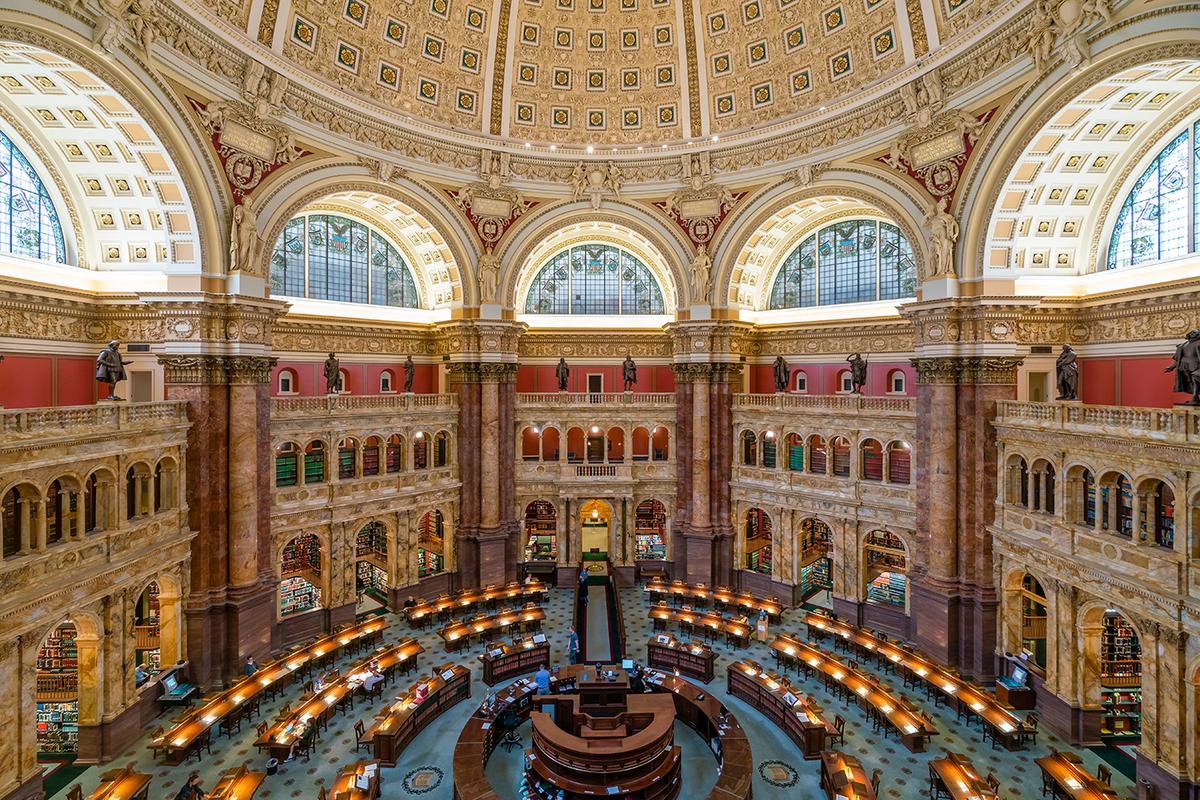
Marble, bronze, gold, mahogany, and many other types of materials were cast, sculpted, and inset to achieve the main Reading Room’s awe-inspiring architecture. The Room is situated under the building’s centrally located dome. Supporting deep inset arches with stained glass windows are eight giant Numidian (North African) marble columns, on which 10-foot-high allegorical female figures in plaster are perched; they represent religion, commerce, history, art, philosophy, poetry, law, and science. Bronze statues at the railing above the portico represent historical figures, including William Shakespeare, Michelangelo, and Ludwig van Beethoven. ymgerman/Shutterstock
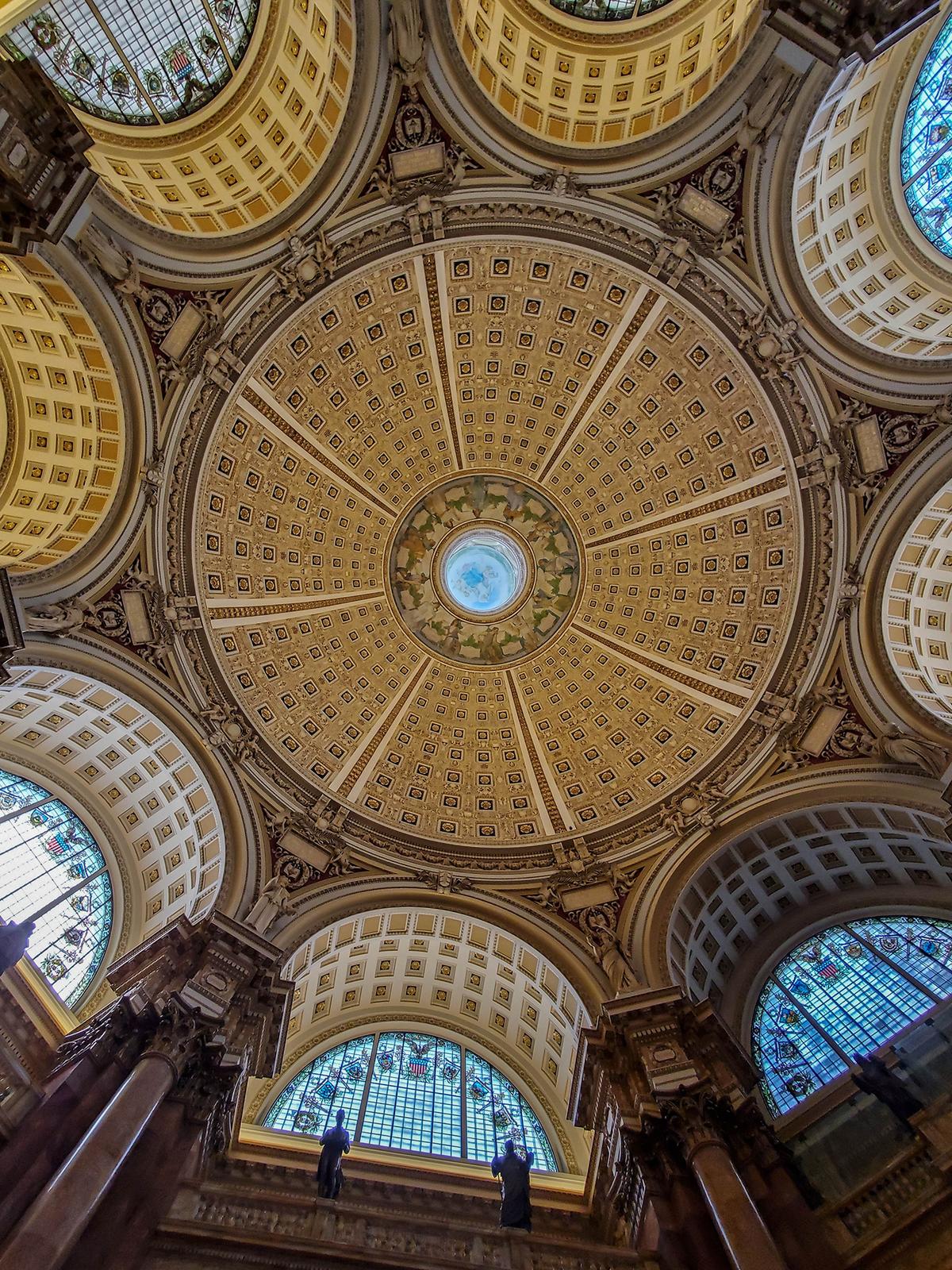
The Main Reading Room's coffered dome, 160 feet above the floor, is resplendent with 320 framed and gilded rosettes. These surround an elaborate painting, titled “Human Understanding,” by American painter and muralist Edwin Howland Blashfield (1848–1936). At the center of Blashfield's painting is a female figure. Set against a soft blue background, she is surrounded by 12 painted figures representing various regions of the world, which were thought to be contributors to Western civilization. Extravagant cornice-topped arches, as well as massive arches decorated with numerous rosettes, coordinate with the ones in the main dome. ChicagoPhotographer/Shutterstock
At the east end of the Great Hall's north corridor is the Librarian’s Ceremonial Office. Paneled in wood, the room includes hand-carved fluted columns, capstones, and botanical designs that decorate the wooden arches. The wood contrasts with the intricacies of the vibrant Grecian-style paintings over the arches and on the lavishly carved and molded ceiling. The desk is original to the room. Library of Congress. Public Domain
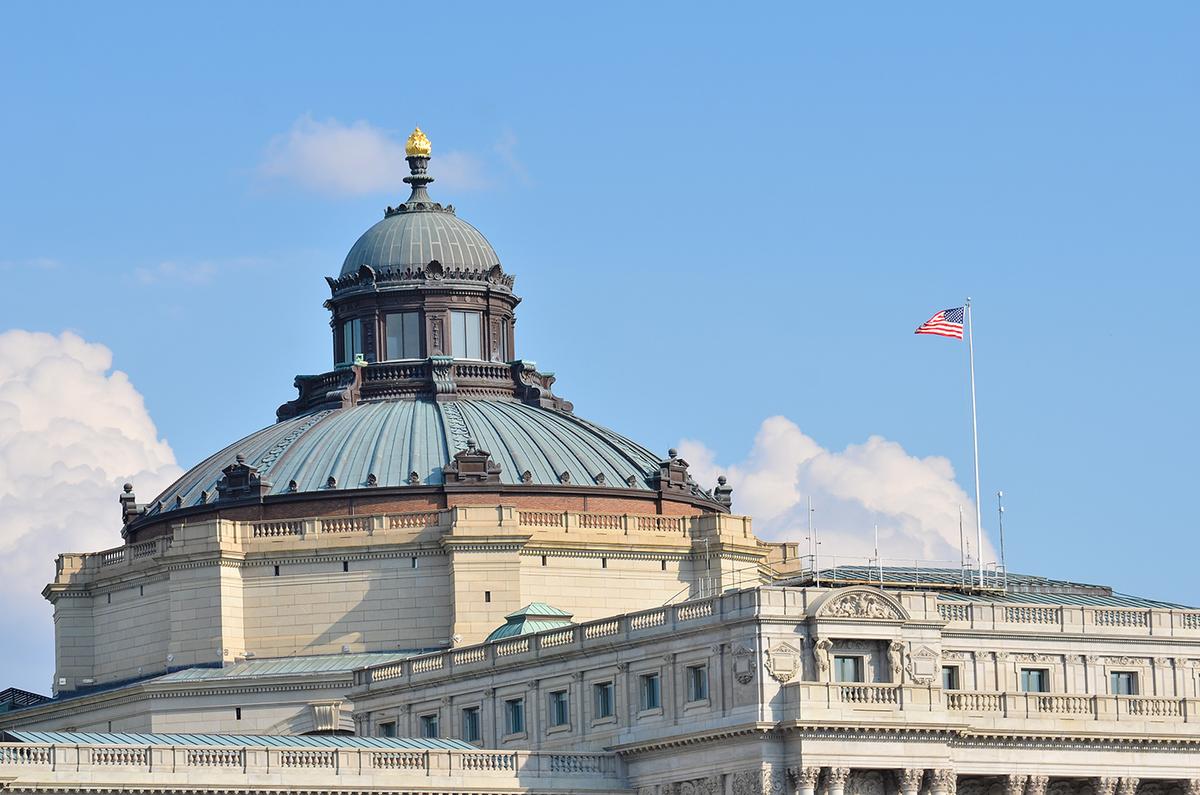
While they are now copper, the roof’s dome and cupola on the main building were originally covered in gold leaf. Out of sight of the general public are details galore: classic dentil moldings and balustrades of carved granite; bronze pediments; corbels; and scallop designs. Around the dome and the cupola are observation towers. A shell design in copper embellishes the cupola like a crown. What can be seen from street level is the gilded “Flame of Knowledge” motif adorning the dome. Orhan Cam/Shutterstock
In the south corridor of the Great Hall’s second floor is this impressive ceiling. Painted in a Pompeiian style, meaning a colorful plaster technique common in ancient Rome, the paneled ceiling depicts Greek philosophical virtues. It was created by American painter, muralist, and illustrator George W. Maynard (1843–1923). Appearing as if draped over the circular windows are carved wreaths of fruit and foliage topped with laurel sprigs. Below the round windows are scholarly quotations on gilded wall tablets. Library of Congress. Public Domain
What arts and culture topics would you like us to cover? Please email ideas or feedback to [email protected].
A 30-plus-year writer-journalist, Deena C. Bouknight works from her Western North Carolina mountain cottage and has contributed articles on food culture, travel, people, and more to local, regional, national, and international publications. She has written three novels, including the only historical fiction about the East Coast’s worst earthquake. Her website is DeenaBouknightWriting.com