
If you are approaching 62—the earliest you claim Social Security—the change in FRA alters the math you might’ve worked out before the amendment took effect.
Understanding these changes deserves ten minutes of your attention before you decide when to claim benefits.
Quick Answer: What Is Your Full Retirement Age?


Everyone can still claim as early as 62, but with an FRA of 67, claiming at 62 locks in a permanent cut of roughly 30 percent. Waiting past 67 earns delayed credits of 8 percent per year until 70, for a maximum of 124 percent of your full benefit.
The Schedule That Just Finished
Congress set this in motion with the 1983 Social Security amendments, passed during a funding crisis, which raised the retirement age from 65 to 67 so gradually that no single birth year felt a jump.
Here is the completed schedule:
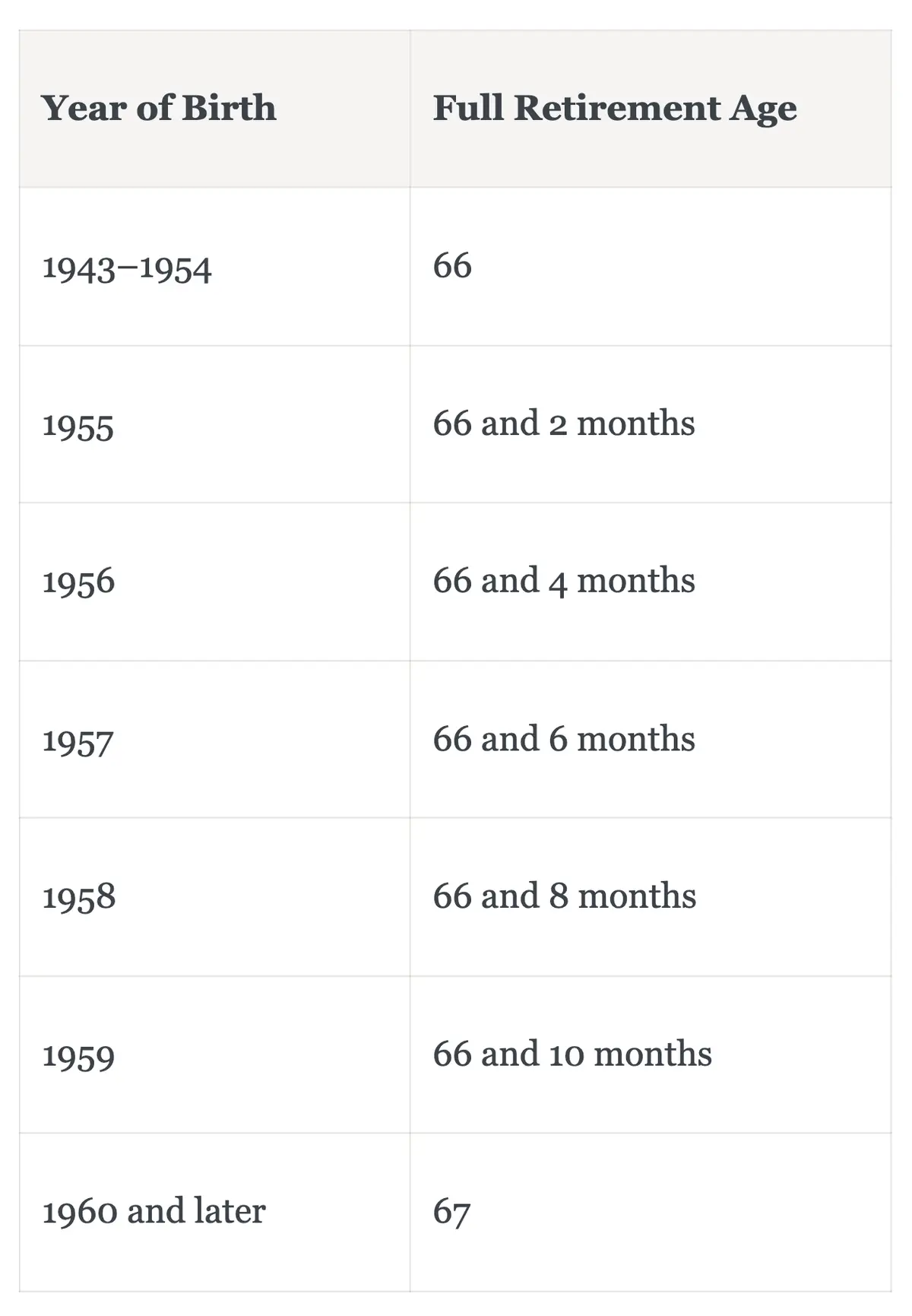
The 1959 cohort is the last to reach an FRA below 67, and its final members cross that line this fall. Under current law, the chart above is now permanent.
The Math in Real Dollars
Looking at the differences through percentages might obscure the details, so consider a hypothetical $2,000 monthly benefit at FRA:
Claiming early at 62 equals about $1,400 per month, a 30 percent reduction, for life.
Claim at 67, it’s the full $2,000.
Waiting until 70 equals about $2,480—three years of 8 percent delayed credits.
That is a spread of more than $1,000 per month between the earliest and latest claiming ages, on the same earnings record. The credits stop at 70, so there is hardly ever a good reason to wait past that birthday.
The reduction is calculated month by month and every cost-of-living adjustment compounds on whichever base you chose, which is why the decision echoes for decades.
The First-of-the-Month Rule People Often Miss
Buried in Social Security’s rules is a “quirk” that shifts the calculation for anyone born on the first day of a month. The agency treats you as having reached each age in the month before your birthday.
Born June 1, 1964? For benefit purposes, your clock runs as if you were born in May. The bigger version applies to New Year’s babies: if you were born on January 1, you fall under the prior year’s FRA schedule entirely.
2 Things That Are Not Changing
Medicare is still 65, and the FRA move never touched Medicare eligibility. Enrolling at 65 remains the rule, and waiting for your Social Security FRA to sign up can trigger lifelong late-enrollment penalties unless you have qualifying employer-sponsored health coverage.
The earnings test still ends at FRA. If you claim before 67 and keep working, benefits above an earnings threshold are temporarily withheld, then credited back once you reach FRA. After 67, you can earn any amount with no withholding.
An Informed Decision Is the Best One
There is no universally right claiming age. Health, family longevity, savings, and whether you are the higher earner in a couple all matter, and the higher earner’s choice also sets the survivor benefit a spouse may live on for years.
FAQs About Full Retirement Age 67
How Much Less Do I Get if I Claim Social Security at 62?
With a full retirement age of 67, claiming at 62 reduces your benefit by roughly 30 percent, permanently.
If your full entitlement provided $2,000, it would be reduced to about $1,400. The reduction is computed monthly, so each month you wait past 62 restores a fraction of it. The cut also flows through to future cost-of-living adjustments, which apply to your reduced base, and it can lower the survivor benefit your spouse would receive if you are the higher earner.
Is Waiting Until 70 Always the Better Choice?
No, it is a trade, not a rule.
Delaying to 70 buys a benefit 24 percent above your full amount, which is powerful insurance for those enjoying a long life and valuable for a surviving spouse. But it means bridging years of expenses from work or savings, and someone with serious health concerns or limited resources may reasonably claim earlier. The right answer depends on longevity odds, other income, and household claiming strategy, not a single break-even age.
Is Medicare’s Age Going Up to 67 Too?
No. Medicare eligibility remains 65 and was never part of the retirement age transition.
Treat the two as separate clocks: most people should enroll in Medicare at 65 even if they plan to delay Social Security until 67 or 70, because late Medicare enrollment can carry permanent premium penalties. The one common exception involves people still covered by qualifying employer health insurance, who should confirm their situation before deciding to delay.
What If I Was Born on the First of the Month?
Social Security treats you as reaching every age in the month before your birthday, which nudges your full retirement age and benefit calculations one month earlier.
If you were born on January 1, the effect is larger: you fall under the prior year’s schedule, so a January 1, 1960 birthday carries an FRA of 66 and 10 months, not 67.
The Epoch Times copyright © 2026. The views and opinions expressed are those of the authors. They are meant for general informational purposes only and should not be construed or interpreted as a recommendation or solicitation. The Epoch Times does not provide investment, tax, legal, financial planning, estate planning, or any other personal finance advice. The Epoch Times holds no liability for the accuracy or timeliness of the information provided.