British artist Shane Couch reflects his lifelong love of the sea in blue-sky history paintings of classic yacht races. “More than documenting history, I’m trying to make it real again,” he told The Epoch Times. That means meticulously painting maritime history, commonly known as marine history, including its emotions, power, and joy.
Recently, The American Society of Marine Artists Awards 2024 presented Couch with the “Best in Show” award for “Spinnakers to Starboard J Class Long Island Sound 1930.”
“The history of boats drives me as an artist,” he said.
Playing at Sea
Couch grew up in an agricultural village, a couple of miles inland from the coastal town of Southport, in the northwest of England. He couldn’t smell the sea, but it seems to have been in his bones.His father and grandfather both served in the navy, and the family had all manner of sailing and naval history books. Couch grew up with stories of life on the seas and the various ships they’d both served on. He lived out those stories in his mind and often charted the history in detail.
He spent a lot of his childhood on his knees, secretly reenacting naval battles or yacht races with models that his dad made of old sailing ships, aircraft carriers, battleships, and the like. Once in a while, his dad spotted an out-of-place model airplane that gave away those reenactments.
He also imagined sitting on a boat watching the great yachts race for the America’s Cup or Nelson’s fleet fight in the Battle of Trafalgar. He drew those imaginings, bringing the action to life.
He always wondered: “What would it have been like to have been there?” And that wonder never left him.
From Sea to Air to Oil Painting
Couch didn’t become a marine painter right away. His high school art teacher told him to forget about being an artist. He spent 15 years working as an aircraft engineer. But he took the sea with him. Every spare moment, he continued to read and sketch naval history; even during work breaks, he’d sketch away.One time, his boss’s secretary saw him sketching a couple of warships, which she called galleons. She’d been looking for a particular painting for her husband but couldn’t find it. Couch offered to paint one for her, and if she didn’t like it then she needn’t buy it.
Having never painted before, Couch set off to the local art shop for advice. “He lays out all these brushes for me and all these paints, and I’m thinking: ‘Well, I can’t afford all of them.’ So we narrowed it down to a few basic ones,” he said.
Couch created this first oil painting in his kitchen, propping the canvas up on an open oven shelf as a makeshift easel.
“She loved it. She bought it, and I got another six orders,” he said. Within a year, he quit his job.
Couch later traveled to the UK epicenter of sailing—the Isle of Wight, on the south coast—and found a gallery owner keen to stock his paintings. He soon moved to the island and began meeting sailors who raced the great J Class yachts, affectionately known as the J’s.
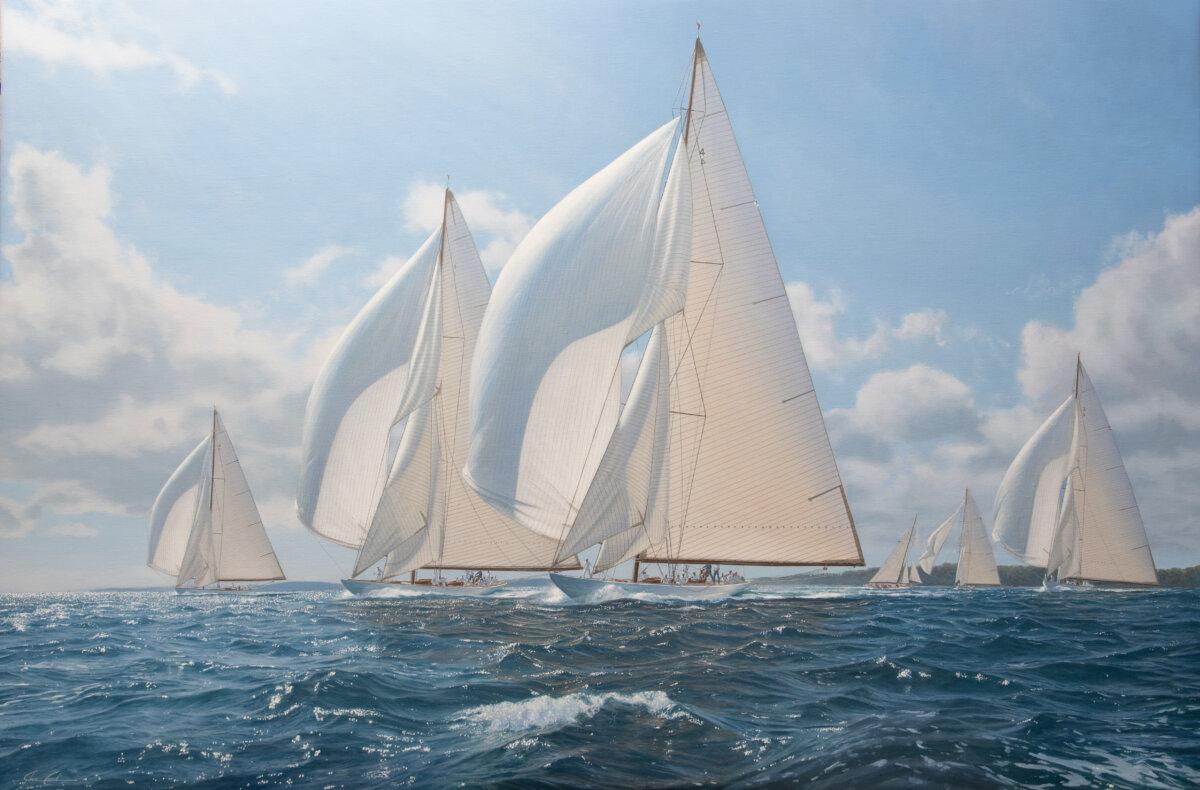
“Spinnakers to Starboard J Class Long Island Sound 1930,” 2024, by Shane Couch. Oil on canvas; 40 inches by 60 inches. The painting won Best in Show at The American Society of Marine Artists Awards 2024. Courtesy of Shane Couch
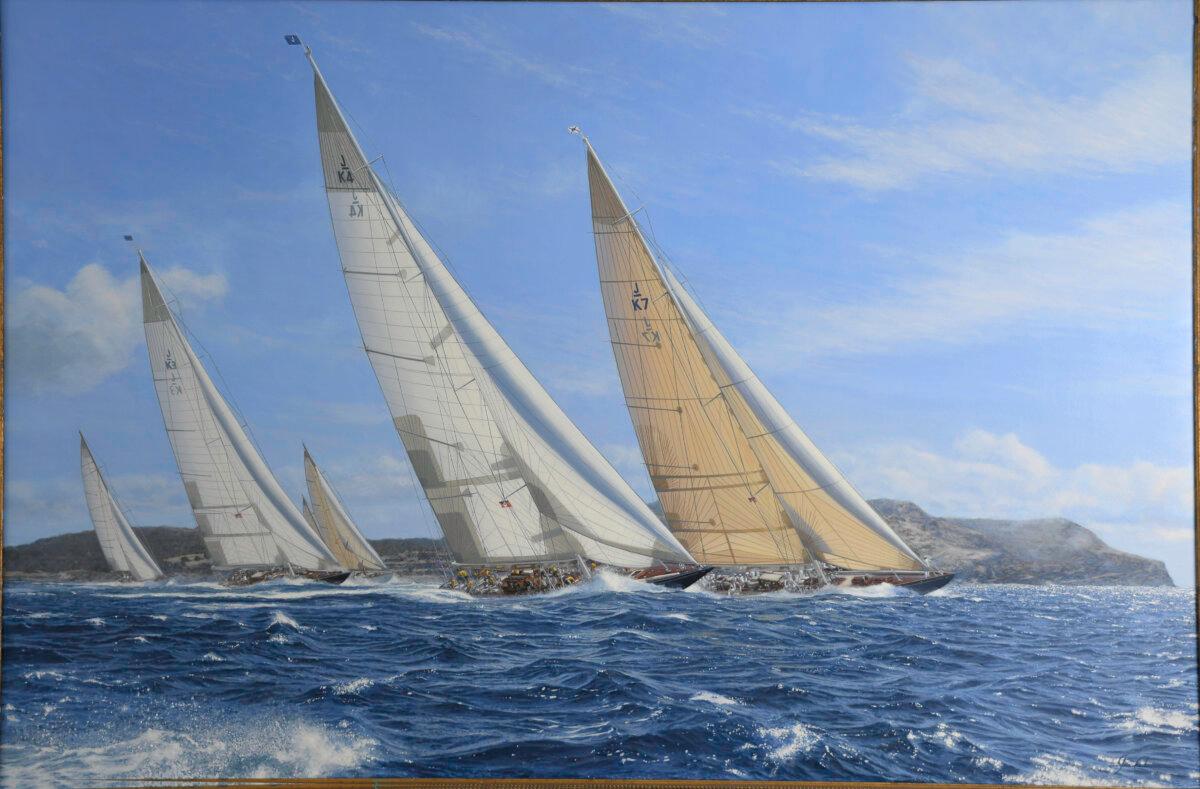
“Return of the J's Antigua 1999,” 2020, by Shane Couch. Oil on canvas; 40 inches by 60 inches. Courtesy of Shane Couch
The J Class is defined according to the Universal Rule for racing boats that the United States adopted in 1905. Couch says, most people agree that the J Class vessels are the most iconic classic yachts of all time:
“The sound: They’re like whales. When you hear all the halyards [sail ropes] and the boom moving, it’s just a deep groan, as if they’re alive and they’re talking. And you’ve got that huge, long bow, like a huge, great big sword just parting the waters in front of them. They are just an incredible, incredible machine—and, once seen, you’re forever in love with them.”
Surprisingly, he also found his sea legs on the Isle of Wight. Having never sailed before, he caught the sailing bug:
“I’ve been lucky enough to sail on some of the most beautiful, majestic old boats in the world, which are either replicas or the original boats from the period that I paint. And so I’m very lucky to sort of have this visual database in my head of these boats and how they move.”
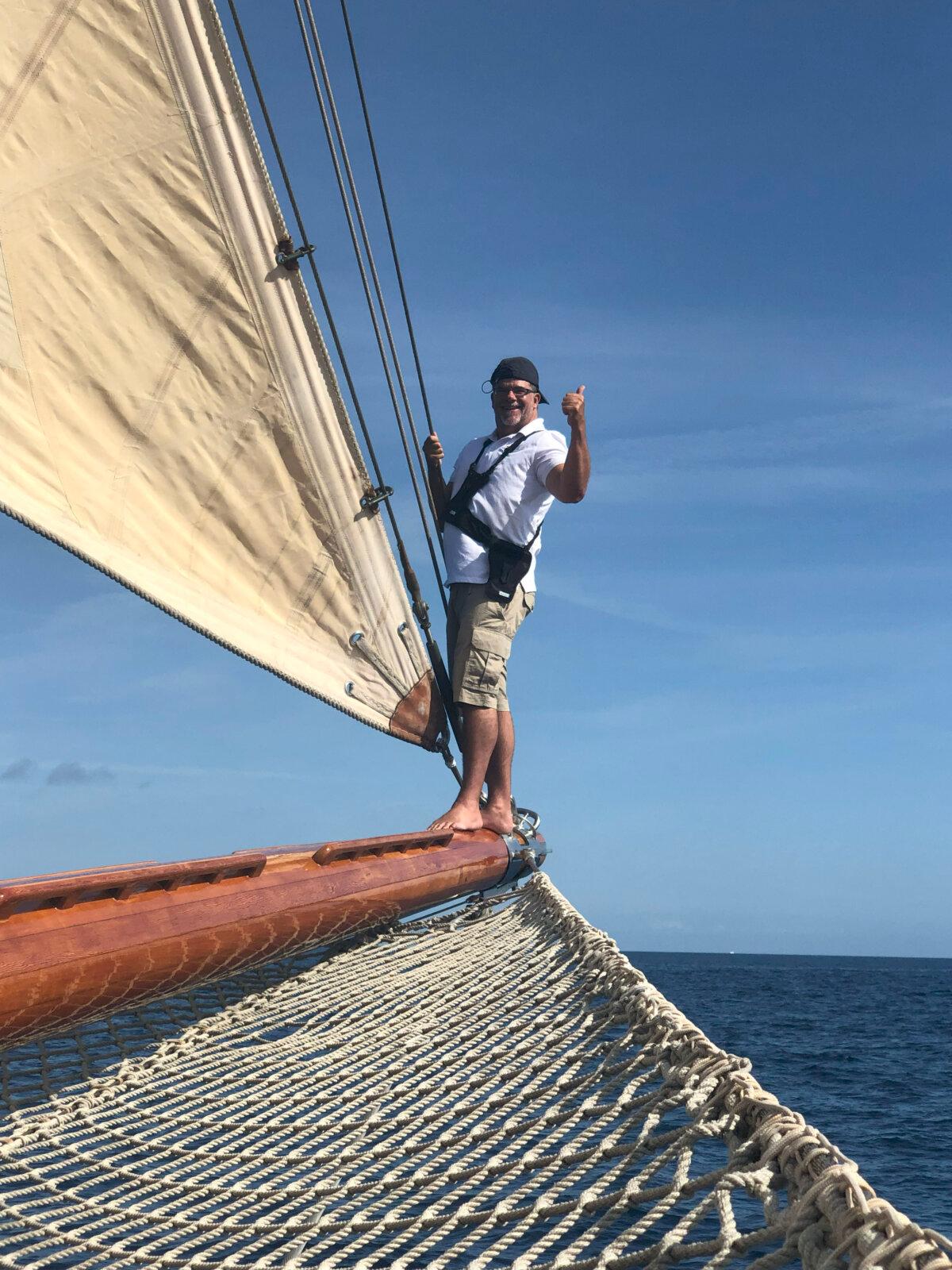
Marine artist Shane Couch transfers his love of sailing onto each canvas he paints. Couch enjoys nothing more than capturing a blue-sky sailing day on canvas. Courtesy of Shane Couch
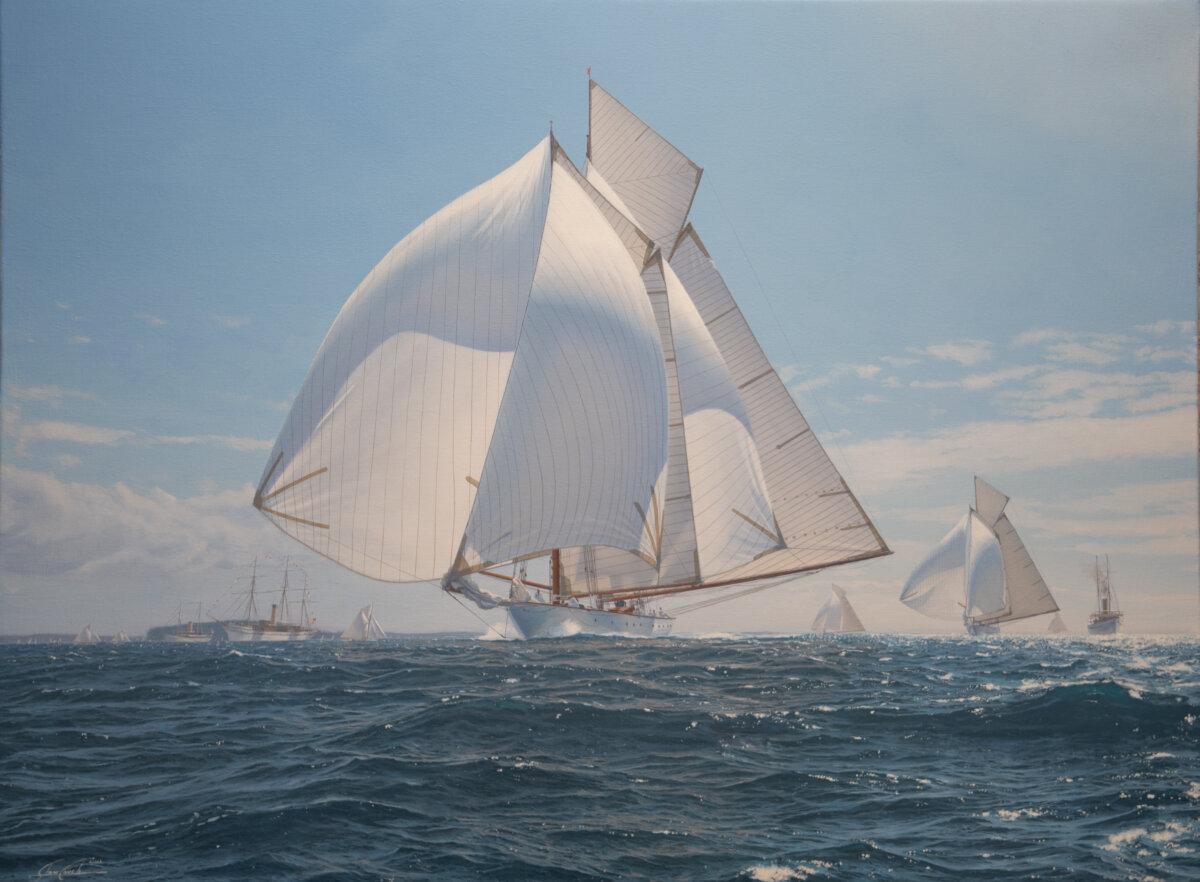
Schooner Ingomar Racing on Long Island Sound, 1907,” 2025, by Shane Couch. Oil on canvas; 30 inches by 40 inches. Courtesy of Shane Couch
Boating History
Couch loves the characterful stories behind these classic yachts, just as much as the boats themselves. The innovators and entrepreneurs behind the boats—such as skipper Harold “Mike” Stirling Vanderbilt and boatbuilders John Brown Herreshoff and Capt. Nathanael Greene Herreshoff of the Herreshoff Manufacturing Company—pushed the boundaries of yachting.“When I read about the likes of Vanderbilt and Herreshoff, I’m fascinated by their process[es] and how they approach problems inspires me,” he said.
In the first year the J’s raced, in 1930, Vanderbilt’s boat, the Enterprise, proved slower than its rival, the Weetamoe. Couch explained that Vanderbilt realized he only needed to increase the boat’s speed “by point one of a knot per mile” and he’d beat the Weetamoe. Vanderbilt challenged himself to make the Enterprise just that little bit quicker. “So he’s looking at weights and efficiency, crew efficiency, sail handling, materials used, and, bit by bit, he sort of chips away, and eventually he … wins it.”
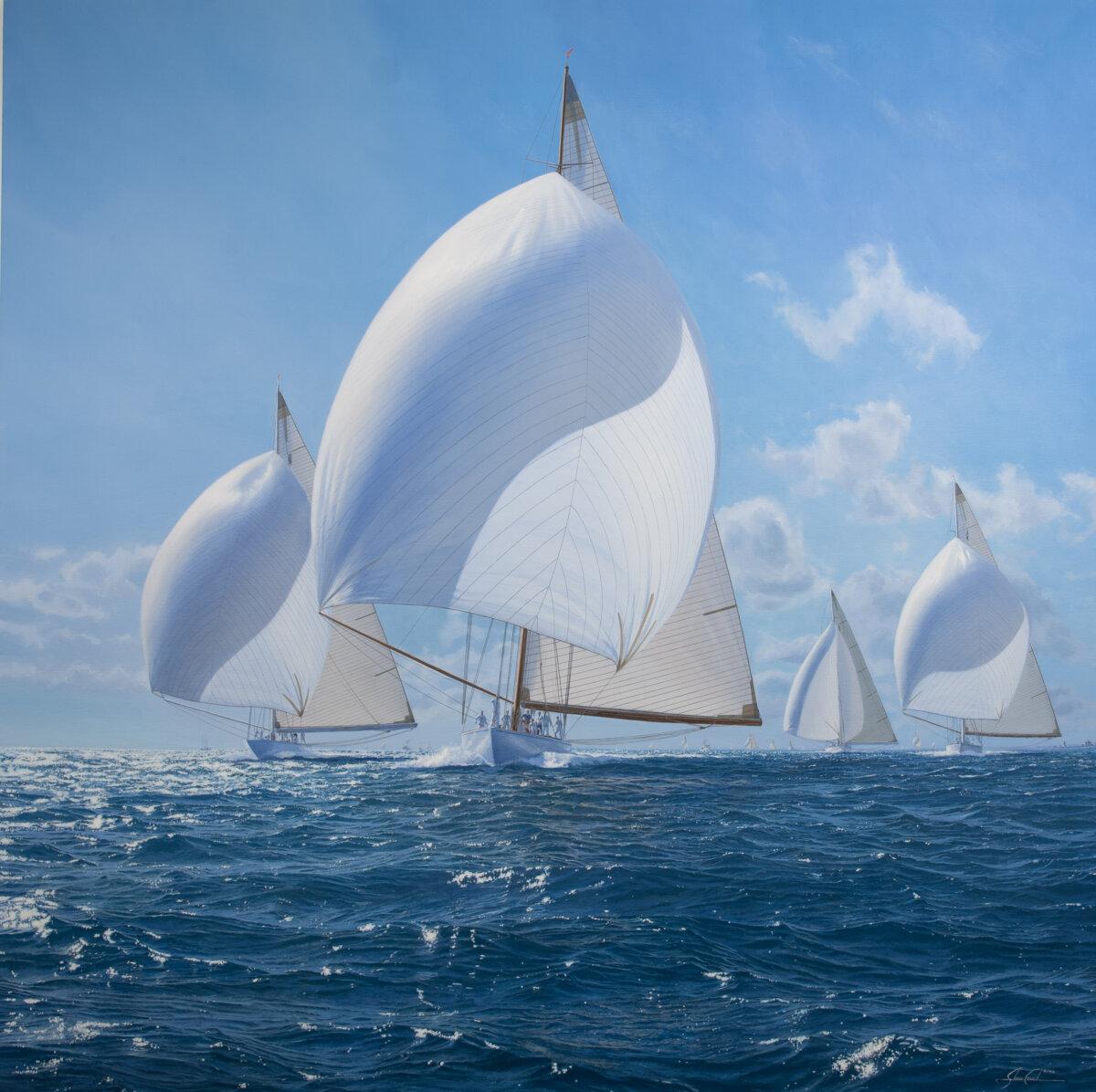
“Yankee Leads the Fleet,” 2024, by Shane Couch. Oil on canvas; 60 inches by 60 inches. Courtesy of Shane Couch
Then, in 1934, Vanderbilt skippered the Rainbow against the Yankee, the Eastern Yacht Club of Boston’s syndicate boat. Couch’s painting “Yankee Leads the Fleet” shows the Yankee ahead of the Rainbow, the Weetamoe, and the Vanite on the first leg (from New London, Connecticut, to Newport, Rhode Island) of the 1934 New York Yacht Club Cruise. That season, the Yankee seemed invincible; it had defeated the New York Yacht Club syndicate boat in every regatta, and it was the firm favorite to defend the America’s Cup trophy. Vanderbilt again asked himself: “What can I do to make our boat faster?” Couch said: “He put a load of ballast into Rainbow and completely made her a different boat.” And again, Vanderbilt won. Couch captures that race on canvas in “Battle for Selection America’s Cup Trials 1934.”
“You can tell I love that mentality, because as a painter, that’s my approach.”
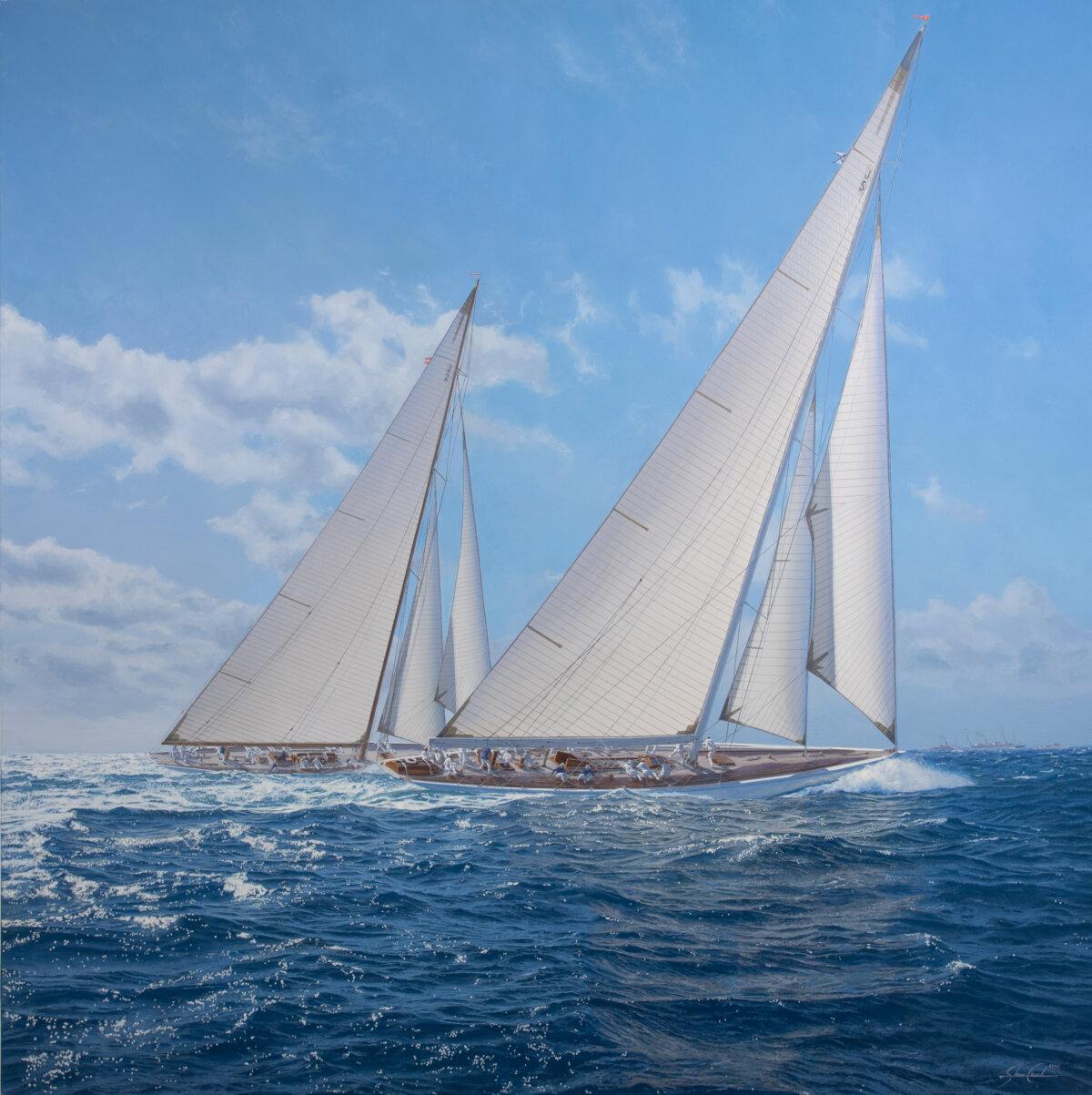
“Battle for Selection America's Cup Trials 1934,” 2025, by Shane Couch. Oil on canvas; 60 inches by 60 inches. Courtesy of Shane Couch
Painting Process
Couch approaches painting in “a very practical and analytical manner,” which he attributes to his engineering background. Painting with his engineering hat on means he’s always searching for solutions, including meticulously researching his subject matter beforehand and then picking each finished painting apart and asking himself: “What can I do better next time?”When he taught himself oil painting, he saw each painting as a river’s stepping stones to mastering his art. “I knew I couldn’t do it in one jump.” Each painting moved him closer to the riverbank of mastery. “What I’ve certainly realized is: When you get to the other side, you realize [that] you’re just on another island. There’s another river to cross.”
Each time Couch paints marine history, he feels a huge responsibility for the characters involved. “I feel like they stood over me painting, thinking: ‘You better get this right!’”
That’s why the research process always starts long before picking up his paintbrush. He always visits the location of each race he paints. To truly depict the ships in situ, he needs to understand the space and how the place names and landmarks mentioned in the race reports relate to one another. He also takes lots of reference photographs.
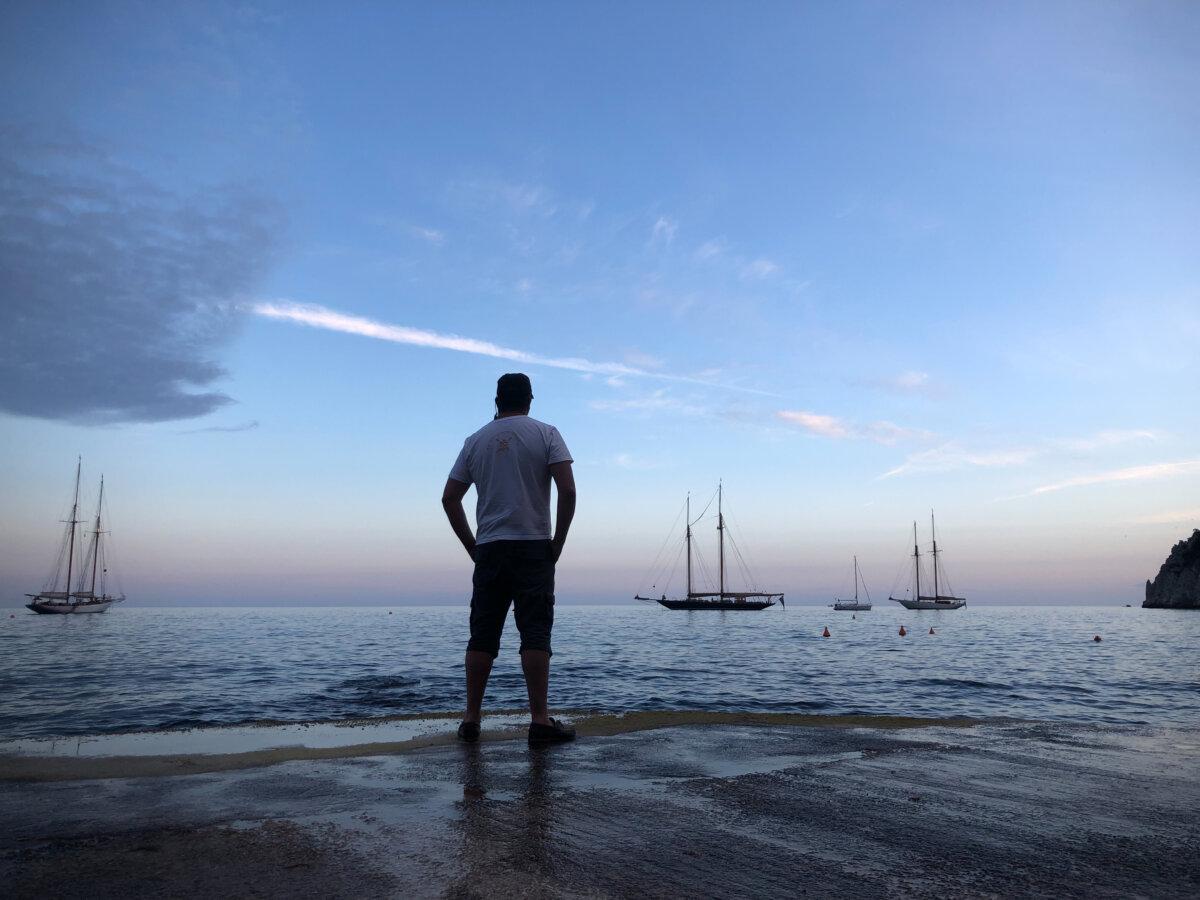
Marine artist Shane Couch at the Capri Classica 2019, in Italy. The Capri Classica was the first round of the International Schooner Association’s 2019 Schooner Cup Series. Courtesy of Shane Couch
He strives to find firsthand historic sources, often from his extensive library of America’s Cup race reports, yachting magazines, and newspapers such as the New York Herald.
While reading, he’ll chart the information—much like he did when he was little—so that he can visualize exactly what’s happening. As he notes the tide, weather conditions, and yacht placements, pivotal moments from the race flash through his mind, inspiring him to put pencil to paper for thumbnail drawings. These small drawings spark further inspiration so that he’ll then focus on a few different points in the race, sketching various viewpoints until he’s excited by one composition.
He used to three-dimensionally draft the yachts by hand from the original plans, another skill from his engineering days. But nowadays, he creates three-dimensional models on his computer to mimic his sketch, check the yacht proportions, and try out different variations.
He also spends a lot of time on the sea chasing bigger boats, shooting video footage of them traveling through the water, so he can study how the water curls, forms, and creates all the motion.
“I’m obsessed by how the water and the hull react, because that’s where the design and the beauty of the boat lines all come together: how that water flows around the hull and forms all the waves and all the curves and all the reflections. All those things. It’s what gives grace, beauty, and power to the subject.”
He references these videos when deciding on a composition.
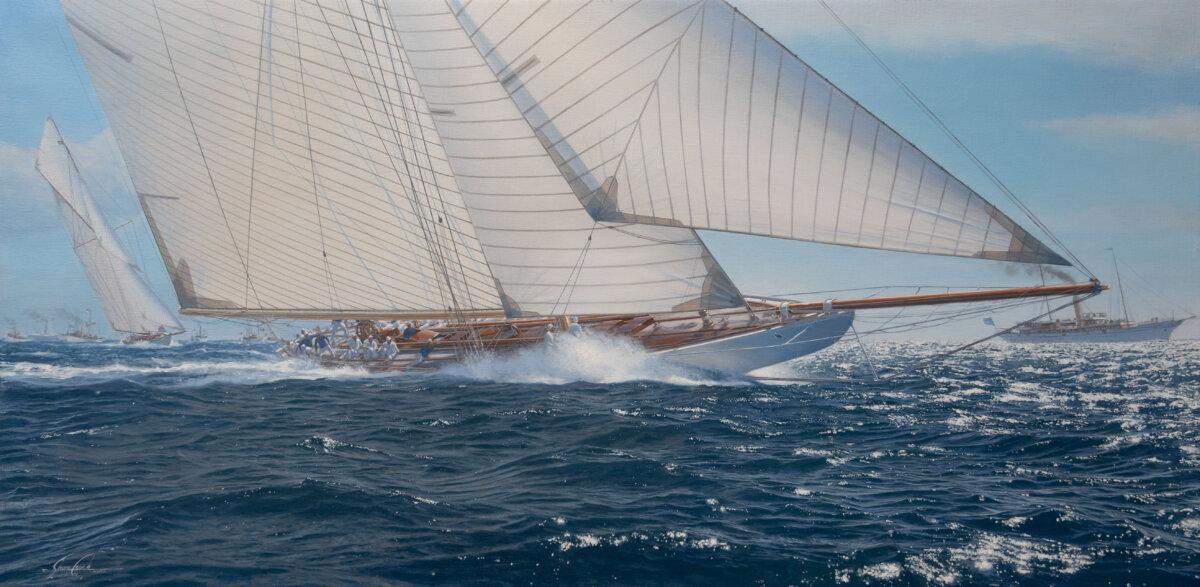
“Reliance 1903 America's Cup,” 2024, by Shane Couch. Oil on canvas; 21 inches by 42 inches. Courtesy of Shane Couch
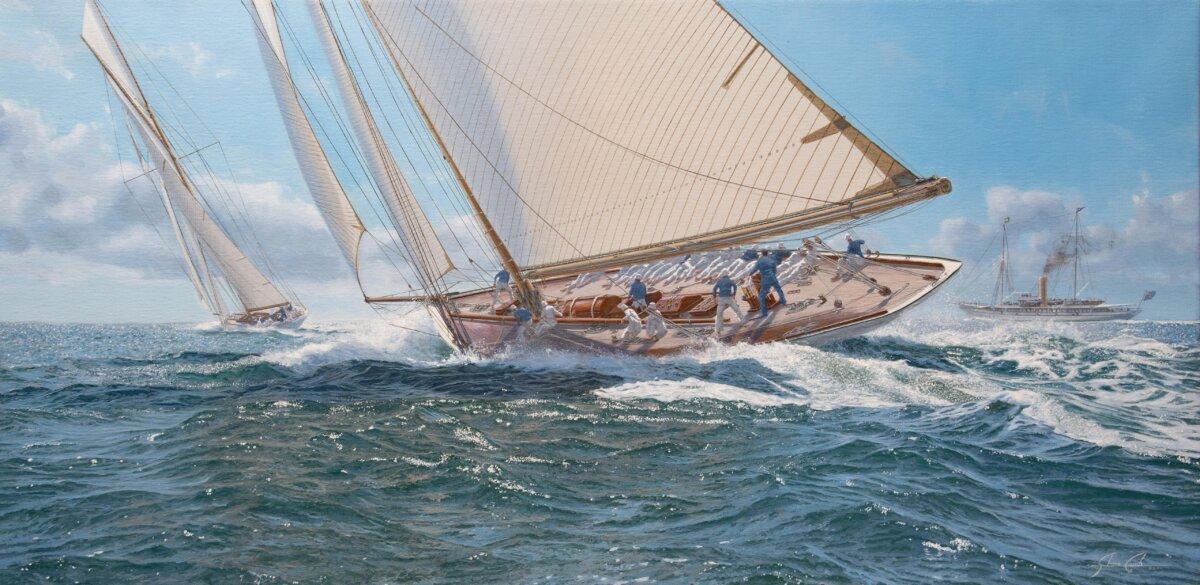
“Shamrock III 1903 America's Cup,” 2024, by Shane Couch. Oil on canvas; 21 inches by 42 inches. Courtesy of Shane Couch
He chooses the color tones last. But he will always select a sunny race to paint. When he’s standing at the easel painting for hours, he has to paint something that excites him and makes him happy. And he’s happiest when he’s in his boat and “the wind is enough to get the sea really up and choppy. But you’ve got a nice blue sky, all the sparkles on the water, and everything’s alive.”
To find out more about Shane Couch’s marine paintings, visit ShaneCouch.com
What arts and culture topics would you like us to cover? Please email ideas or feedback to [email protected]