Theodore Roosevelt, the Bad Lands, and Healing Power of the Wilderness

Driven by grief, Theodore Roosevelt fled to the wilderness of the Bad Lands and found healing, then passed it down to future generations.
Theodore Roosevelt, the Bad Lands, and Healing Power of the Wilderness
"Cowboys in the Badlands," 1888, by Thomas Eakins. Theodore Roosevelt's time spent in the Badlands helped restore his broken spirit. Public Domain
|Updated:
0:00

Gunshots rang out inside the saloon. One man lay unconscious on the floor. An unarmed Theodore Roosevelt stood over the ruffian, taking in the moment that would secure his place among the rough and tumble of the Bad Lands.

The gunman had been taunting patrons in the isolated saloon, even shooting up the establishment’s clock. “Four Eyes!” the man yelled at Roosevelt when he walked in. “Four Eyes is going to treat!” Roosevelt laughed and sauntered to a corner table. With both guns cocked, the man strode over to Roosevelt, leaned over him, and demanded he buy drinks. Roosevelt stood, feigning obedience to the demand, then quickly landed three punches to the man’s head.

“When he went down he struck the corner of the bar with his head,” Roosevelt recalled. “I took away his guns, and the other people in the room, who were now loud in their denunciation of him, hustled him out and put him in the shed.”
It was during the summer of 1884. Roosevelt had returned to the Bad Lands to be a “ranchman.” He had just given the owners of the Maltese Cross Ranch a $14,000 check for 450 head of cattle and had plans to start his own ranch. Roosevelt’s arrival was not driven by fortune and opportunity. He was driven from the crowded bustle of Manhattan to the “melancholy pathless plains” of the Bad Lands by grief.

Driven by Grief

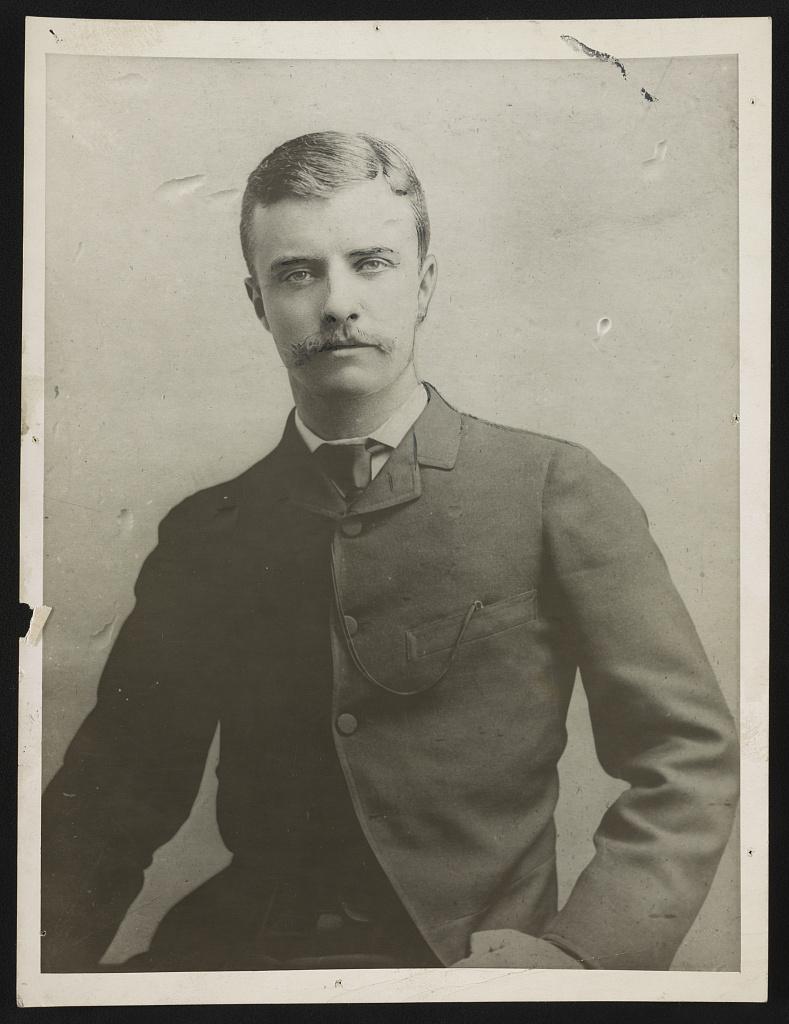
A portrait of Theodore Roosevelt as assemblyman in 1884. Library of Congress. (Public Domain)
A portrait of Theodore Roosevelt as assemblyman in 1884. Library of Congress. Public Domain

Roosevelt had just endured the harshest of winters. On Feb. 14, 1884, he slashed a large “X” in his diary, followed by eight words: “The light has gone out of my life.”

Roosevelt’s wife, Alice, and mother, Mittie, died that day—only two days after Alice had given birth to their daughter. His immediate response to the deaths was to work tirelessly. It was a similar response to when his father died six years prior. Despite his self-prescribed heavy workload, the grief was consuming him.
“He feels the awful loneliness more and more,” his sister Corinne recalled. “And I fear he sleeps little for he walks a great deal in the night and his eyes have that strained red look.”
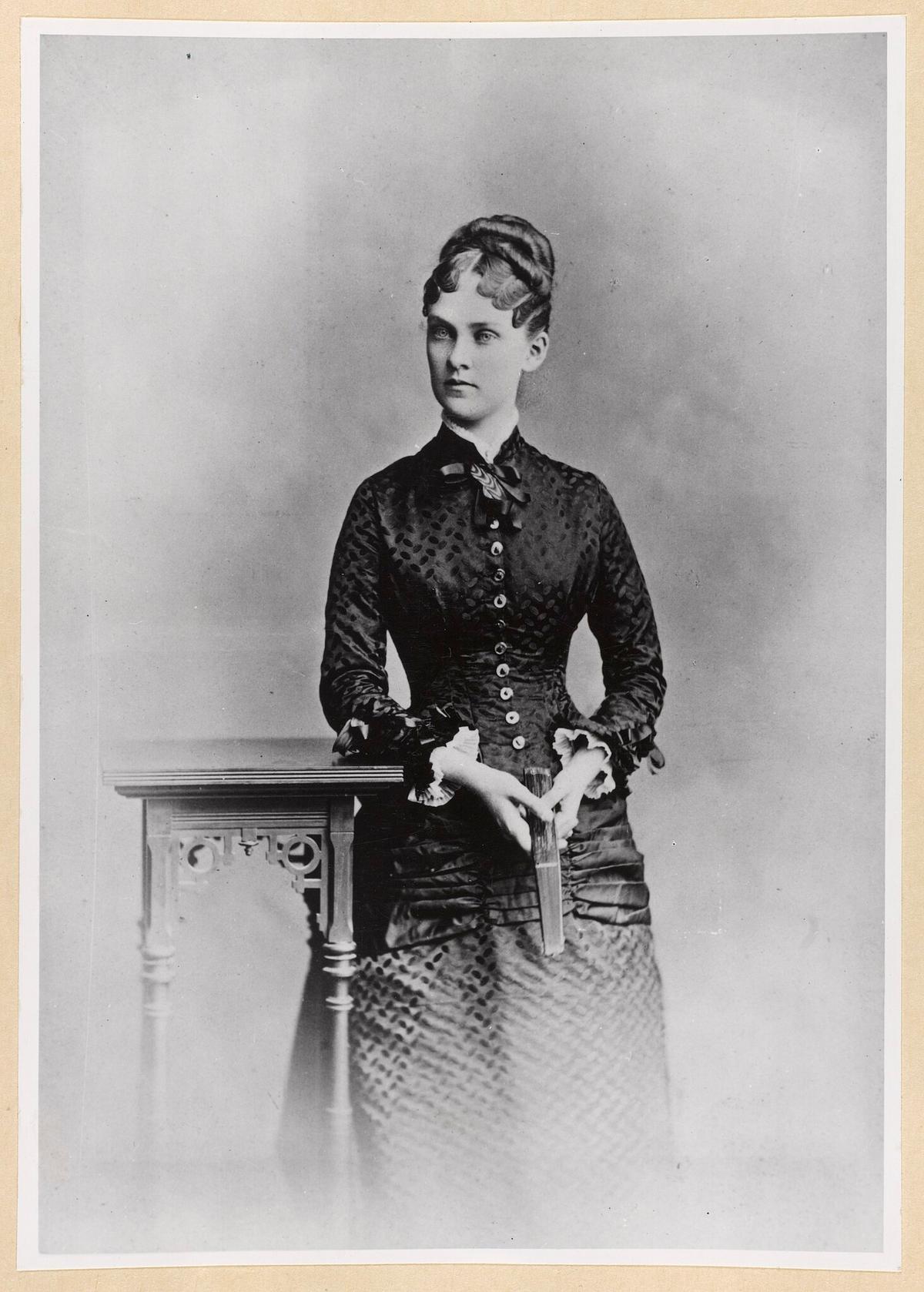
A portrait of Alice Hathaway Lee, Roosevelt's first wife, circa 1880–1884. Aside from a written eulogy, Roosevelt never spoke of her after her death in 1884. Library of Congress. (Public Domain)
A portrait of Alice Hathaway Lee, Roosevelt's first wife, circa 1880–1884. Aside from a written eulogy, Roosevelt never spoke of her after her death in 1884. Library of Congress. Public Domain

Attempting to remove the physical memories of his wife and mother, Roosevelt resolved to sell his house as well as the family home his father had purchased in 1873. The Roosevelts had until May to leave the home. In late May, Roosevelt arrived in Chicago for the Republican National Convention as a delegate-at-large for New York. After backing candidate James G. Blaine—a man he despised, Roosevelt continued west, leaving behind his political career. He also left his infant daughter in the hands of his sister, Bamie.
He viewed the Bad Lands, which he had visited briefly in 1883, as not simply a change of scenery, but a world all its own. It was a place where “civilization was as remote as if we were living in an age long past.” Here, Roosevelt would hunt, ride, drive cattle, read his books, and write feverishly.
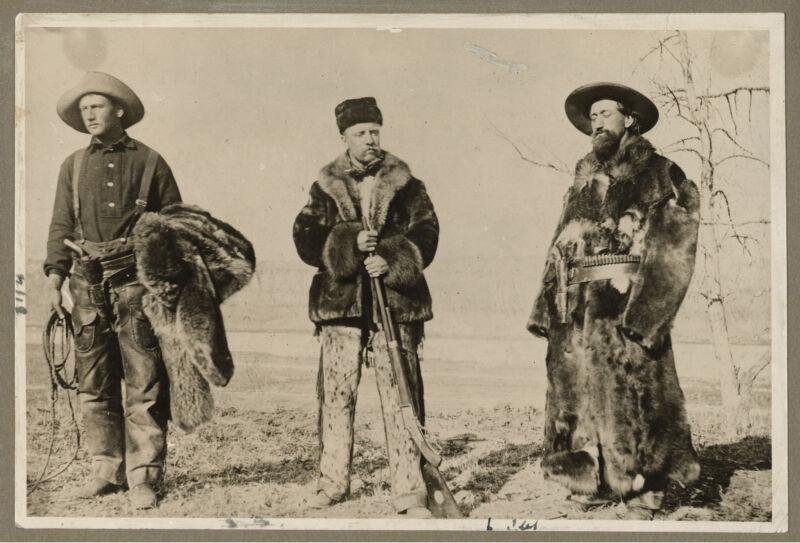
(L–R) Wilmot Dow, Theodore Roosevelt, and Bill Sewall at Elkhorn Ranch, circa 1886. The men had served as guides for Roosevelt in Maine, and Roosevelt hired them to build and manage his Elkhorn Ranch. (Public Domain)
(L–R) Wilmot Dow, Theodore Roosevelt, and Bill Sewall at Elkhorn Ranch, circa 1886. The men had served as guides for Roosevelt in Maine, and Roosevelt hired them to build and manage his Elkhorn Ranch. Public Domain
The Harvard graduate and former politician had a strange appreciation for the Bad Land’s isolation. His friend, Bill Sewall, who helped build the Elkhorn Ranch, was perplexed by Roosevelt’s view of the territory, suggesting that whoever held such a view “must have a depraved idea of life or hate himself or both.” Perhaps Sewall was right. Roosevelt’s light had gone out. His actions over the preceding months in New York, his endless wandering along the plains, and the recent bar fight suggested he did not fear death. But it also suggested he was hoping to find that light again.

Outpacing Grief

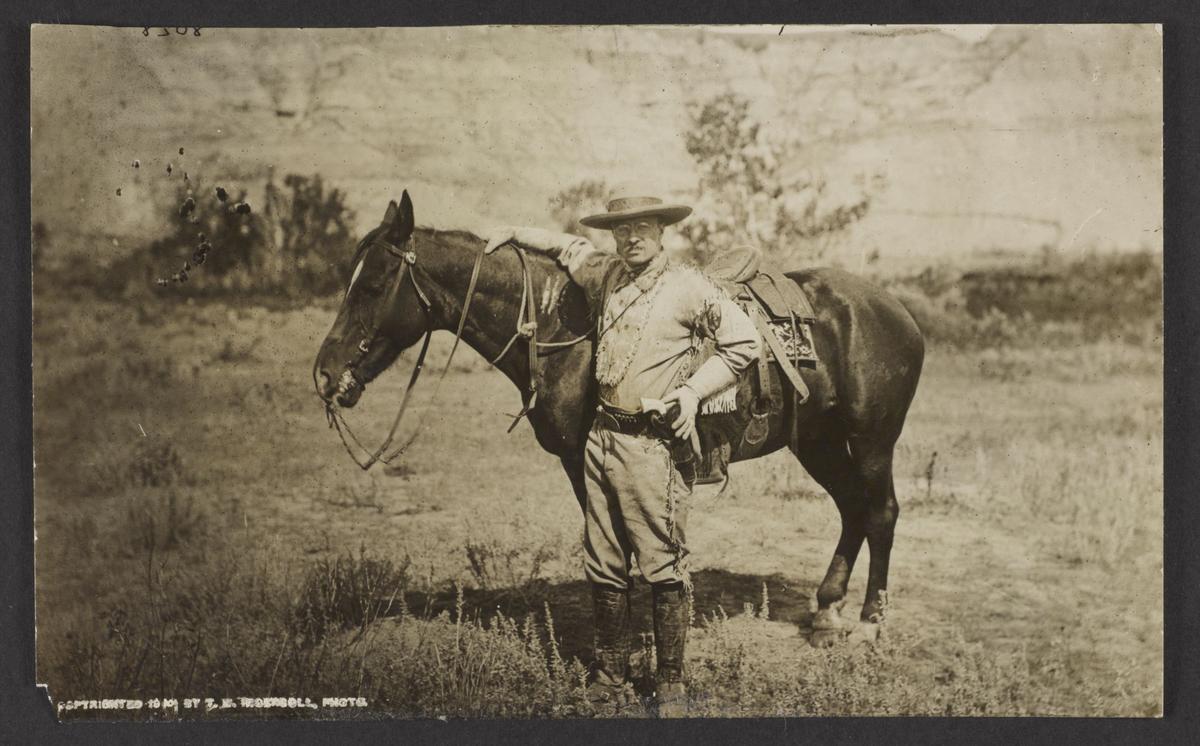
Theodore Roosevelt wearing a cowboy outfit and standing next to his horse, Manitou, in the Badlands, 1884. Library of Congress. (Public Domain)
Theodore Roosevelt wearing a cowboy outfit and standing next to his horse, Manitou, in the Badlands, 1884. Library of Congress. Public Domain
Upon his “perfectly sure-footed” horse, Manitou, he often rode from dusk to dawn. He thrived on the freedom that few, except those willing to rough it in the wild, got to experience. His horse, “as fast as any horse on the [Missouri] river,” gave him the ability to outrun his grief. “Black care rarely sits behind a rider whose pace is fast enough,” he wrote.
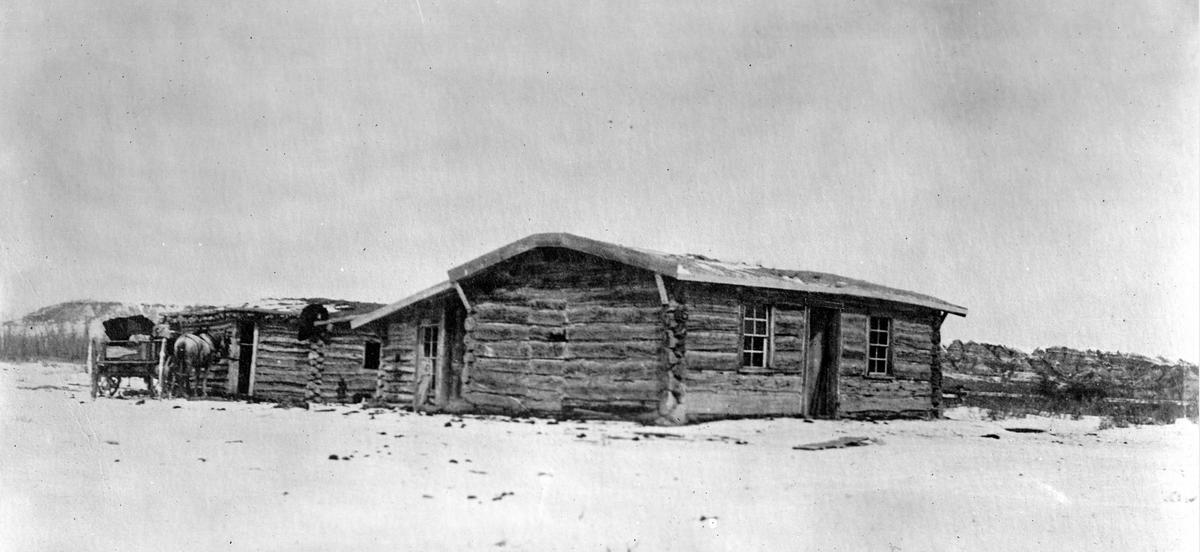
By August, Roosevelt, Sewall, and Wilmot Dow established the Elkhorn Ranch, though construction of the ranch house didn’t begin until October. Nonetheless, its location was ideal for a man who wanted to be alone with his thoughts. His nearest neighbors were no closer than 10 to 15 miles, and the Maltese Cross Ranch about 40 miles away. Roosevelt was never idle in his isolation. He was often on the move across what he considered his “ideal ‘hero land.’”
Theodore Roosevelt's Elkhorn Ranch on the banks of the Little Missouri River, North Dakota. (Public Domain)
Theodore Roosevelt's Elkhorn Ranch on the banks of the Little Missouri River, North Dakota. Public Domain

The same month that Elkhorn Ranch was established, Roosevelt and two others set off for the Bighorn Mountains. Riding Manitou and armed with his lever action 45-75 Winchester rifle with its custom engraved deer, buffalo, and antelope, he was gone for nearly two months. He seemed unaffected by nature’s harsh treatment of him and his fellow travelers.

“One day we rode through a driving rainstorm, at one time developing into a regular hurricane of hail and wind, which nearly upset the wagon, drove the ponies almost frantic, and forced us to huddle into a gully for protection,” he wrote his sister Bamie. “Another time a sharp gale of wind or rain struck us in the middle of the night, as we were lying out in the open (we have no tent), and we shivered under our wet blankets till morning.”

During this long venture, he killed hundreds of birds and small game. He shot blacktail deer, elk, and a 1,200-pound grizzly bear.

The Bad Lands, with its solitude and harsh environs, had begun to heal Roosevelt, providing him with something that eluded him in New York City and even those early months on the plains.
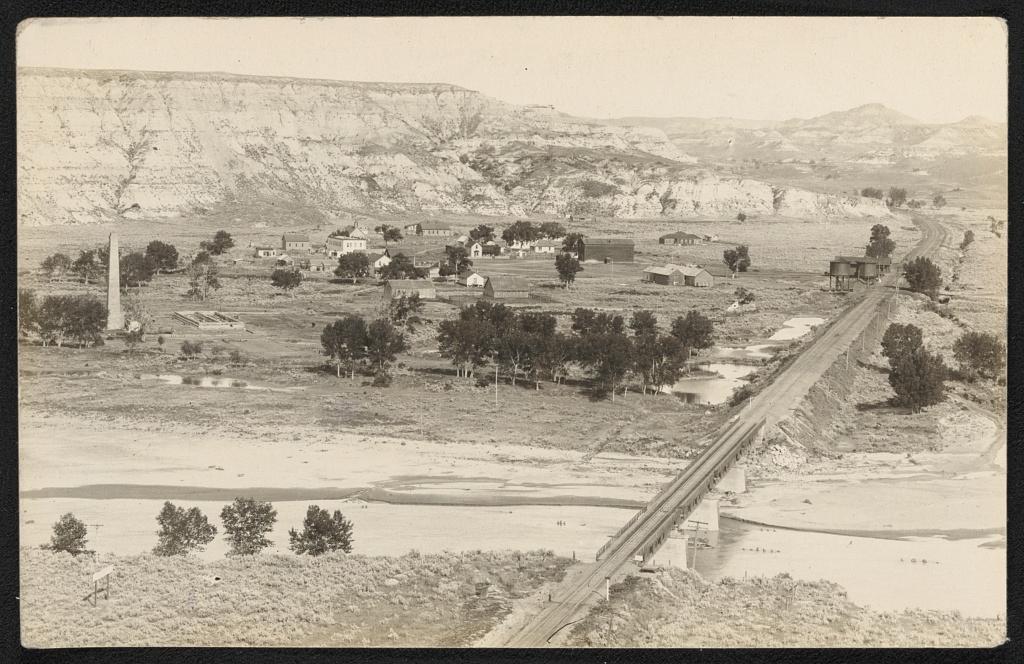
An aerial valley view of Medora, North Dakota, where Theodore Roosevelt once ranched. Library of Congress. (Public Domain)
An aerial valley view of Medora, North Dakota, where Theodore Roosevelt once ranched. Library of Congress. Public Domain
“So I have had good sport,” he wrote Bamie on Sept. 20, “and enough excitement and fatigue to prevent overmuch thought; and, moreover, I have at last been able to sleep well at night.”

A Pragmatic Concern

In David McCullough’s book “Mornings on Horseback,” he stated that “the most immediate and important benefit of [Roosevelt’s] time in the Bad Lands was what it did to restore him in body and spirit.”

Roosevelt’s time in the Bad Lands extended from 1883 to 1886, though he often returned to New York. Cattle drives, hunting, and riding the plains took up much of his time, but his compatriots were always surprised that even after long days, he would make time for his books and his writing.
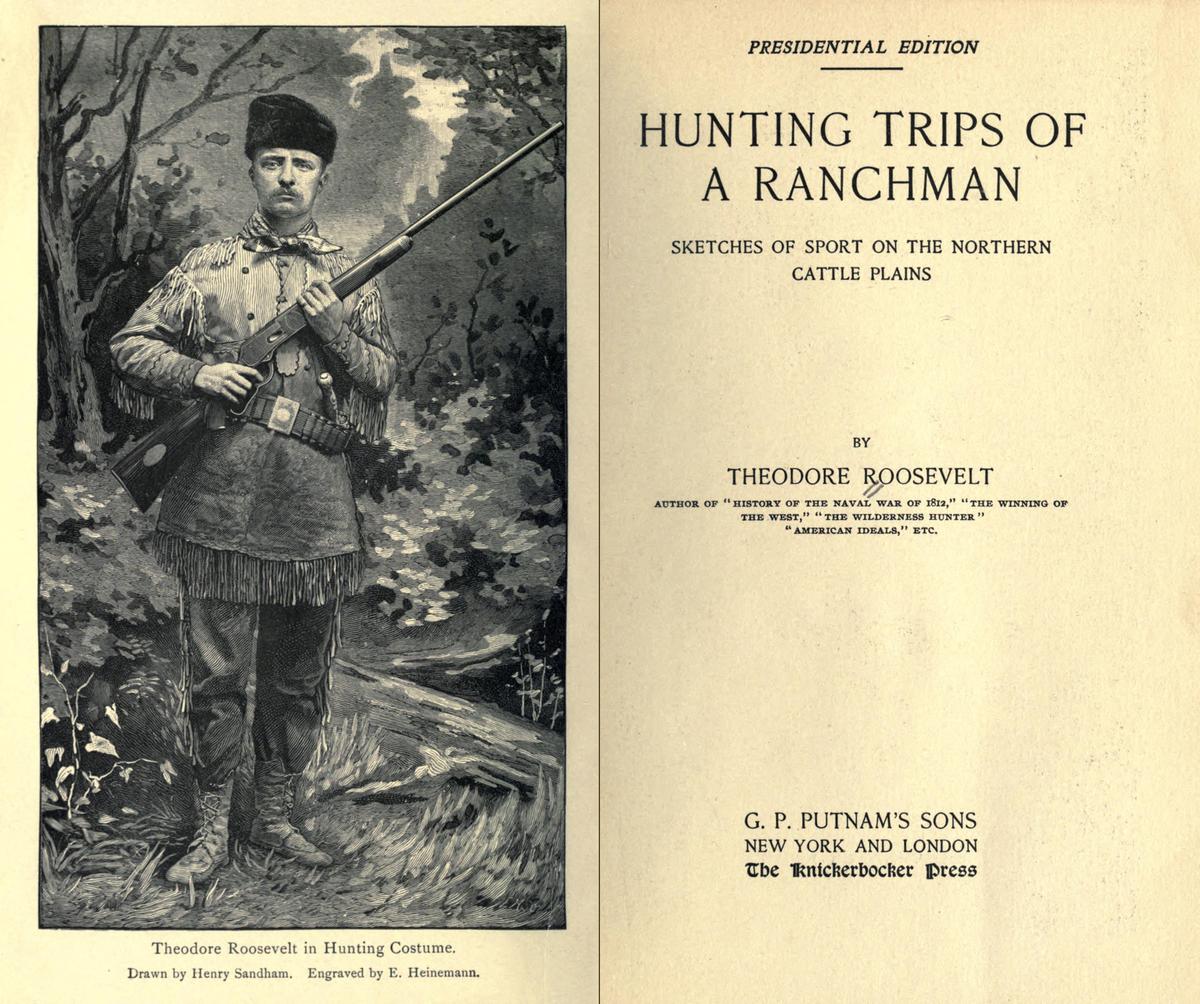
Frontispiece of "Hunting Trips of a Ranchman," 1885, by Theodore Roosevelt. Internet Archive. (Public Domain)
Frontispiece of "Hunting Trips of a Ranchman," 1885, by Theodore Roosevelt. Internet Archive. Public Domain
In 1885, he published “Hunting Trips of a Ranchman” in which he detailed his adventures. He was pragmatic in his view of the future of such places. Fitting for this period in his life, his assessment possesses a sorrowful tone: “The free, open-air life of the ranchman, the pleasantest and healthiest life in America, is from its very nature ephemeral,” he wrote in his book.

“The broad and boundless prairies have already been bounded and will soon be made narrow. It is scarcely a figure of speech to say that the tide of white settlement during the last few years has risen over the west like a flood; and the cattle-men are but the spray from the crest of the wave, thrown far in advance, but soon to be overtaken.”

America was becoming an industrial powerhouse and with that power came environmental desolation. Roosevelt was concerned the country’s beautiful landscapes would soon be commercialized. Furthermore, he was concerned that swaths of hunting lands would fall into the hands of the rich, leaving the average American on the outskirts.

“From its very nature, the life of the hunter is in most places evanescent; and when it has vanished there can be no real substitute in old settled countries,” he wrote in “The Wilderness Hunter,” published in 1893.

“Shooting in a private game preserve is but a dismal parody; the manliest and healthiest features of the sport are lost with the change of conditions. We need, in the interest of the community at large, a rigid system of game laws rigidly enforced, and it is not only admissible, but one may almost say necessary, to establish, under the control of the State, great national forest reserves, which shall also be breeding grounds and nurseries for wild game; but I should much regret to see grow up in this country a system of large private game preserves, kept for the enjoyment of the very rich. One of the chief attractions of the life of the wilderness is its rugged and stalwart democracy; there every man stands for what he actually is, and can show himself to be.”
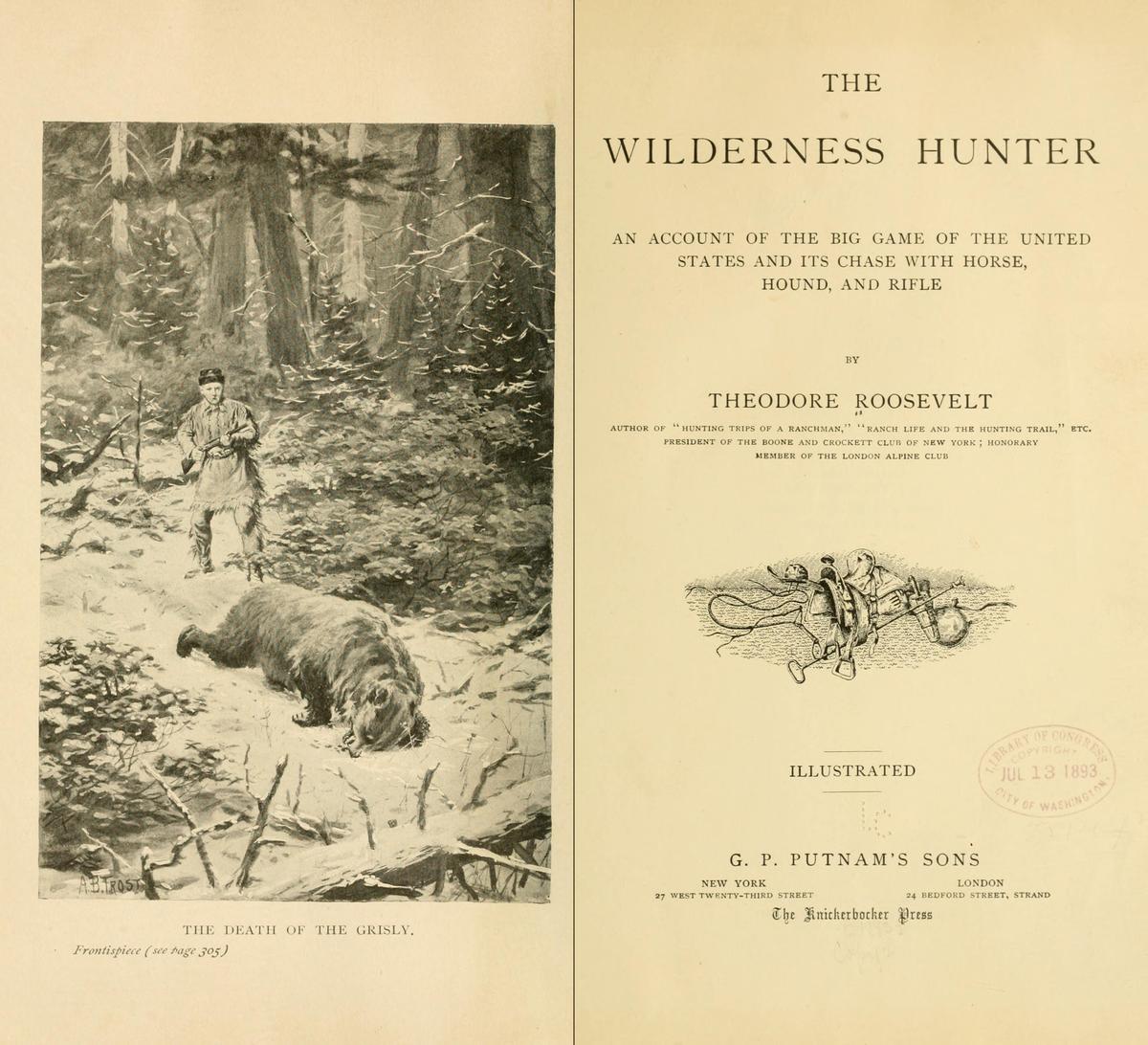
Frontispiece of "The Wilderness Hunter," 1893, by Theodore Roosevelt. Internet Archive. (Public Domain)
Frontispiece of "The Wilderness Hunter," 1893, by Theodore Roosevelt. Internet Archive. Public Domain

Protecting the Wild

Roosevelt, of course, was a wealthy man, which makes his statement even more convincing. He was a product of the healing properties of that “rugged and stalwart democracy.” By the end of his wilderness period, Roosevelt was indeed restored in both body and spirit. The light that had gone out of his life had returned. He was ready to return to his political career, but more importantly, he was ready to love again. He remarried on Dec. 2, 1886, to childhood friend Edith Carow. Roosevelt hoped to ensure that Americans, both broken and whole, could have a chance to encounter the wilderness as he did.

He received his chance in 1901 when he became president after the assassination of William McKinley. Roosevelt took up the charge of conservation by way of land preserves. During his time as president, he established the country’s first 18 national monuments, five national parks, 55 federal game preserves and bird reservations, 150 national forests, and approximately 230 million acres of public lands. He established the U.S. Forest Service as well as the National Wildlife Refuge System. Roosevelt came to be known as the “conservation president.”

When Roosevelt wrote the preface of “The Wilderness Hunter,” he attempted to convey the importance of what he had personally experienced. He seems to list all the healing properties of the wilderness, healing properties he hoped would prove beneficial to future Americans.

“No one, but he who has partaken thereof, can understand the keen delight of hunting in lonely lands. For him is the joy of the horse well ridden and the rifle well held; for him the long days of toil and hardship, resolutely endured, and crowned at the end with triumph. In after years there shall come forever to his mind the memory of endless prairies shimmering in the bright sun; of vast snow-clad wastes lying desolate under gray skies; of the melancholy marshes; of the rush of mighty rivers; of the breath of the evergreen forest in summer; of the crooning of ice-armored pines at the touch of the winds of winter; of cataracts roaring between hoary mountain masses; of all the innumerable sights and sounds of the wilderness; of its immensity and mystery; and of the silences that brood in its still depths.”
What arts and culture topics would you like us to cover? Please email ideas or feedback to [email protected]
Google LogoMark Us Preferred on Google
Dustin Bass
Dustin Bass
Author
Dustin Bass is the creator and host of the “American Tales” podcast and cofounder of “The Sons of History.” He writes two weekly series for The Epoch Times: Profiles in History and This Week in History. He is also an author.