Long the inspiration for legend, myth, and poetry, the Holy Grail has profoundly shaped Western literary and cultural consciousness: the imaginative romances of Chrétien de Troyes, the lush paintings of Dante Rossetti, the haunting verses of Tennyson that seem to elide the natural and supernatural realms. In our collective imagination, the Grail has figured as an emblem of moral testing and spiritual longing in the borderlands between worlds.
What few realize, however, is that tales of a quest for the Holy Grail are not entirely fictional. The origin of the notion of a quest for the Holy Grail is often attributed to the fertile imagination of a 12th-century French trouvère, Chrétien de Troyes, writing about the Arthurian legends.
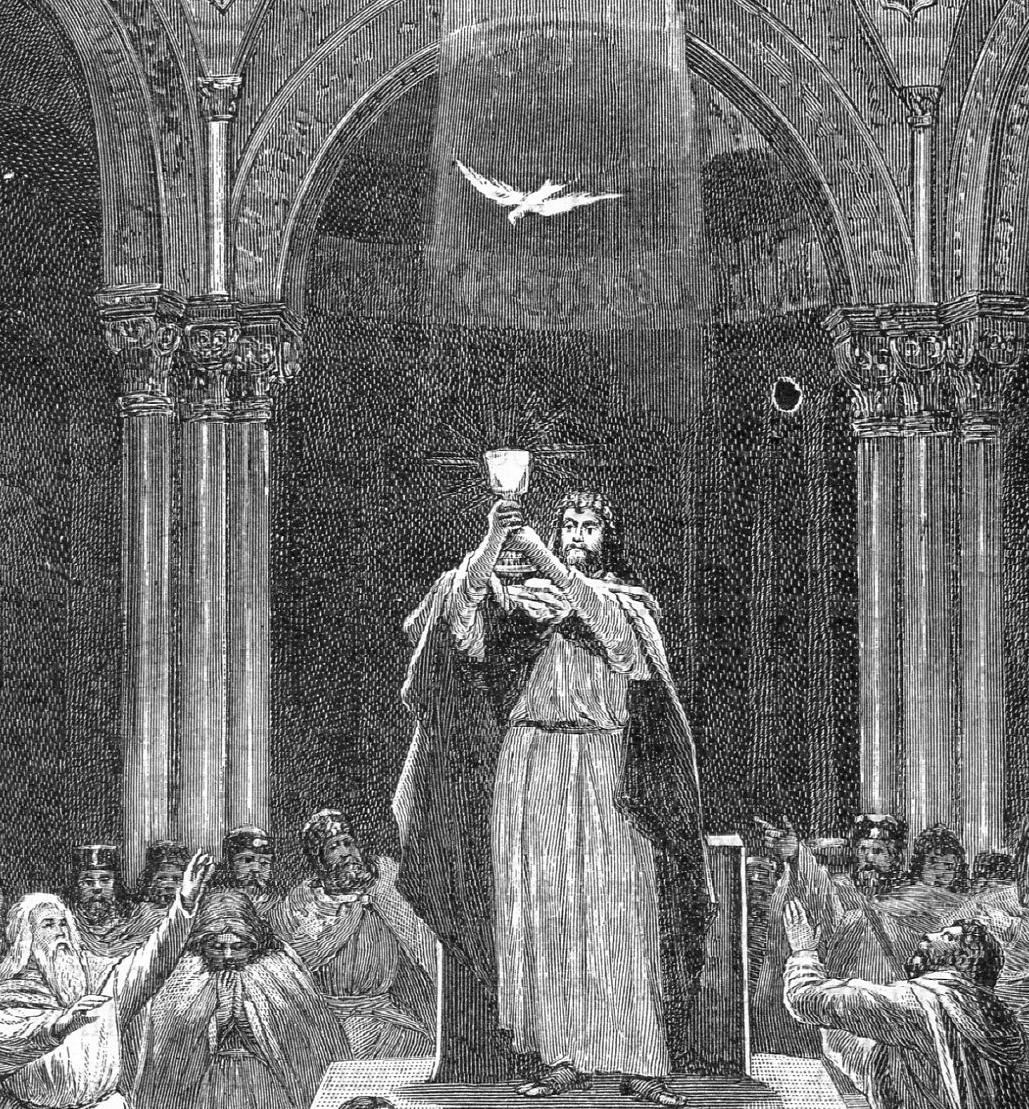
His final tale was “The Story of the Grail,” in which the young Welsh knight Perceval stays at the castle of the “Fisher King,” where he witnesses a strange procession of magnificent objects, including a gold grail, or cup, that glows. Perceval tries to determine who and what the mysterious grail is for. But de Troyes died before finishing his tale. Others attempted to complete the story, giving rise to the Grail literature that became a defining feature of the Arthurian legends.
As Joan Duran-Porta of the University of Barcelona noted, “The search for the Grail, physical or symbolic, has since then loomed large in this vibrant body of literature about magical adventures.” Over time, through the story’s iterations, this mysterious cup became identified with the chalice used by Jesus Christ at the Last Supper.
But is that the whole of the story? Is the Grail, as Duran-Porta argues, simply “a literary object ... the product of the imagination of a poet”?
A Religious Foundation
The Gospels recount Jesus’s celebration of the Passover with his disciples shortly before his crucifixion and death.

“And whilst they were at supper, Jesus took bread, and blessed, and broke: and gave to his disciples, and said: Take ye, and eat. This is my body. And taking the chalice, he gave thanks, and gave to them, saying: Drink ye all of this. For this is my blood of the new testament, which shall be shed for many unto remission of sins” (Matt. 26:26-28).
Tradition holds that St. Peter or his follower St. Mark brought the chalice from Jerusalem to Rome, where it became a part of papal liturgies. The earliest forms of some of the most important prayers of the Catholic Mass include the line “hoc praeclarum calicem”—“I take this glorious chalice.” This laudatory phrase doesn’t appear in other ancient anaphoras; it appears to be specific to Rome, suggesting that Christ’s own chalice was used in the Masses at Rome.
Thus, the theory goes, the Holy Chalice remained in the possession of the early popes up until the time of Pope Sixtus II. Saint Sixtus II valued the Chalice even above his own life: During the persecutions by the Emperor Valerian, he hatched a plot to save the Chalice from falling into Roman hands. He didn’t do the same for himself, eventually surrendering to martyrdom in A.D. 258.
Sixtus entrusted the precious relic to his deacon, Saint Lawrence, who was commissioned to carry it beyond the long reach of the emperor. St. Lawrence, a native of Spain, took the Chalice to Huesca in the third century.
But again, a few centuries later, the Chalice was in peril. When the Muslims invaded Spain in 713, the Chalice was secreted away in the Pyrenees region of Spain. For a time, it lay hidden in the monastery of San Juan de la Peña, until in 1399 the monks handed it over to King Martin I of the Spanish kingdom of Aragon. He kept it first in his palace at Saragossa and then the palace at Barcelona.
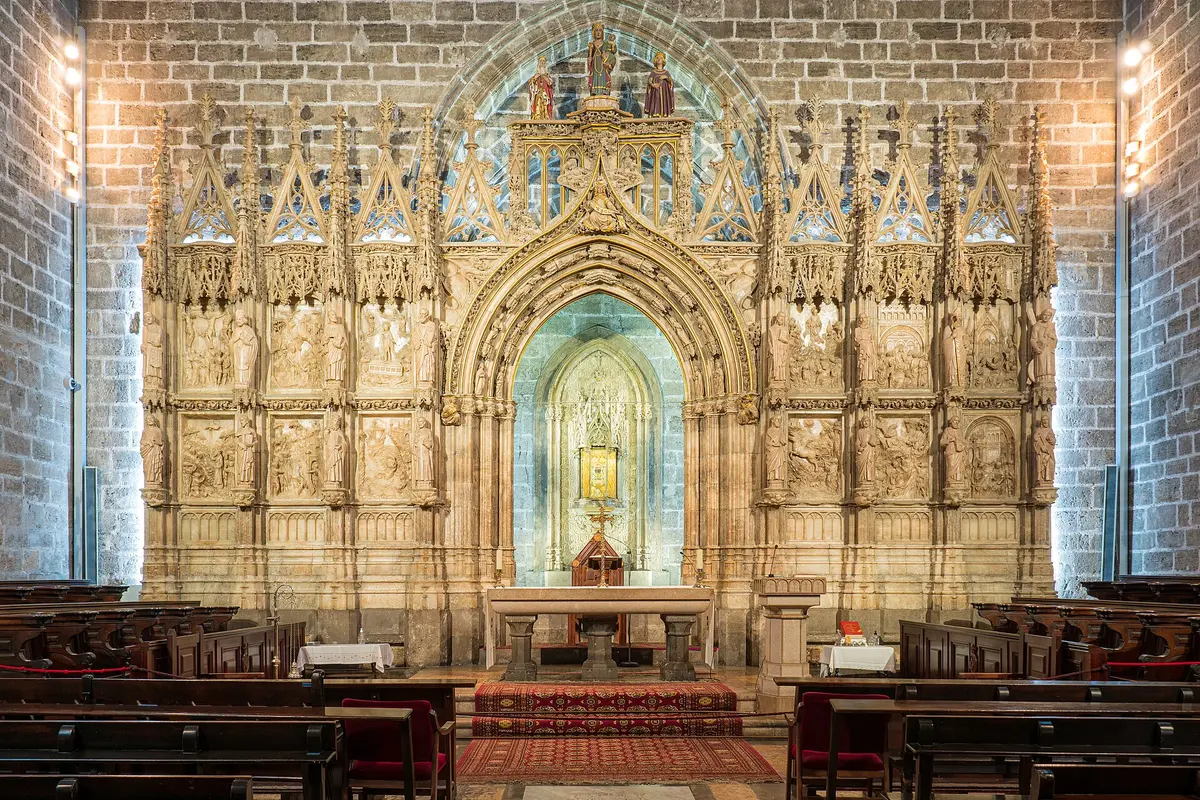
His second successor, King Alfonso the Magnanimous, carried the Chalice to Valencia. Partly in order to fund the conquest of Naples, the king took a loan from the Church, and part of the repayment of that loan included the Chalice, which he delivered to the Valencia Cathedral in 1437. The Chalice remains there to this day.
Though its travels ended in 1437, its trials did not. It survived a fall on Good Friday of 1744 and the cathedral’s desecration during the Spanish Civil War. A family hid the Chalice in their home until the fighting ended.
The Holy Chalice
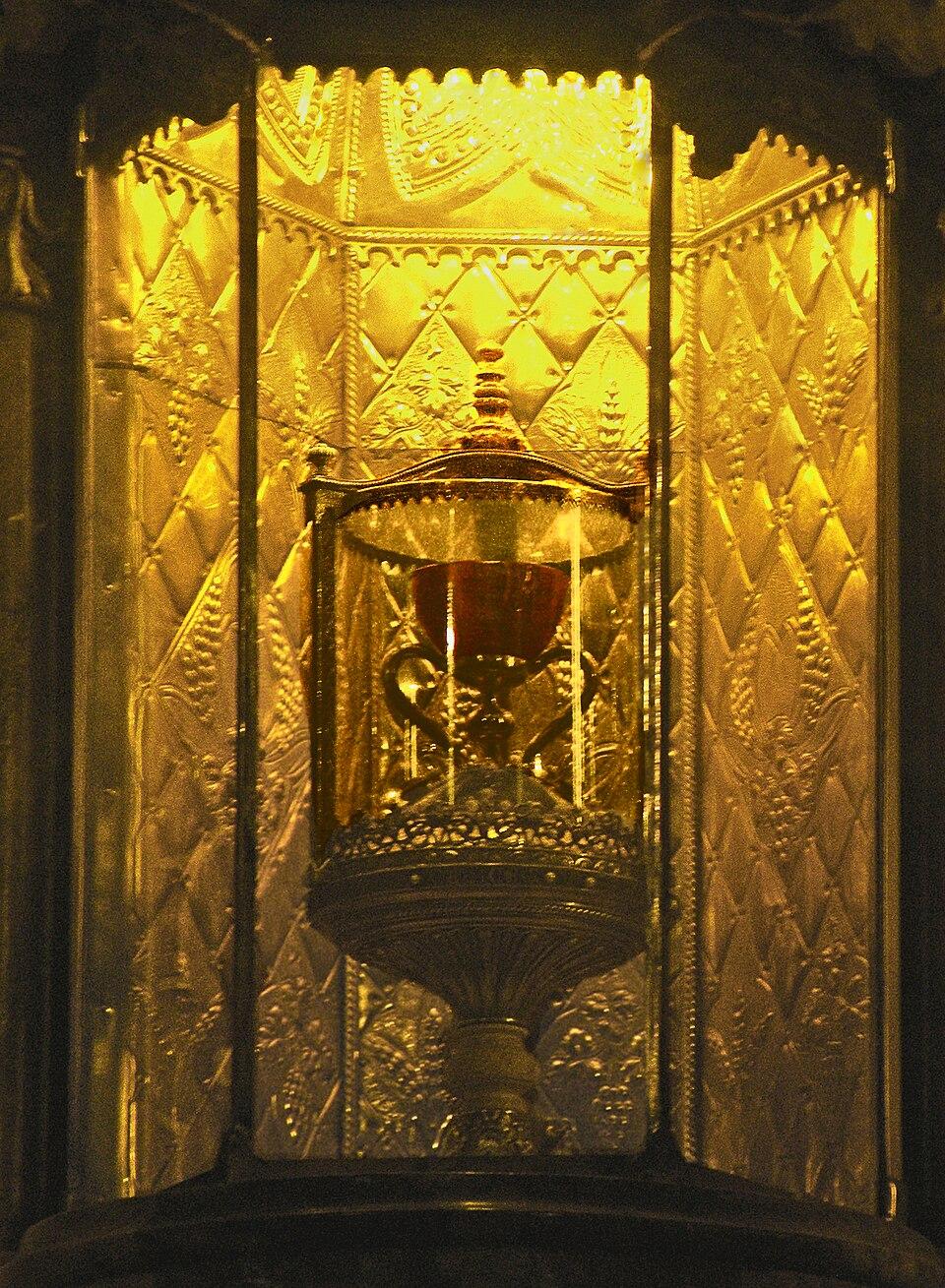
The Holy Chalice is composed of two parts: a carved gold base with handles and a cup. The upper cup portion is considered the relic that Jesus used. This cup is composed of reddish-brown agate, with faintly visible coruscating swirls that resemble the banded surface of Jupiter or perfectly polished and stained wood grain.A 1960s archaeological study of the cup discovered that it dated from the 1st or 2nd-century B.C. and was crafted by hand in the area between Palestine and Egypt, the only region where that kind of agate can be found. The cup is the same size as a traditional Jewish kiddush cup, or blessing cup, which is precisely what would have been used at the Last Supper.
The gold stand dates from the 11th century and indicates that medieval craftsman wished to create a suitable setting to display the cup they considered a relic.
It now rests quietly in the cool, shadowy interior of a special chapel in the Valencia Cathedral, gleaming gently inside a crystal case.
Century after century, passing from the hands from one guardian to the next, emerging again and again from under the clouds of persecution, war, and disaster, the Chalice has come down to our own day, a tangible link to the time of Jesus and one of the best-kept secrets of Valencia.
Only the pope is permitted to use the Chalice. Pope John Paul II and Pope Benedict XVI both did so. The former referred to the relic as “a witness to Christ’s passage on Earth.” Is it certain? No. But, in the words of art historian Dr. Ana Mafé:
“If there is any chalice that, according to tradition, was in the hands of Jesus, without a doubt, the only cup that fulfils all the requirements when subjected to a scientific analysis that can be replicated anywhere in the world with the same results is the Holy Chalice of the Valencia Cathedral.”