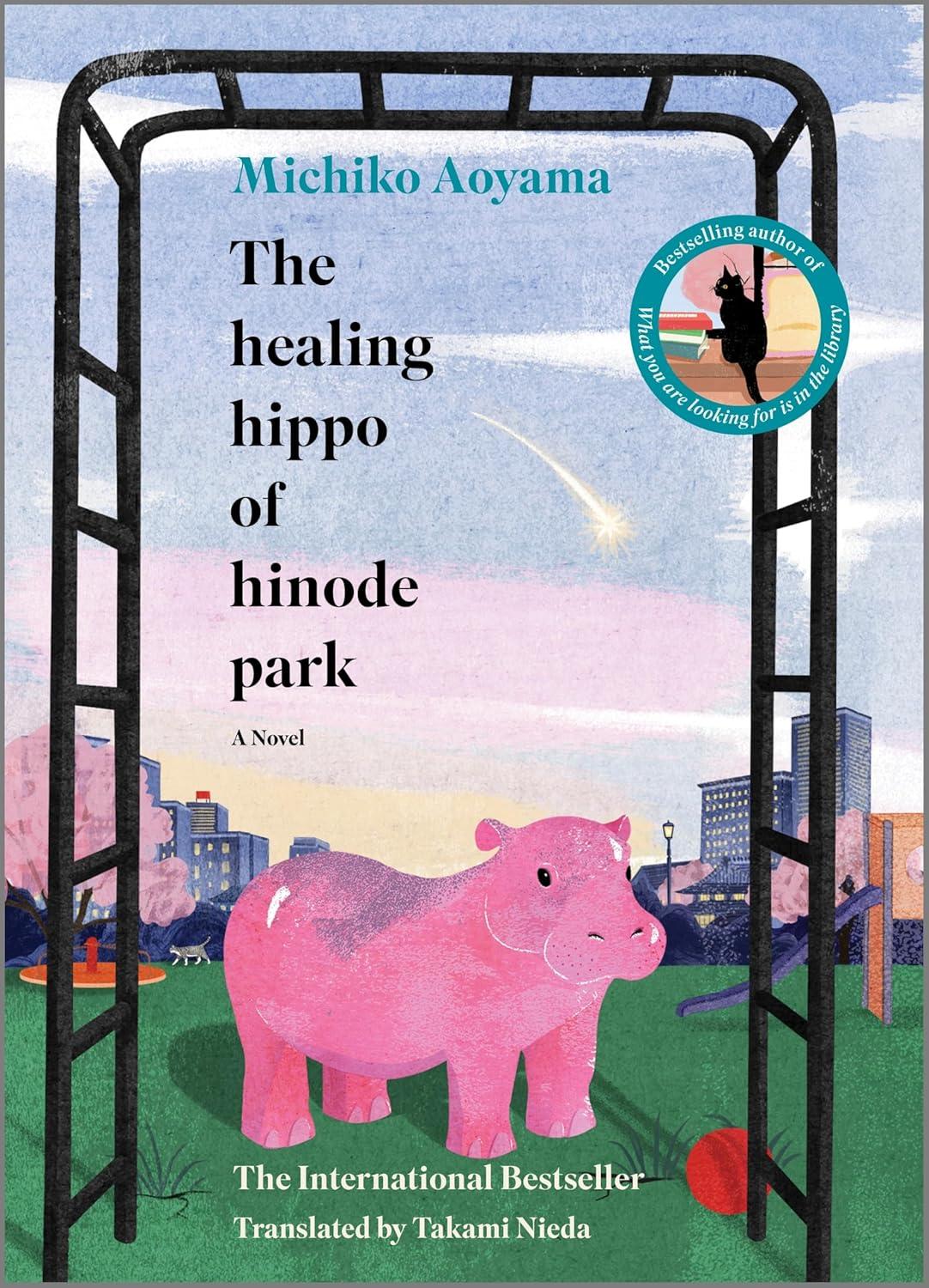
Can a concrete hippopotamus in the corner of a children’s playground change people’s lives? In Michiko Aoyama’s “The Healing Hippo of Hinode Park,” some residents of a community near a condominium turn to a community superstition to help them find a cure for their ailments, both physical and psychological.
At the Advance Hill condo complex, the local legend says that if someone rubs Kabahiko, the hippo statue in the nearby playground, on the same body part where they’re experiencing a problem, it will cure it. The older woman who runs the dry cleaning store on the main floor of the complex swears by Kabahiko’s power, saying she rubbed the hippo’s back and it cured her hernia.
It’s a joke, obviously, and people laugh it off. Kabahiko is just a ridiculous-looking children’s statue, with its weathered paint cracked, silly grin, and that chip just below its eye that makes you unsure if it’s laughing or crying. But despite the absurdity of the idea, the novel follows five loosely connected people who end up asking the hippo for a solution to their suffering.

Many Ailments
You might at first mistake “The Healing Hippo of Hinode Park” for a young adult novel, especially after reading the first story. Kanato Miyahara wishes to reclaim the “smart” brain he had in junior high. School used to be a breeze for him, but he suddenly finds himself near the bottom of his new high school class, and he can’t understand why. He rubs Kabahiko’s head, pleading, “Please help me heal my twisted, stubborn brain.”Most of the other stories have an adult as the protagonist. The second story features Sawa Himura, a mother and former retail professional. After the birth of her first child, she experiences a sudden loss of personal identity, which, in turn, creates a metaphorical loss of her voice. Wracked with insecurity, she never challenges others’ opinions or their demands of her and cannot find the will to speak for herself.
Chapter 3 features Chiharu Niizawa, a wedding planner, who develops a patulous eustachian tube dysfunction, a condition that causes her voice to echo in her head in a very distressing way. She’s depressed and withdrawn, suffering at home and pointlessly whittling her days away.

Hippo Hippocrates
Most turn to the hippo out of a sense of “Why not? I’ve tried everything else.” Kabahiko (a play on the Japanese word for “hippo”) is a neglected yet humble creature sitting in the corner, faded and cracked but still smiling, content in its small corner of the playground. Its Zen-like stillness and enigmatic Mona Lisa-like smile inspire those around it, even though it doesn’t actually do anything in the physical sense.“The Healing Hippo of Hinode Park” isn’t “magical realism” in the traditional sense. Kabahiko is not some supernatural catalyst or force for solving problems. Instead, each story is a meditation on fundamental questions of happiness, success, and living, exploring the ways people hinder their own paths.
Asking the hippo for help may start them on the path toward a solution, at the very least, by defining it, but it’s almost always through interactions with their community that true healing can occur.
Then again, who can say where a healing spirit may come from?
Iyashikei (Healing Fiction)
In contrast to the high-stakes drama frequently used in Western storytelling, there is a highly popular, quiet genre in Japanese literature that offers something far subtler. Known as “iyashikei,” or “healing” fiction, it is steeped in gentleness, inviting readers to slow down and savor the quiet beauty of everyday life.Conflict doesn’t drive the plot here. Iyashikei stories unfold in peaceful settings where the pace is unhurried and life’s small moments take center stage. Some highlight the comfort of routine. Others, such as “Hippo,” explore private journeys to overcome challenges. What unites them all is the strength found in community, and the quiet joys that come from nature, conversation, and shared meals.
With soft-spoken charm, healing fiction often illuminates the quiet heroism of kindness, the bonds of community, and the unexpected ways healing can take root even in the simplest of places.
Constant exposure to social media and digital noise wears us down. Books like these remind us how even a slight change in perspective or a single meaningful interaction can have profound effects. It’s an invaluable lesson for all of us, no matter where we come from.