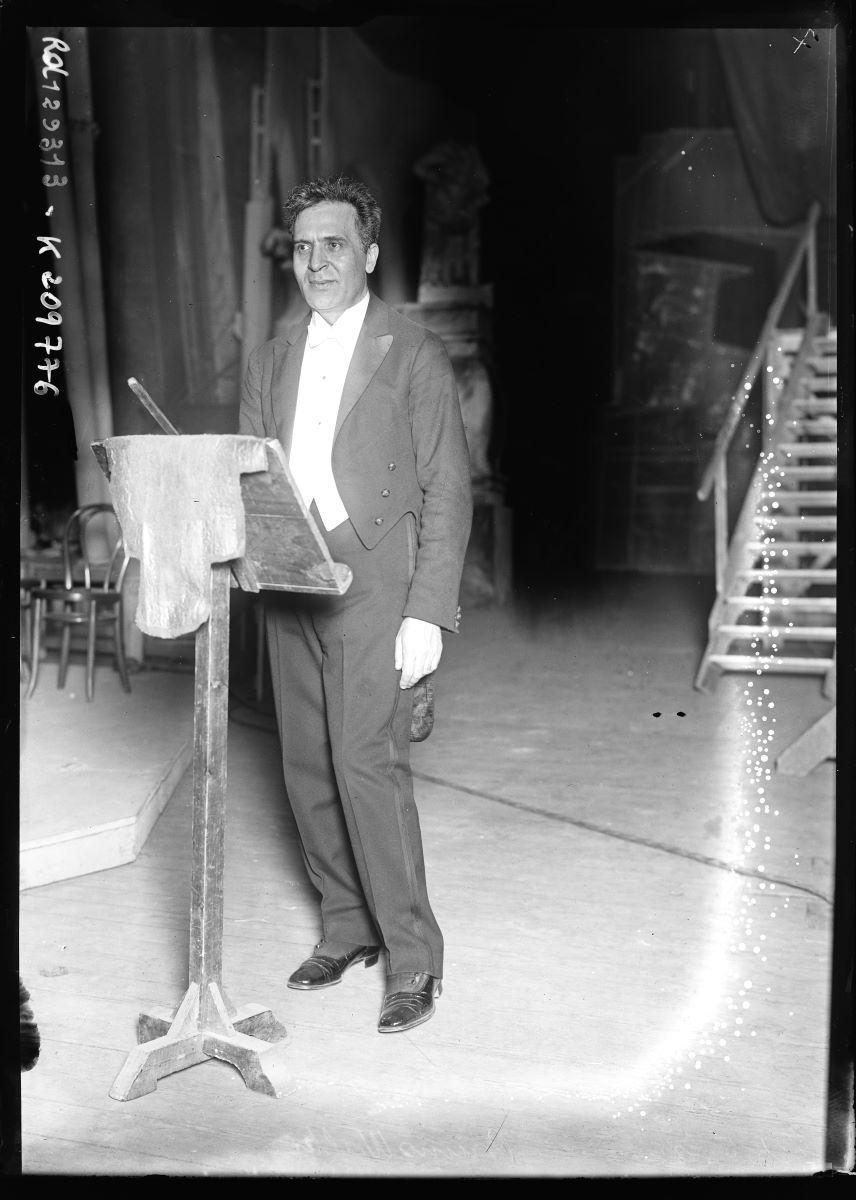
Walter, who later in life changed his name from Bruno Schlesinger, was born in 1876 to a middle-class Jewish family in Berlin. At the age of 8, he entered the Stern Conservatory to study music, and, by 1894, he had made his conducting debut in Cologne.
Mentored by one of history’s great composers, Gustav Mahler, Walter’s musical career soared over the next several decades, which included conducting the world-premiere of Mahler’s Ninth Symphony in Vienna. When the Nazis came to power in 1933 and restricted him from conducting symphonies, he moved to Austria where he soon became the artistic director at the Vienna Opera House. When Germany annexed Austria, Walter fled to America, arriving in 1939.
Milstein was born in Odessa, Ukraine, in 1903 and was trained by two of Eastern Europe’s great pedagogues: Pyotr Stolyarsky, of Odessa, and Leopold Auer, of St. Petersburg, Russia. Early into the Russian Revolution, his teacher, Auer, left the St. Petersburg Conservatory where he had worked for 49 years. The Revolution had left Milstein without his professor and in poverty. His talent and his associations with composers and fellow musicians kept his career moving forward. In 1928, Milstein decided to follow the path Auer paved 10 years prior, and moved to America.
Auer’s arrival in New York in February 1918 was quickly followed by his American debut at Carnegie Hall. Now, nearly three decades removed, Auer’s pupil, Nathan Milstein, stood on the same stage, preparing to perform the solo that had actually launched Auer’s career more than 90 years before. Although this was not Milstein’s American debut, it would become a debut in a different and more lasting sense.
Goldmark in America
Peter C. Goldmark had a device prepared to capture the performance. He was born in Budapest, Hungary in 1906, but he and his family escaped the communist takeover in 1919 by moving to Austria. There, he studied physics at the University of Vienna, and soon found his calling in the new technology of television.
He moved to Cambridge, England, where he worked for a radio and television equipment company from 1931 to 1933. By 1936, the young Hungarian had moved to America and was working for Columbia Broadcasting System (CBS) as its television department’s chief engineer. The department was small—two technicians and a single room. There was plenty of room for growth.
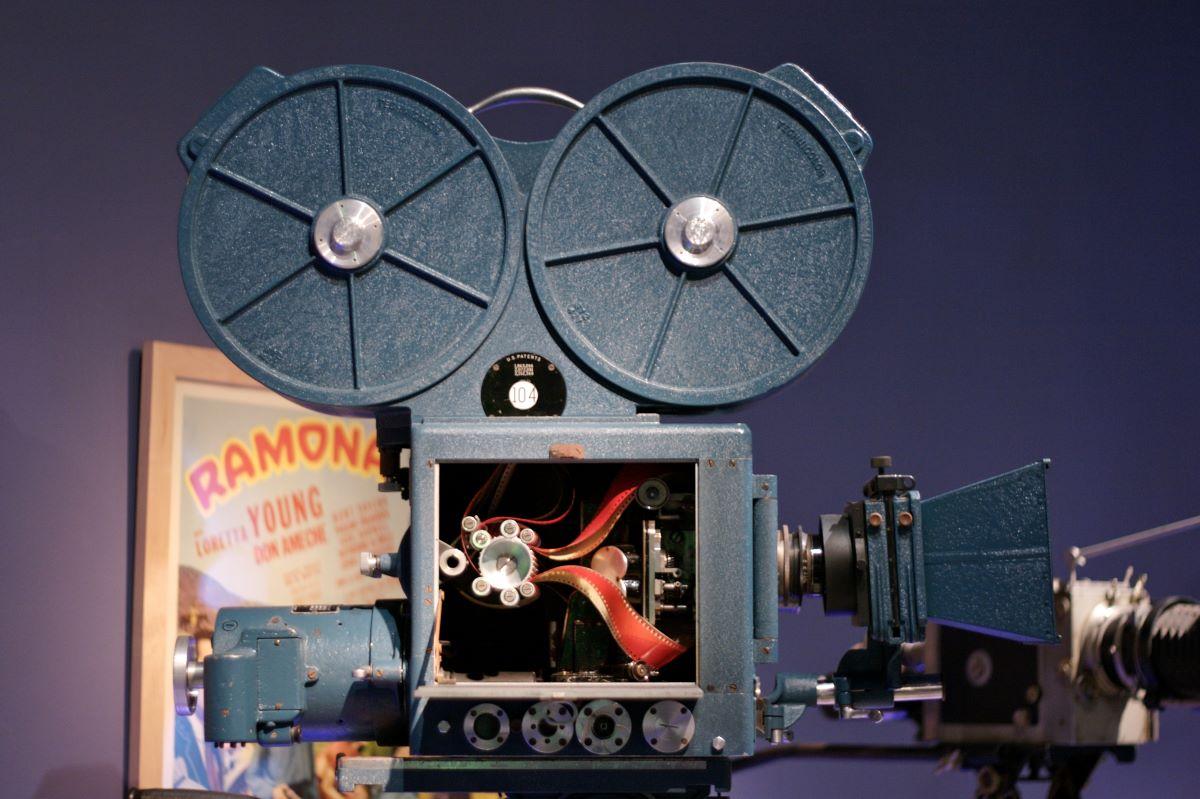
He and his growing department helped improve CBS’s black-and-white television system. In March of 1940, he saw the Technicolor presentation of “Gone With the Wind,” and set to work on developing a color system for CBS. The engineers at Radio Corporation of America (RCA) were actually ahead of Goldmark and his department. They had conducted a presentation of color television to the Federal Communications Commission (FCC) in February.
The presentation didn’t go well, thus opening the door for Goldmark to make his mark on the medium. And indeed he did by deciding to make a momentous occasion all the more memorable by conducting the presentation at the top of the Chrysler Building in late August. This was followed by a successful presentation to the FCC.
Goldmark’s New Endeavor
The troubles in Europe, however, forced him away from his television work, and in 1942, he and several CBS associates joined Harvard’s Radio Research Laboratory (RRL). Luckily, CBS and RRL came to an agreement, turning Goldmark’s CBS laboratory into a lab for RRL while keeping Goldmark and the others as paid CBS employees. Goldmark advocated for a laboratory in England, and by the fall of 1943, the American British Laboratory was established, where he worked as technical supervisor and then acting director.His time in England didn’t last long; he was back in New York by December to become CBS’s Engineering and Research Department director. When the war ended, he returned to his work on a color television system. But there was another technical problem that caught his eye, or more accurately, his ear.
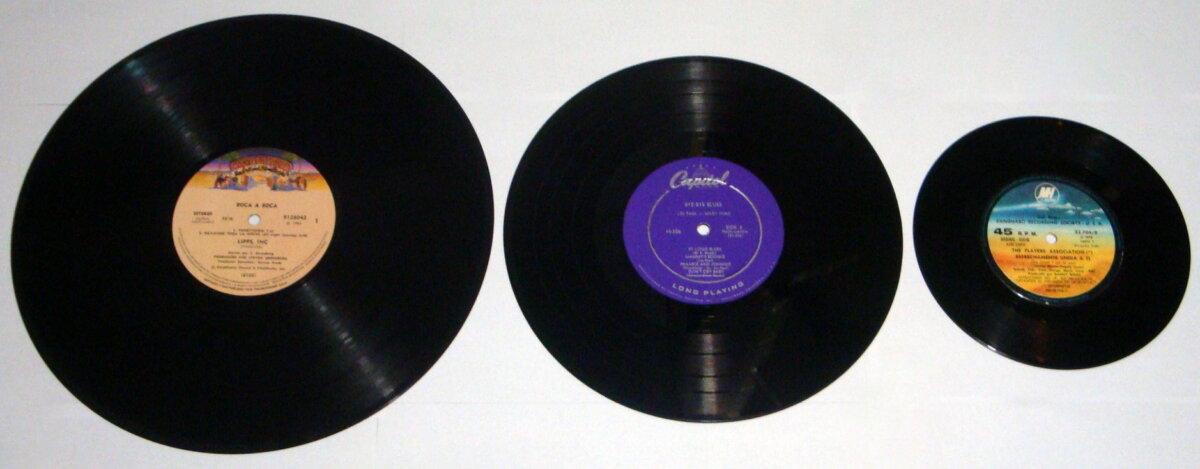
One evening during the fall of 1945, Goldmark was at a dinner. The host wished to play for him a recording of Johannes Brahms’s Second Piano Concerto. Goldmark was an avid musician, having excelled at the cello in Hungary and Austria. The listening session of Brahms’s famous work was frustrating. The concerto is approximately 50 minutes, but it took much longer to get through it, because the recording was on six different records, requiring about 12 stops to flip or replace the record. These records, known as 78s for their number of revolutions per minute (rpm), were capable of only three-to-five minute recordings, depending on whether they were 12 inches or 10 inches in size.
Goldmark set his sight on creating a record capable of much longer recordings. RCA had actually attempted this innovation nearly 15 years prior by making a 33 1/3 rpm record. On Sept. 17, 1931, at the Savoy Plaza Hotel in New York City, RCA conducted its presentation, but there were two glaring issues. Despite its recording length, its sound quality had degraded. Secondly, because the country was in the midst of the Great Depression, the timing was poor. CBS had also produced a long-play (LP) album, though primarily for cinema purposes. Neither efforts were commercially viable.
Making the LP
When the war ended, the timing was right for Goldmark. Now, he just needed to ensure sound quality. Over the course of the next three years, he and his team of CBS engineers, collaborating with the CRC engineers (renamed Columbia Records, Inc. (CRI) in 1947), developed a new LP. The breakthrough came by way of Goldmark’s innovation he called microgrooves. These infinitesimal grooves enabled the vinyl to play at 33 1/3 rpm with a much improved sound quality.Goldmark, CBS, and CRI decided to put the new technology to the test. For its first LP, they would use New York Philharmonic’s empty Carnegie Hall performance, which captured the brilliance of Walter’s baton and the beauty of Milstein’s violin. The CBS and CRI executives called for a press conference to conduct a demonstration of its new record. It was during this week in history, on June 18, 1948, at the Waldorf-Astoria Hotel in New York City that a group of news reporters gathered to witness the first public demonstration of Columbia’s LP.
The LP Dominance
Not only did the new LP play longer, allowing for practically all classical numbers to be played on one side, but the sound quality was greatly improved. Additionally, there was no need for new equipment. Part of the presentation was conducted by James H. Carmine, executive vice president of the Philco Corporation, which produced one of the era’s most popular phonographs. Carmine stated that the Philco phonographs would play both the new LPs and the old 78s.Three days after the demonstration, the first LP was put on the market: Mendelssohn’s Violin Concerto in E minor as performed by Nathan Milstein and the New York Philharmonic—a testament to Euro-American musical genius and technological innovation.
The LP dominated the music industry for decades until the advent of the cassette tape, and then especially the compact disc. By the late 1980s, the death knell of the LP seemed to have been rung, but over the course of the past decade, the LP has witnessed a resurgence among consumers. It recently resumed its place as the primary physical format for listening to music, and last year surpassed $1 billion in sales.