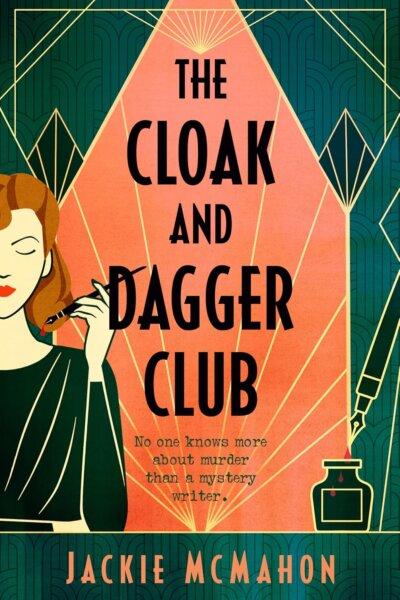
The year is 1930. Lucy Hubbard is a mystery writer. She’s published her first novel. It received strong sales and glowing reviews. Jackie McMahon’s “The Cloak and Dagger Club” sets the story at a meeting where an actual mystery emerges.
To cement her arrival on the literary scene, Hubbard was invited to join the exclusive Cloak and Dagger Club, made up of London’s most renowned mystery writers. The invitation came from Horace Hazelmoor, the club’s president and England’s reigning King of Crime Fiction.
The book opens with Lucy’s moment of triumph, her arrival at the Ritz Hotel, where Hazelmoor lives and the Cloak and Dagger Club holds dinner meetings. The story soon dissolves into farce.

Lucy’s former fiancé, Frank Murray, is there. He’s a rising star in Britain’s mystery world. While Hazelmoor is still Britain’s top crime writer, critics believe Frank will soon surpass him.
Once best friends, the couple went through a messy breakup. Lucy didn’t realize Frank would be there. To ratchet up her discomfort, when Hazelmoor asks Frank if he knows Lucy, he denies ever having met her previously. She, in turn, denies knowing him.
Hazelmoor arrived at the meeting late, drunk, and belligerent. He continues drinking heavily throughout the meeting. Then, he starts baiting the other members of the club, hinting that he knows dark secrets about all of them that will ruin them. Lucy realizes she was invited to the club by Hazelmoor only to humiliate Frank.
Hazelmoor’s conduct is so outrageous that another member, mystery writer Graham Lockhart, punches him in the face. Chaos follows as Hazelmoor grabs the tablecloth while falling to the floor, clearing the table of its contents.
The uproar ends the meeting. Frank and two other male club members escort Hazelmoor to his hotel room to sleep off his intoxication.
Frank knows he didn’t do it. More importantly, Lucy knows Frank couldn’t have done it. Despite their breakup and the bitterness it caused, she knows Frank well. He lacks the personality to commit murder (except in mystery novels). Reluctantly at first, the two decide to join forces to solve the murder, especially since Inspector Naughton, who’s investigating the case, seems convinced that Frank did it.
If not Frank, then who? The two decide it must be another Cloak and Dagger Club member. It was an open secret among them that Hazelmoor had something on all of them. He enjoyed tormenting the other writers in the club, yet none of the members ever quit.
Frank and Lucy decide that one of the other members must have a secret worth killing Hazelmoor to keep hidden. This is another reason Lucy is convinced Frank isn’t the killer. Frank’s secret was his history with Lucy, which was embarrassing but not career or freedom threatening.
Sure enough, their investigations reveal that the other members have secrets ranging from the amusing to the appalling. The closer they get to solving the mystery, the greater the danger to each of them becomes. Lucy receives threatening notes. Frank gets arrested.
Homage to Crime Fiction
In both its setting and its style, this book is an homage to the crime fiction of Britain between the World Wars. “The Cloak and Dagger Club” was inspired by the very real 1930s Detection Club. This was a set of British mystery writers, a veritable who’s who of Britain’s crime fiction. Its members included Agatha Christie, Dorothy Sayers, R. Austin Freeman, and G.K. Chesterton. Several of the Cloak and Dagger Club members were loosely based on Detection Club members. Its oath was borrowed from the Detection Club’s.All the fictional club’s members write detective novels, not mystery thrillers, which was one of the rules of the Detection Club at its founding in 1930, when “The Cloak and Dagger Club” is set.
It’s also set in the time and place of golden-age British detective fiction, the 1930s. This books follows the rules of 1930s British detective fiction. The victim, the investigator, and the perpetrators are solidly upper-middle or upper class.
There are secrets that the investigators must uncover. Basic British decency prevails. There’s a warm predictability. You know in the end that evil will be exposed, right will triumph, and justice will be served.
Its predictability enhances rather than diminishes the novel. It offers order in an often-ill-ordered world. Cleverly written, with a logical sequence, it plays fairly with readers who are attempting to solve the mystery alongside the protagonists. It provides two attractive main characters and plausible character development. It’s a fun and entertaining read.
A summer read? Absolutely. And it is summertime.