Fly fishing is a sport immersed in history and tradition, like an angler’s boots planted in a stream amid swirling eddies. It’s an art, a science, and an obsession. Legends and lore weave in and out of the tactics, techniques, and strategies that form this timeless pursuit of the wily trout.
No one knows exactly when fly fishing started. But we do know it’s ancient. The earliest known records of fly fishing trace back to ancient Rome and Macedonia. Two Roman writers—Marcus Valerius Martialis (known as Martial) and Claudius Aelianus—mention fly fishing in texts that date from between A.D. 100 and A.D. 200. In a poem, Martial wrote, “Who has not seen the scarus [a type of parrotfish] rise, decoyed and killed by fraudulent flies?” A century later, the Roman naturalist Aelianus went into even more detail, describing fish behavior modern that fly anglers will recognize:
“When the fish observes a fly on the surface, it swims quietly up, afraid to stir the water above lest it should scare away its prey; then coming up by its shadow, it opens its mouth gently and gulps down the fly, like a wolf carrying off a sheep from the fold or an eagle, a goose from the farmyard; having done this, it goes below the rippling water. ...
“[Fishermen] fasten red (crimson red) wool around a hook, and fix onto the wool two feathers which grow under a cock’s wattles, and which in color are like wax. The rod is six feet long, and their line is the same length. Then they throw their snare, and the fish, attracted and maddened by the color, comes straight at it, thinking it would gain a dainty mouthful from the pretty sight.”
The basic technique for beguiling fish with flies hasn’t changed much in 2,000 years. That’s part of the sport’s appeal: With some simple gear, it pits human against fish in raw combat that has been constant across the centuries. When a man goes fly fishing, he’s brought into close contact with the experiences of countless generations before him, who underwent the same trials and triumphs in the pursuit of fish in much the same way.
The low-tech, high-technique quality of fly fishing facilitates a close encounter with the natural world. The fly fisherman immerses himself in the fish’s environment. He becomes one with the river, breathing in its early-morning mists, feeling its rhythm, and synchronizing his cast to it. This ties him to a time when technology had yet to separate humanity and nature. For many centuries, anglers depended so closely on the river for their next meal that the connection was impossible to forget.
Fly fishing has evolved from a sustenance activity into a sport engaged in for its own sake—first by the English gentry, who were wealthy enough not to worry about catching dinner. Perhaps this contributed to fly fishing’s high-brow reputation, although today the sport isn’t confined to a social class.
Within the larger stream of fly fishing tradition—encompassing everything from beautifully painted vintage fly-tying guides to rusty old fly reels to the fly fishing literature epitomized by Norman Maclean’s “A River Runs Through It”—there are little side tributaries of individual traditions. Each angler develops their own small rituals associated with the craft.
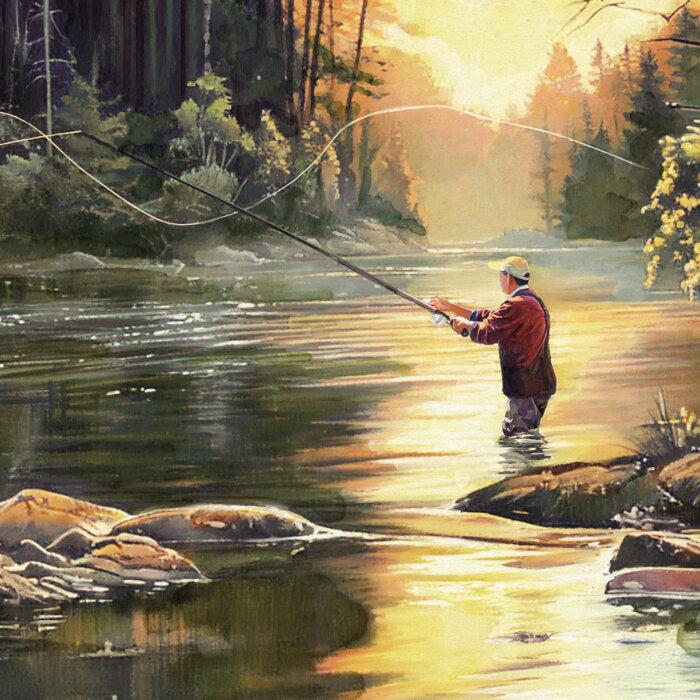

Pat Burke writes about his personal fly fishing traditions: He breaks out a flask when a 20-inch fish is caught, always brings beer and a grill on float trips, and names all trout over two feet long. Somehow, fly fishing is an art form that begs to be honored with ritual. I know of fishermen who often keep a cigar to smoke streamside. When I was a teenager, my father and I used to always finish a day’s fishing by drinking together—he’d sip an IPA, and I’d sip a root beer.
In keeping with other great traditions, fly fishing has its own legends and heroes, household names in the angling community that are utterly unknown to the world outside the fly fishing sanctuary. One is tackle expert Hoagy B. Carmichael, featured in a recent issue of Fly Fisherman magazine; he worked alongside Everett Garrison to popularize the craft of bamboo rod making with the seminal 1977 book “A Master’s Guide to Building a Bamboo Fly Rod.” Another is Bernard “Lefty” Kreh, a World War II combat veteran who went on to pioneer saltwater fly fishing tactics and advocate for catch-and-release fishing. According to fly fishing master Flip Pallot, Kreh was fly fishing’s “Babe Ruth, but even bigger.” At the age of 90, he could reportedly still outcast much younger anglers.
Casting a fly rod is no simple business. It takes practice, repetition, and a certain knack. Timing, coordination, grace, and finesse are everything. Maybe it’s because fly fishing requires so much technical skill that it has such a strong sense of tradition. To really become a great angler, you need a mentor. Whether it’s learning to cast or selecting the right fly, books and videos can only get you so far. You need contact with a living teacher. The fly fishing tradition is passed from person to person through hands-on experience far more than through texts or images. It’s a living thing.
Maybe the challenging techniques involved in fly fishing add to its mystique. It’s a little set apart; few people simply pick up a rod and begin successfully angling with a fly. This barrier to entry lends the sport a mysterious quality. Indeed, most anglers treat their time on the water as something sacred.
The pristine, shining waters under glorious skies and the shadows of cold mountains, fringed with trees and bedecked with birdcalls—these landscapes feel majestic. The angler’s closeness to the fish is a privilege and a gift. The angler always remembers that.
Lines flick. Water dazzles. A trout rises. In an explosion of water that sparkles like diamonds, the fish has taken the fly, the angler set the hook, and the battle has commenced. Over the next few minutes, a ritual that has played out a thousand times in that same valley, beneath those stately, pine-rimmed cliffs, will play out again.
Like all traditions, it is both always the same and always new—like the river itself, which keeps its shape and identity though the water flows forever fresh.