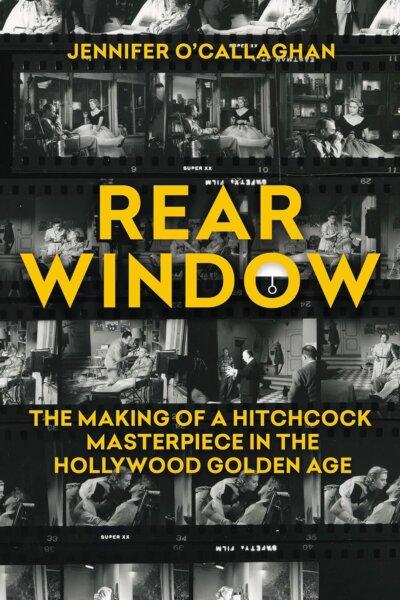
Alfred Hitchcock’s “Rear Window” is among the master filmmaker’s most entertaining thrillers, and its journey from concept to classic is the focus of Jennifer O’Callaghan’s wonderfully insightful new book.
“Rear Window” has its roots in Cornell Woolrich’s 1942 short story, “It Had to Be Murder.” In 1953, playwright and Broadway director-producer Joshua Logan adapted the story into a 13-page screen treatment.
When Hitchcock joined the project, he tasked John Michael Hayes with creating a screenplay. His treatment fleshed out Woolrich’s main characters while adding MacGuffins and plot twists that could accommodate the running time needed for a feature-length film.
The film required only two sets: the cramped room in which photographer L.B. Jefferies is confined to a wheelchair with a waist-to-foot cast on his leg and the massive brick apartment building facade with a grassy courtyard opposite Jefferies’s residence. The tenants of that building become the object of Jefferies’s increasingly obsessive spying, thanks to their wide-open windows.
The Amazing Set
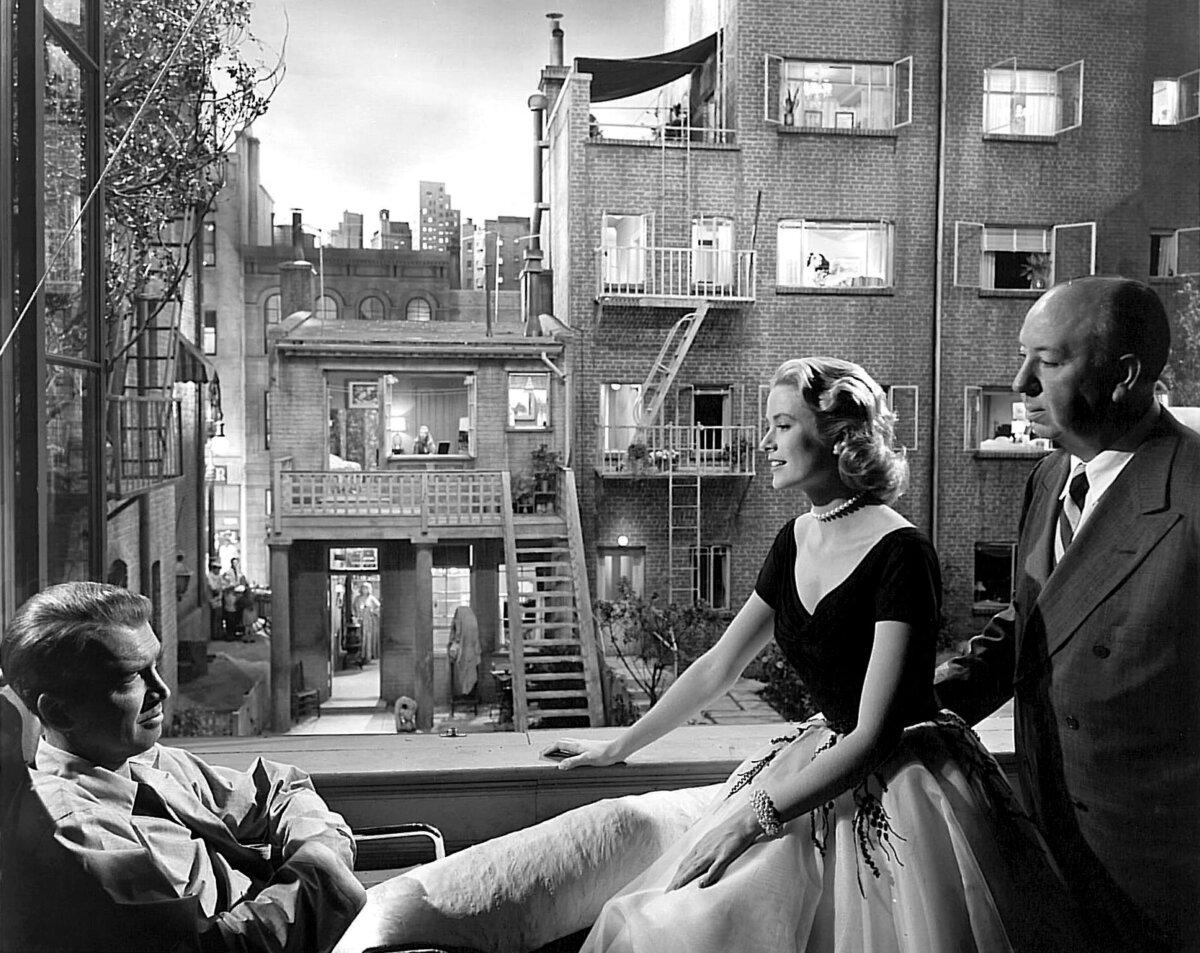
The apartment structure set was based on a building in the New York City neighborhood of Greenwich Village and its construction was an engineering feat that stood 40 feet high, spanned 185 feet in length, and encompassed the entirety of Paramount Pictures’ Stage 18. It also involved a sophisticated lighting design to show the passing of day into evening.
“Each of the apartment complexes had running water, electricity, and support from steel girders,” O’Callaghan wrote about the mammoth set. “Since they were fully functioning, Georgine Darcy [who played Miss Torso] claimed to have essentially lived in her small apartment and never left the studio during most of her time working on ‘Rear Window.’”
Hitchcock considered his favorite leading man, Cary Grant, to play Jefferies but felt that the actor’s dapper persona would be at odds with the character’s paranoid anguish. James Stewart, who had starred in Hitchcock’s 1948 film “Rope,” took the role. He also formed a production partnership with Hitchcock to share the rights to the project.
Hitchcock was working with Grace Kelly on “Dial M for Murder” when “Rear Window” was being planned, and he wanted the blonde star to play Stewart’s stylish fashion model fiancée. But Kelly was being pursued by Elia Kazan to play a grittier role as the sister of a murdered union organizer in “On the Waterfront.” She had great difficulty trying to decide which of the roles to pursue. Kelly procrastinated until the last possible minute before deciding to go with Hitchcock.
Perhaps the most surprising aspect of O’Callaghan’s book is the discovery that neither Stewart nor Kelly was the highest-paid performer in “Rear Window.” That honor went to Thelma Ritter. The Brooklyn-accented, scene-stealing character actress played Jefferies’s nurse; she brought sarcastic humor and wry-faced exasperation that enlivened the proceedings.
Production Code Issues
A major concern during the creation of “Rear Window” was clearing the story with the Production Code Administration, Hollywood’s censorship office. The script was pegged by the censors for “sexual suggestiveness” and “voyeuristic quality.”The censors were particularly concerned with Jefferies’s fixation on Miss Torso and her minimal acquaintance with clothing. Hitchcock shrewdly invited the censors to visit his massive set, where he explained how distance and camera angles would minimize the raised objections. His brilliant salesmanship paid off, and the project was approved for production.
While “Rear Window” was a critical and commercial success, O’Callaghan noted that it received only four Academy Award nominations (including a Best Director nod for Hitchcock), and did not win. “On the Waterfront” was the big Oscar winner that year.
O’Callaghan provides an in-depth consideration of the film’s legacy through its 1962 re-release (which played up Burr’s presence to cash in on his “Perry Mason” television fame) and into the convoluted legal morass that kept “Rear Window” and four other Hitchcock films out of commercial release for years.
The author also considers how the voyeuristic aspects of the “Rear Window” plot shaped Hitchcock’s later films, most notably “Psycho,” and inspired a surplus of similar features over the decades.
Movie lovers are in for a treat with this deftly researched and engagingly written tribute to a grand thriller. If anything, O’Callaghan’s “Rear Window” should spark a new wave of interest in the Hitchcock masterwork.