Thick, yellowed pages seem to whisper ancient wisdom as they turn. Illuminations glimmer with gold leaf and burn with otherworldly color, like stained glass. Old paper and bindings carry a sweet, spicy scent aged like fine wine.
There’s plenty of this and more at book dealer Peter Harrington’s display at the annual Winter Show, held at the Park Avenue Armory in New York City from Jan. 23 to Feb. 1, 2026. Peter Harrington, founded in 1969, is one of the world’s premier rare book dealers and among the largest purveyors of antiquarian books in Europe.
Exploration and the American Story
Harrington’s Winter Show exhibition this year includes selections that document the Age of Exploration and the American founding, the history of the climate change debate, a unique pre-Raphaelite illuminated manuscript, and a complete first-edition collection of “The Chronicles of Narnia” by C.S. Lewis. The show—and Harrington’s work in general—underscores the importance of textual history, cultural heritage, and the way a book’s physical form modifies and enhances the experience of the works it contains.Among the notable pieces is a 1504 edition of Amerigo Vespucci’s “Mundus Novus,” one of the foundational texts related to the discovery of America. It is the primary written account proclaiming the existence of a “New World,” based on Vespucci’s voyages and early descriptions of Brazil. Printed in Rome in Latin, the edition features woodcuts, constellation imagery, and diagrams. It stands as a physical emblem a crucial turning point in history.
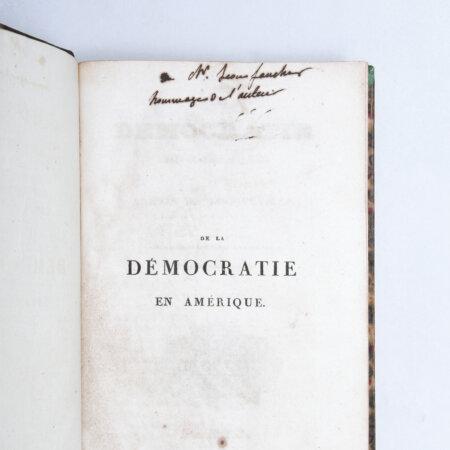
First edition of Alexis de Tocqueville’s "Democracy in America," featured by Peter Harrington at the 2026 Winter Show. Courtesy of Peter Harrington
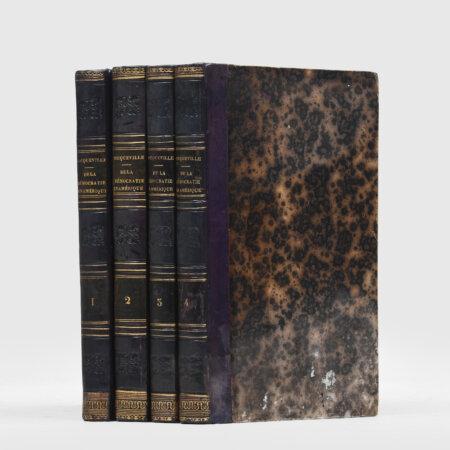
Exterior of a first edition of Alexis de Tocqueville’s "Democracy in America," featured by Peter Harrington at the 2026 Winter Show. Courtesy of Peter Harrington
Other items related to the discovery and founding of America include letters by Hernán Cortés, Revolutionary War documents, and a first edition of Alexis de Tocqueville’s “Democracy in America.”
A Historical Record of Climate Change
Another part of the collection, “The Science of Climate Change,” traces an ongoing debate familiar today but that has roots as far back as the 15th century. This collection compiles scientific documents such as handwritten observational data, research papers, and annotated incunabula (early printed books) from the 15th through the 21st centuries detailing the development of environmental science. These pieces were collected over a decade by David L. Wenner and provide a backdrop for today’s debates over the human impact on the natural world.Pom Harrington, the current owner of Peter Harrington, which he inherited from his father, explained to The Epoch Times: “Seeing this progression—from early natural philosophy to specialized scientific research—helps us understand how evidence builds, language evolves, and public understanding slowly forms.”
Noteworthy Literary Works
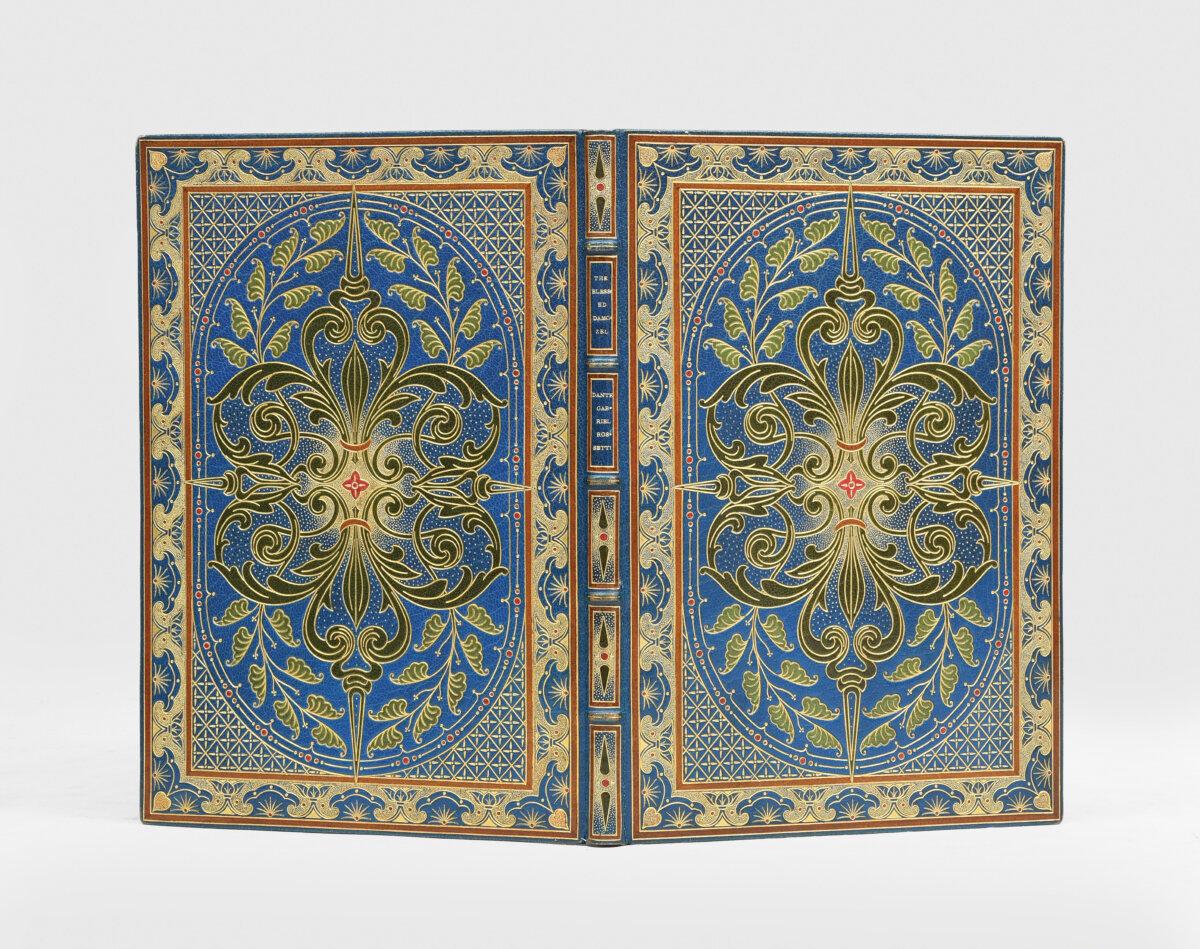
Illuminated vellum manuscript of "The Blessed Damozel," created by calligrapher Alberto Sangorski (1862–1932) for the luxury bookbinding firm Robert Riviére & Son. Courtesy of Peter Harrington
“The Blessed Damozel” by Dante Gabriel Rossetti with illuminations by Alberto Sangorski constitutes another highlight of the exhibit. Rossetti (1828–1882) was an English painter and poet who helped initiate the Pre-Raphaelite movement known for rejecting contemporary academic painting in favor of bright colors and mythical subject matter of late medieval Europe. Rosetti’s literary influences included Shakespeare, Sir Walter Scott, Gothic fiction, and the Romantic poets. In his work, Rossetti linked painting, poetry, medievalism and social idealism.

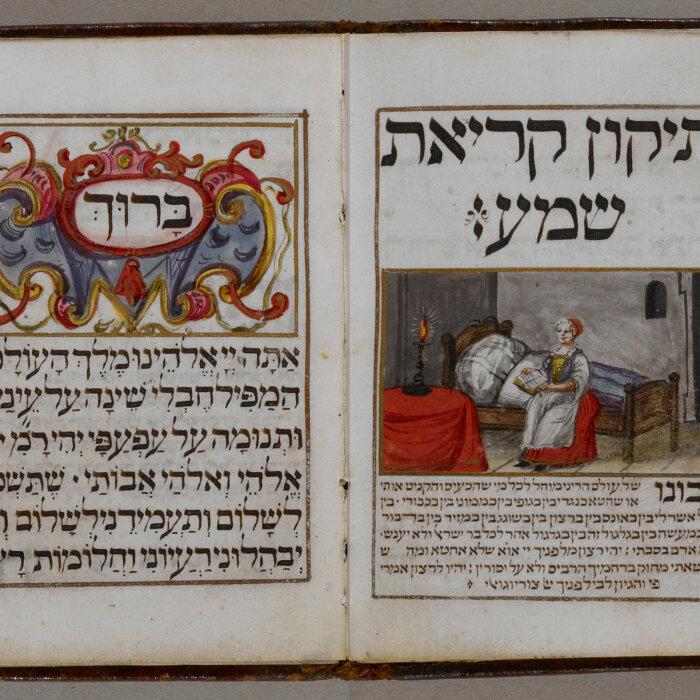
One of Rosetti’s best-known poems is “The Blessed Damozel,” which drew inspiration from a work by Edgar Allan Poe. It depicts a lady in heaven observing her lover on Earth and yearning for their reunion in heaven.
The Winter Show’s manuscript edition is written on vellum (animal skin) and was illuminated by calligrapher and illuminator Alberto Sangorski for the luxury bookbinding company Robert Riviére & Son. Self-taught, Sangorski found inspiration in the revival of medieval script and illustration styles in the late 19th century. He crafted extraordinary, sumptuously detailed illuminations and miniatures to accompany works such as Tennyson’s “The Lady of Shallot” and “Morte d’Arthur.”
The manuscript exists within an elaborate floral and filigreed cover of blue and red and inside features a miniature of Rossetti’s famous “Blessed Damozel” painting. Vines, flowers, and leaves curl about the page edges, adorning the text with vibrant color and natural imagery. This work speaks to a mindset of craftsmanship in which cost and efficiency are set aside in favor of skill, beauty, and permanence.
The Winter Show also showcases a beautiful first-edition set of “The Chronicles of Narnia” by C.S. Lewis, bound by Chelsea Bindery in custom morocco. The spines spell out “Narnia,” with distinctive character designs, gilt edges, and illustrations by Pauline Baynes. As with so many of the items contained in this exhibition, this set is a work of art in its own right, a physical extension and embodiment of the literary art contained within.
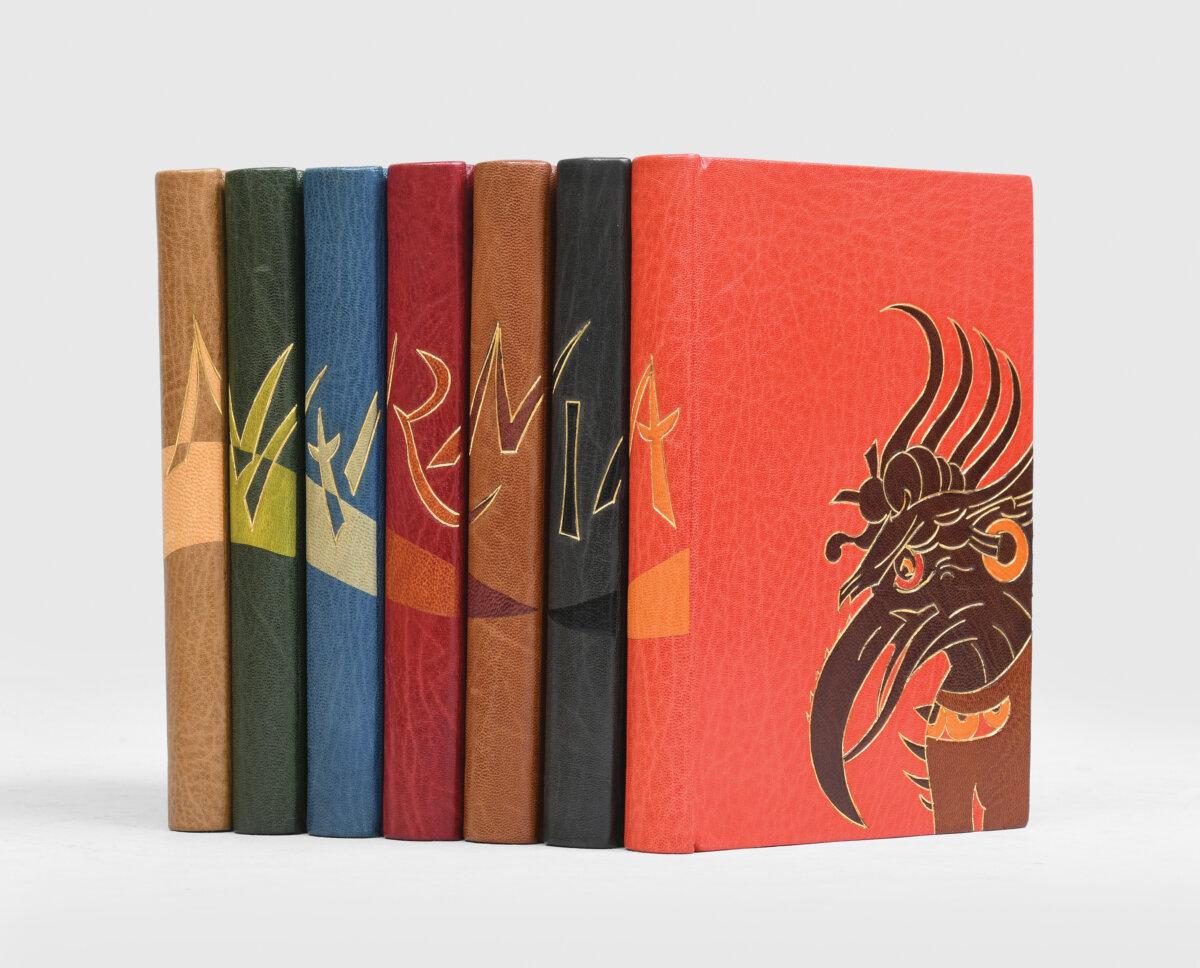
A finely bound set of first editions of "The Chronicles of Narnia," by C.S. Lewis (1950-56). Courtesy of Peter Harrington
The beautifully and lovingly crafted books resemble the types one might imagine on Mr. Tumnus’s shelf—that is to say, the craftsmanship mirrors the magic of the stories and fires the imagination. They help readers in step “through the wardrobe” into Lewis’s fantasy realm.
The Narnia set illustrates how the physical traits of books are not neutral vehicles for transmitting texts. Books give shape, form, and heft to stories. They embody the words they contain in ways that can powerfully shape the reader’s experience. In the case of old books, they also reveal textual history through their materials, condition, marginalia, and publication history.
Why Peter Harrington’s Rare Books Matter Today
Harrington explained the significance of rare books and manuscripts this way: “Rare books and manuscripts are not just carriers of text—they are historical objects that show how ideas first entered the world. Their paper, bindings, annotations, and illustrations preserve the cultural moment in which they were created.” He added:“These works become in themselves enduring expressions of history, mute witnesses to epoch-making events, which makes them worthy of preservation and respect. “These works are essentially first-hand witnesses to history: preserving them matters because digital or modern copies strip away that context. When we lose original books, we lose evidence of how knowledge, art, and science evolved. Studying and preserving them keeps our cultural memory intact and reminds us that today’s ideas are part of a much longer human story.”
Books such as those in this exhibit allow us to experience viscerally the scattered markers of history and culture, the physical artifacts that have shaped and continue to shape our world. They also remind us, in our hyper-digital age, of the distinct pleasure of opening a physical volume—an object held by many hands and masterfully crafted to enshrine and reflect the beauty of what it contains.
An evanescent ebook can never accomplish that.
What arts and culture topics would you like us to cover? Please email ideas or feedback to [email protected]